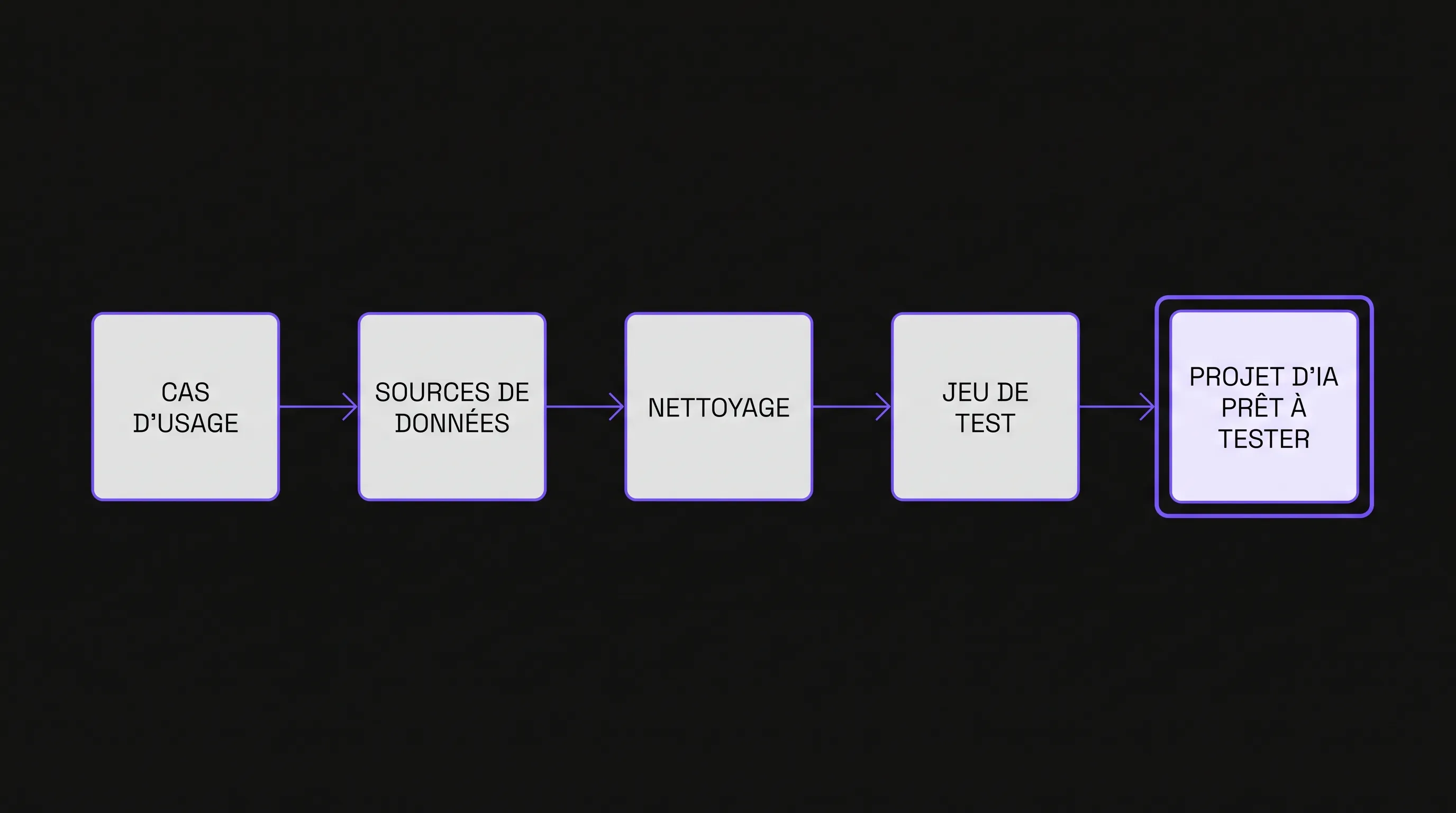
Preparing data before an AI project isn't just for data scientists. It's when a business clarifies what to automate, what data it owns, what can legally be used, and what is needed for reliable results, preventing costly missteps for SMEs and scale-ups.
Preparing your data before an AI project is not a technical step reserved exclusively for data scientists. It is the moment when a company clarifies what it wants to automate, what information it already has, what it can legally use, and what is missing to achieve reliable results. For an SME or scale-up, this preparation prevents launching an attractive prototype that becomes unusable as soon as it encounters real-world business cases.
The good news is that you don't need a perfect data warehouse to get started. Above all, you need to know which data matters, where it is located, who is responsible for it, and how to measure its quality in relation to the intended use case.
Why Data Determines the Success of an AI Project
An AI model doesn't create value out of thin air. Whether it is an internal assistant, a recommendation engine, document automation, or a sales scoring tool, it always depends on a business context and actionable data.
In an AI project, the most costly mistakes rarely stem from the initial choice of algorithm. They more often come from a poorly framed problem, data scattered across multiple tools, incomplete fields, or historical records that fail to reflect operational reality.
Data preparation therefore serves three simple goals: reducing uncertainty, accelerating development, and avoiding compliance risks. It also allows you to decide earlier whether a use case warrants full development or should be simplified.
If you are already structuring your overall approach, Impulse Lab's guide on the AI process from idea to production complements this data-driven approach well.
Start with the Use Case Before Opening Any Files
The temptation is strong to start by inventorying every available database. This is rarely the right starting point. Before preparing your data for an AI project, you must define the decision, task, or deliverable that the AI is meant to improve.
A useful use case is framed with an action verb: categorizing support tickets, extracting information from contracts, predicting churn risk, generating draft responses, detecting billing anomalies. This framing helps distinguish indispensable data from data that is merely nice to have.
Define the Expected Output
Ask yourself what the end user needs to receive. A probability? A text response? A prioritized list? An alert? A summary? The nature of the output directly dictates the data required.
For example, a document search assistant requires up-to-date, properly chunked documents linked to the correct access rights. A sales forecasting model, on the other hand, will need structured history, reliable dates, consistent statuses, and a clear indicator of success or failure.
Link Every Data Point to a Business Decision
Useful data is data that influences a decision. If no one can explain how a field will be used, it should not be prioritized in the first version of the project.
Use Case
Required Data
Common Risk
Preparation Priority
Support assistant
Tickets, validated answers, knowledge base
Outdated or conflicting content
Clean and validate sources
Sales scoring
CRM, purchase history, opportunity statuses
Inconsistently entered fields
Standardize definitions
Document extraction
PDFs, invoices, contracts, target fields
Inconsistent formats
Build a representative sample
HR automation
Internal requests, rules, workflows
Sensitive personal data
Verify rights, access, and minimization
This scoping step sounds simple, but it prevents collecting data too broadly. In an AI project, having too much data loosely connected to the business need slows you down just as much as a lack of data.
Conduct a Pragmatic Data Audit
A data audit does not need to be an 80-page report. For an initial initiative, it must answer one question: does the available data allow for a credible test of the use case?
This is also the right time to involve business teams. They often know why a field is blank, why a status is bypassed, or why an official database has not been used for six months.
The Six Criteria to Review
To prepare your data before an AI project, begin by assessing each source against six criteria: availability, quality, freshness, structure, usage rights, and representativeness.
Criterion
Key Question
Red Flag
Availability
Is the data accessible without complex manual exports?
Does the company have the legal right to use it for this purpose?
Personal data lacking a clear legal basis or vague purpose
Representativeness
Does the sample cover real-world cases?
Data that is too clean, missing rare edge cases, seasonal bias
This diagnosis helps you prioritize. You don't need to fix all the company's data—only what stands in the way of testing and deploying the selected use case.
Clean, Structure, and Document Without Overinvesting
Data cleaning can quickly turn into a bottomless pit if no scope is defined. The goal is not to achieve a flawless database, but one that is reliable enough to learn, test, and make decisions.
For a first AI project, work with a representative sample rather than the full history. This sample should include straightforward cases, common cases, and a few edge cases. This is often where implicit business rules come to light.
Standardize What Directly Impacts Results
Efforts should focus on elements that genuinely change the system's output. For a CRM, this might mean lead statuses, conversion dates, and loss reasons. For a document repository, it could mean document version, business domain, validity date, and confidentiality level.
Avoid cleaning data just for the sake of it. Fixing columns that won't be used in the project creates no immediate value. Conversely, failing to standardize a core field can render results impossible to interpret.
Create a Lightweight Data Dictionary
A data dictionary outlines important fields, their meanings, formats, and owners. It can simply start in a spreadsheet. What matters is that teams share the same definitions.
For instance, an active customer might mean an invoice in the last 12 months for finance, a recent login for product, or an open opportunity for the sales team. If this definition isn't clarified, the AI risks amplifying confusion that already exists within the organization.
Prepare Data Based on the Type of AI Solution
Not all AI initiatives require the same preparation. A project built on a large language model—such as an internal assistant connected to a knowledge base—does not have the same requirements as a predictive model trained on numerical historical data.
Understanding this distinction helps you better prepare your data before an AI project and avoid wasted effort.
For an AI Assistant or RAG System
A RAG system (Retrieval-Augmented Generation) first searches for relevant documents and then uses them to generate a response. Its quality heavily relies on the quality of the underlying documentation.
The priorities here are eliminating duplicates, updating versions, logically structuring content chunks, and managing access rights. An assistant that confuses an obsolete procedure with an up-to-date one will deliver a convincing yet dangerous answer.
You should also create a small benchmark set of reference questions. These serve to verify whether the assistant retrieves the right content, cites the correct internal sources, and refuses to answer when information is unavailable.
For a Predictive or Scoring Model
A predictive model requires past examples and a known outcome. If you want to predict churn, you need to know which customers actually left. If you want to prioritize leads, you need a reliable definition of conversion.
The critical element is often the target variable. It must be stable, understood by business stakeholders, and measurable over time. Without a reliable target, the model learns from noisy signals.
To frame these decisions before development, you can refer to this AI project scoping checklist, specifically to align the business problem, users, KPIs, and technical constraints.
Safeguarding GDPR, Privacy, and Access Rights
Data preparation isn't just about quality. It also entails having the legal right to use that data for the intended context. This is especially true for customer, employee, candidate, patient, prospect, or user data.
In its guidance on core GDPR principles, the CNIL reminds organizations that data processing must respect principles such as purpose limitation, data minimization, storage limitation, and security. These principles apply directly to AI projects.
Minimize Data Usage
The practical rule is simple: if a data point isn't necessary for the use case, don't include it in the sample. This reduces risks, simplifies testing, and eases internal adoption.
In some cases, you can pseudonymize or anonymize data prior to experimentation. Note, however, that genuine anonymization must prevent any reasonable re-identification. Simply removing names is not always enough if other fields allow individuals to be singled out.
Manage Access Rights Starting with the Prototype
Many companies secure production but overlook prototypes. This is a mistake. Temporary exports, shared spreadsheets, and test environments often contain sensitive data.
Define who can access the data, where it is stored, how long it is kept, and how it is deleted after testing. These rules don't need to be burdensome, but they must be explicit.
Test Value with a Sample Before Scaling
Once your data is prepared, don't jump straight into full-scale development. First, test its value on a scoped sample. This step helps separate a truly promising use case from an attractive idea that offers little ROI.
A solid test compares the AI against a baseline benchmark. For example: How long does manual processing currently take? What is the existing error rate? How many tickets are escalated? What is the average response time?
These metrics let you measure tangible gains. They also keep you from judging a project solely on an impressive demo. An AI that works on three cherry-picked examples is far from an operational solution.
To dive deeper into aligning data, strategy, and return on investment, the article Business AI: Aligning Strategy, Data, and ROI helps anchor data preparation within a sound business perspective.
Checklist Before Launching Development
Before engaging a development team or AI agency, validate the following points with business stakeholders, IT, and data leads:
The use case is formulated as a specific business task or decision.
End users and the exact context of use are identified.
Priority data sources are cataloged along with their owners.
Critical fields are defined with shared team alignment.
A representative sample is available for testing.
Sensitive data has been identified.
Access rights, retention, and deletion protocols are defined.
Success criteria are measurable before and after the test.
Expected limitations of the system are documented.
A go/no-go or simplification decision point is planned after the prototype.
This checklist won't eliminate all uncertainty, but it turns an AI project into a manageable process. It also provides a sound foundation for service providers, internal teams, or technical partners tasked with building the solution.
FAQ
Do we need to clean all company data before starting an AI project? No. It is best to start from a specific use case and clean only the data necessary for the test. A scope that is too broad wastes time without guaranteeing additional value.
How much data is needed to get started? It depends on the project type. A document assistant can start with a limited yet reliable corpus. A predictive model needs enough historical data with known outcomes. In both cases, representativeness matters more than raw volume.
Who should be involved in data preparation? Business teams, IT, compliance officers, and the project team should all be involved. Business teams understand what the data means, IT understands the systems, and compliance safeguards usage.
Can an AI project be launched with imperfect data? Yes, provided the flaws are identified and controlled. The real risk stems from hidden issues: misunderstood fields, stale data, selection bias, or ambiguous business metrics.
Is an AI audit useful before developing? Yes, especially if the company has yet to prioritize a use case or if data is scattered. An audit highlights realistic opportunities, technical constraints, and the initial preparation steps needed.
Turn Your Data into a Solid Foundation for AI
Preparing your data before an AI project means mitigating risk before investing in development. You clarify the need, verify the quality of available information, secure compliance, and validate business value on a controlled scope.
Impulse Lab guides SMEs and scale-ups through this phase with AI audits, custom web and AI solutions, process automation, integrations with existing tooling, and adoption training. If you want to assess your data readiness and identify the most realistic use cases, you can reach out to the Impulse Lab team.