Industrial RPA: Where Automation Brings the Most Value
Stratégie d'entreprise
Productivité
Automatisation
Optimisation
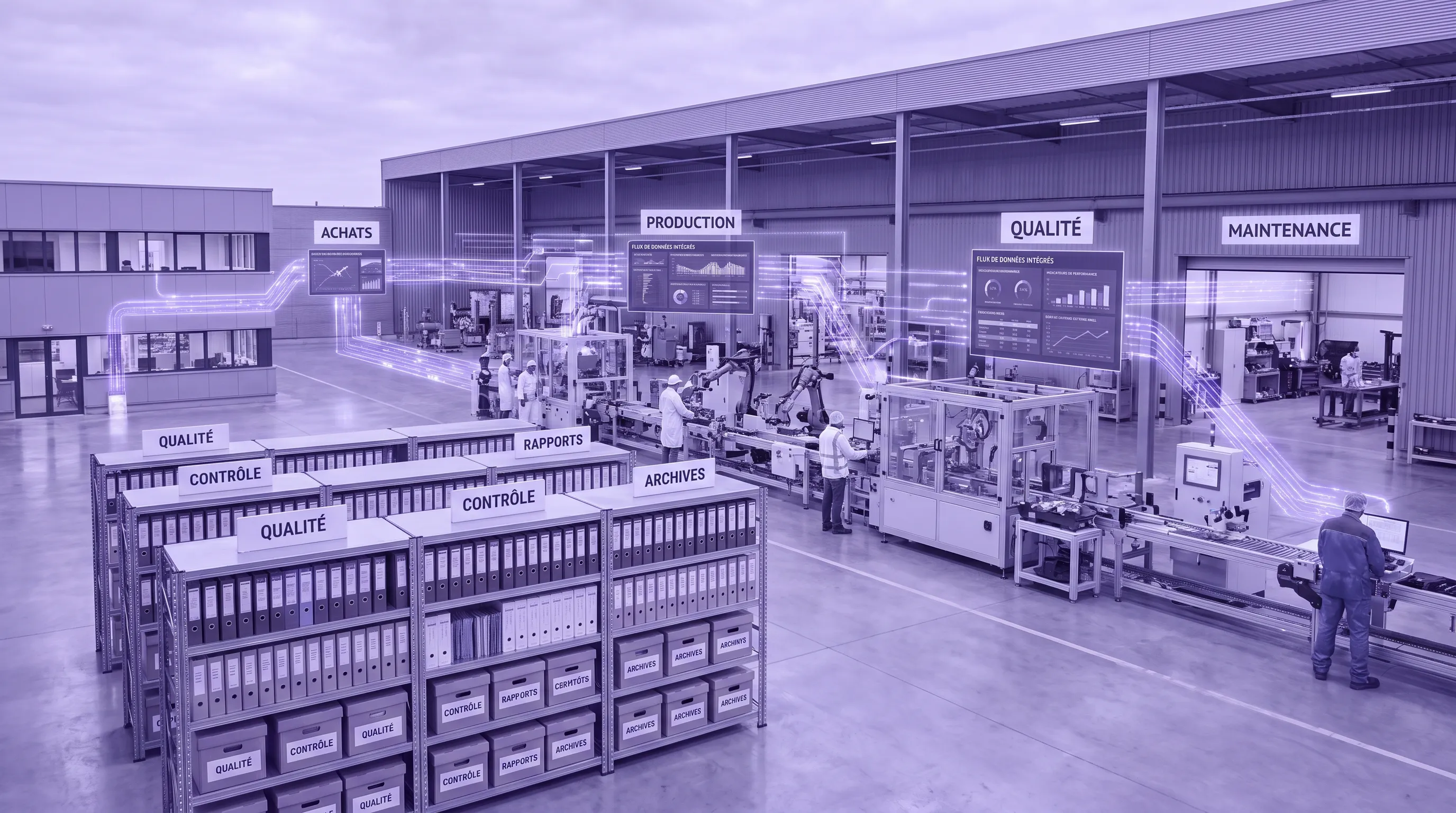
In manufacturing, automation often brings to mind factory robots, production lines, or PLCs. Yet, much of the productivity loss isn't on the machine itself. It hides between systems, in the copy-pasting between ERPs, MES, Excel, and emails.
July 24, 2026·13 min read
In the industrial sector, automation often brings to mind factory robots, production lines, sensors, or programmable logic controllers (PLCs). Yet, a large part of productivity losses does not occur on the machine itself. It hides between systems, in the copy-pasting between ERP, MES, WMS, Excel, supplier portals, emails, and quality files.
This is precisely where RPA brings the most value. RPA, or Robotic Process Automation, refers to software robots capable of executing repetitive tasks within existing digital tools. In an industrial context, it does not replace production equipment. It automates the administrative, operational, and coordination processes surrounding the factory.
For an industrial SME or a scale-up structuring its operations, the right question is therefore not just "can we automate?". The real question is: where does industrial RPA create the most value, with controlled risk and a fast return?
Industrial RPA: What exactly are we talking about?
An RPA robot is software that replicates actions usually performed by an employee on a computer: opening an application, retrieving data, filling out a field, downloading a document, checking a rule, sending a notification, or updating a file.
In manufacturing, it intervenes mostly in the workflows connecting key functions: procurement, production, quality, maintenance, supply chain, finance, sales administration (ADV), and customer service. It is particularly useful when the company uses multiple tools that do not communicate perfectly with each other.
RPA is relevant when the process is:
Repetitive, with sufficient volume.
Based on clear rules.
Digital, even if documents are sometimes unstructured.
Stable over time.
Costly in terms of errors, delays, or data re-entry.
Conversely, it is less suited for complex decisions, highly variable processes, or tasks directly linked to industrial safety without human validation. It can nevertheless be enhanced by AI to read documents, classify emails, detect anomalies, or assist teams in handling exceptions.
Where does RPA bring the most value in manufacturing?
The best use cases are not necessarily the most visible. Often, they are found in the friction zones between departments: a purchase order received by email, a manufacturing order created from an Excel file, a quality report sent manually to the customer, a transport invoice reconciled with a delivery note.
Here is an initial reading grid to identify high-potential areas.
According to the McKinsey Global Institute, a significant portion of professional activities can be automated at least partially with already available technologies. In manufacturing, this reality rarely translates into total automation of professions. Rather, it translates into the gradual elimination of repetitive tasks that slow teams down.
1. Procurement and purchasing: reducing shortages and manual follow-ups
Industrial procurement often accumulates many repetitive tasks: price requests, order confirmations, lead time tracking, supplier follow-ups, document retrieval, and status updates in the ERP.
An RPA robot can, for example, read a dedicated email inbox for supplier confirmations, extract the announced dates, compare these dates with those expected in the ERP, flag discrepancies, and update a tracking dashboard. It can also download acknowledgments of receipt from a supplier portal or prepare purchase requests based on a stock threshold.
The value is high because supply delays have a domino effect. Information not entered on time can cause a shortage, a schedule change, or a delayed customer delivery. RPA does not make the supplier more reliable, but it gives teams the necessary information faster to take action.
This is often a good starting point for an industrial SME, as rules are relatively clear and volumes are recurring. To choose a first concrete task, you can also rely on a prioritization method like the one described in the article on tasks to automate first with an RPA robot.
2. Production: streamlining data between ERP, MES, and field files
In many industrial companies, production relies on a central system, but also on numerous intermediate files. Teams sometimes use an ERP, an MES, CSV exports, Excel spreadsheets, and internal forms.
RPA can automate the creation or updating of manufacturing orders, the consolidation of reported times, the sending of production reports, or the retrieval of tracking data from different systems. It can also generate alerts when a discrepancy in quantity, deadline, or status appears.
The main benefit is reducing the gap between what happens on the shop floor and what is visible in the management tools. This gap creates delayed decisions: incorrect theoretical stock, poorly anticipated workload, customer delay detected too late, yield analyzed after the fact.
The limitation is important: RPA must not become a permanent workaround for a poorly configured system. If API integration is robust, maintainable, and available, it will often be preferable. RPA is especially useful when full integration is too long, too costly, or impossible in the short term.
3. Quality and traceability: ensuring reliable evidence without burdening teams
Quality is one of the areas where industrial RPA can create a very concrete impact. Quality teams manage documents, inspections, certificates, non-conformities, audits, action plans, and traceability evidence.
A robot can generate an analysis certificate from validated data, automatically archive a report in the correct folder, prepare a batch record, verify that a supporting document is present, or follow up with a manager when a corrective action is due.
The benefit is not limited to time saved. It also concerns reliability. A misfiled document, an unattached file, or a forgotten follow-up can become a problem during an audit or a customer complaint.
However, a simple rule must be kept: the higher the regulatory or customer impact, the more explicit human validation must be. RPA can prepare, check, compile, and alert. It should not independently validate a critical quality decision if the organization has not planned and framed it.
4. Maintenance: better leveraging the CMMS and intervention data
Industrial maintenance is often caught between two constraints: intervening quickly in the field and properly documenting actions. The administrative part is essential, but it can weigh heavily on technicians and maintenance managers.
RPA can help create work orders from alerts, update a CMMS, reconcile a part request with available stock, send a reminder for preventive maintenance, or consolidate maintenance indicators into a periodic report.
It becomes particularly useful when data is spread across the CMMS, the ERP, tracking files, supplier emails, and sometimes subcontractor portals. The robot does not replace the technician's expertise, but it reduces the time spent copying or searching for information.
The point of vigilance concerns the quality of the equipment repository. If machines, parts, locations, or bills of materials are poorly structured, automation risks propagating errors. Before automating, it is sometimes necessary to clean up the most critical databases.
5. Finance, invoices, and closings: automating high-volume workflows
Industrial financial workflows are rich in repetitive tasks: matching orders, receipts, and invoices, processing transport invoices, checking price variances, cost allocation, creating closing reports, or extracting data from the ERP.
RPA is often very profitable here because volumes are high and rules are relatively formalized. A robot can compare a supplier invoice to a purchase order and a receipt, isolate discrepancies, prepare journal entries, or forward exceptions to the right person.
In manufacturing, these automations also have an operational effect. A supplier dispute resolved faster can prevent a delivery block. A smoother closing provides better visibility on margins by product, line, or customer.
The right goal is not to eliminate all human intervention. It is to reserve human time for discrepancies, disputes, and arbitrations, rather than perfectly compliant invoices.
6. Sales admin (ADV) and customer service: accelerating the order-to-delivery cycle
Sales administration is another highly favorable area. Teams receive orders via email, PDF, partial EDI, or customer portals. They must verify references, prices, conditions, and lead times, then enter or check the information in the ERP.
An RPA robot can extract data from an order, verify its consistency, create a draft in the ERP, send a confirmation, track shipping status, or prepare a customer reply regarding delivery progress.
The benefit is twofold: less data re-entry for the sales admin team, and better responsiveness for the customer. In sectors where lead times and delivery reliability are differentiating criteria, this gain can be more strategic than it seems.
Prudence dictates not automating a commercial response if production or stock information is unreliable. A fast but incorrect automated reply damages trust. RPA must therefore rely on controlled data.
How to prioritize RPA use cases in an industrial company?
Not all repetitive processes should be automated first. The right choice depends on volume, stability, risk, technical effort level, and business impact.
A simple method is to score each process on five criteria.
Criterion
Good RPA target
Bad RPA target
Volume
Task performed daily or weekly
Rare or very occasional task
Stability
Clear rules, few variants
Changing or poorly defined process
Data
Accessible and sufficiently clean information
Scattered, ambiguous, or unreliable data
Risk
Controlled impact, identifiable exceptions
Unframed safety, compliance, or customer risk
ROI
Time saved, errors reduced, lead times improved
Low or hard-to-measure gain
In an industrial SME or scale-up, the best first project is rarely the most ambitious. It is better to choose a limited, but frequent, irritating, and measurable process. This approach proves value, helps learn about internal constraints, and then gradually scales automation.
If your organization is just starting, the article on how to get started with Robotic Process Automation details a pragmatic approach: start from a business need, map the workflow, identify exceptions, and then build a controlled initial scope.
Calculating ROI without making mistakes
The ROI of an industrial RPA project should not be limited to the number of hours saved. This is a common mistake. The most significant gains sometimes come from indirect effects: reduction of data entry errors, better visibility on delays, fewer disputes, faster closings, fewer emergencies, or improved service levels.
A realistic estimate can include:
The time currently spent on the task.
The cost of errors and rework.
The time saved on the process.
The number of exceptions that will remain human.
The maintenance cost of the robot.
The frequency of changes in the applications used.
For example, automating order entry can save administrative time, but also reduce reference errors, accelerate customer confirmation, and improve planning. Conversely, an infrequent process with many special cases might show an appealing promise but yield a low ROI.
To delve deeper into this logic, you can consult the analysis on the ROI of automation and artificial intelligence, particularly the pitfalls to avoid when comparing time saved, reliability, and implementation complexity.
RPA, AI, and integrations: choosing the right approach
In 2026, RPA is rarely isolated. It increasingly integrates with AI components, APIs, internal platforms, and business tools. The choice depends on the problem to be solved.
If the process is highly structured, classic RPA is often enough. If data arrives as PDFs, emails, or semi-structured documents, AI can help extract and classify the information. If two systems have clean and stable APIs, a direct integration will often be more robust than a robot clicking through an interface.
The right architecture therefore does not pit RPA, AI, and integration against each other. It combines them intelligently. RPA can be a quick solution to connect existing tools. AI can handle ambiguity. APIs can make long-term exchanges reliable.
For an industrial company, the challenge is not to buy a technology before clarifying the process. Useful automation begins with mapping workflows, pain points, volumes, and exceptions.
Mistakes to avoid in an industrial RPA project
The first mistake is automating a bad process. If the workflow is poorly designed, misunderstood, or unstable, the robot accelerates the mess instead of fixing it. It is sometimes necessary to simplify before automating.
The second mistake is underestimating exceptions. A process that seems simple can contain many variants: specific suppliers, key account customers, configurable products, emergencies, price variances, incomplete statuses. These exceptions must be identified from the start.
The third mistake is building without the users. Procurement, sales admin, quality, maintenance, or finance teams know the real special cases. Without them, the robot risks being technically correct but operationally useless.
The fourth mistake is forgetting maintenance. Interfaces change, business rules evolve, files are renamed, access expires. An RPA robot must be monitored, documented, and updated.
Finally, do not confuse speed with haste. A first project can be fast, but it must remain clean: logs, access rights, error management, responsibilities, and human validation when necessary.
Where to start concretely?
A good starting point is to gather two or three business managers and list the tasks that generate the most re-entry, follow-ups, or errors. Then, select a simple, representative, and sufficiently frequent process to measure the gains.
In manufacturing, the first candidates are often: order entry, invoice-order-receipt reconciliation, supplier status updates, quality archiving, production report consolidation, or maintenance intervention creation.
The next step is to document the real process, not the theoretical one. Who sends what? In which tool? At what time? What are the exceptions? Who validates? What happens in case of an error? This phase often reveals possible improvements even before writing any automation.
Then, build a first robot on a controlled scope, measure the results, and decide whether to expand. It is this incremental logic that avoids large, vague projects and creates a dynamic of adoption.
Frequently Asked Questions
Does industrial RPA replace physical robots? No. RPA automates digital tasks in software, while physical robots act on materials or equipment. Both can coexist, but they do not address the same need.
What is the best first RPA use case in a factory? The best first case is generally a repetitive, stable task with sufficient volume and low risk. Order entry, invoice reconciliation, or supplier follow-ups are often good candidates.
Should you choose RPA or an API integration? If a reliable API exists and the integration is strategic, it is often preferable in the long term. RPA is useful when tools are difficult to connect, when the need is urgent, or when existing interfaces must be used as they are.
Can RPA process PDF documents or emails? Yes, but it depends on their structure. For variable documents, AI or OCR can complement RPA to extract information before validation and processing.
What risks should be monitored in an industrial RPA project? The main risks are poor data quality, unforeseen exceptions, interface changes, poorly managed access rights, and the automation of decisions that should remain human.
Identifying the right automation opportunities
Industrial RPA brings the most value when it tackles the invisible frictions that slow down operations: data re-entry, follow-ups, manual checks, scattered files, un-updated statuses. Chosen well, it improves productivity without disrupting existing systems.
At Impulse Lab, we help companies identify automation opportunities, design custom web and AI solutions, and support team adoption. If you want to know which industrial processes to automate first, a targeted audit can quickly turn an intuition into a concrete roadmap.