Intelligent Landing Page: Convert More with a Contextual Chatbot
optimisation
sales
outreach
Intelligence artificielle
Conception conversationnelle
What if your landing page responded differently to Julie, a scale-up CMO arriving from a Lemlist campaign, and to Karim, a CFO coming from a LinkedIn ad, without you changing a single line of text on the page? That is the promise of an intelligent landing page, driven by a contextual chatbot...
What if your landing page responded differently to Julie, a scale-up CMO arriving from a Lemlist campaign, and to Karim, a CFO coming from a LinkedIn ad, without you changing a single line of text on the page? That is the promise of an intelligent landing page, driven by a contextual chatbot that adapts its discourse to the visitor, the traffic source, the displayed content, and information already known about the person or their company.
An AI landing page doesn't just add a chat widget. It orchestrates a relevant conversational context, page by page, and feeds the chatbot with reliable signals to guide, reassure, and convert faster.
What makes a landing page truly "intelligent"
It detects the arrival context, for example, a click from an outbound email like Lemlist, a LinkedIn post, retargeting, or a brand search.
It recognizes the person when possible and consented to, by retrieving information provided via a form or synchronized from your CRM.
It adapts the conversation to the content of the open page, to respond precisely to what the visitor sees, instead of a generic speech.
It proposes the best next step, depending on the profile and intent, whether it be a demo, a quote, a resource, or a discussion with an expert.
At Impulse Lab, we implement these types of experiences for our clients. For example, a visitor coming from a Lemlist outbound campaign can be welcomed with a message that reiterates the benefit mentioned in the email, asks one or two qualification questions, then proposes booking a slot if the fit is good. To understand the specifics of outreach channels, you can compare two flagship tools in our analysis Lemlist vs Instantly.
How a contextual chatbot works on an AI landing page
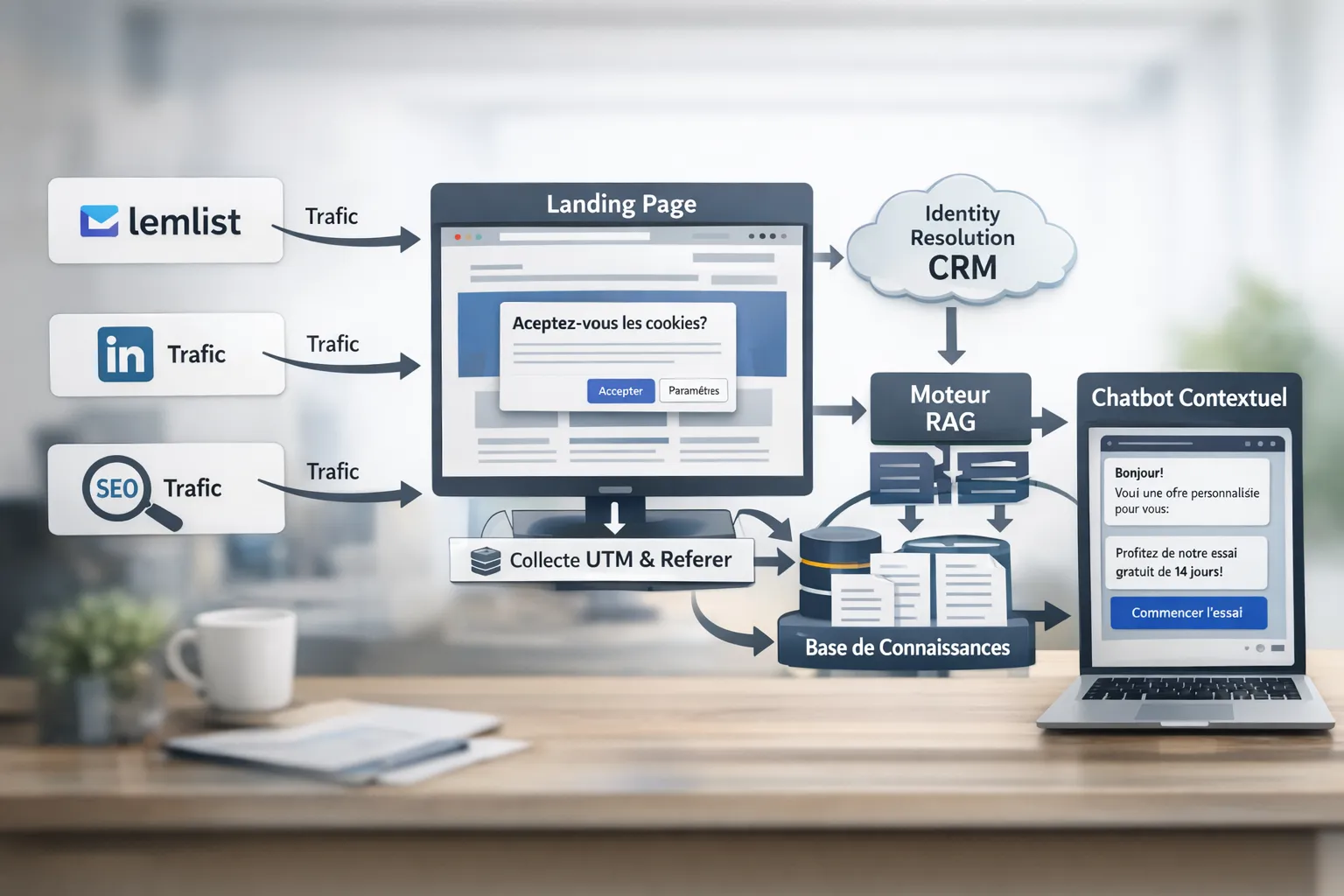
The heart of the system is a "context pack" generated on the front or server side, passed to the chatbot with every message. It consists of structured signals that guide the conversation.
Signal
Example
Effect on chatbot
Traffic source
utm_source=lemlist, referer=linkedin
Hook aligned with the campaign promise and channel vocabulary
Page and section
/pricing, "Pro" tab
Answers bounded to the displayed section info and price objections
Ebook downloaded yesterday, 2 pages viewed on "Integration"
Intelligent rebound, proposes technical demo rather than brochure
Product capabilities
Features eligible on the page
The bot only mentions what is actually available and verified
To ensure reliable answers, we recommend a contextual retrieval engine that feeds the LLM with verified excerpts from the site or your knowledge base. This is the RAG principle, detailed in our guide Robust RAG in Production.
For interaction design, follow conversational UI best practices, notably clarity, error management, and concise answers. See our dedicated article AI UI, Key Principles of Conversational Design.
Concrete personalization scenarios that convert
1) Arrival from Lemlist
Hook that reiterates the email's value proposition, 2 ICP fit questions, then CTA choice. If the prospect mentions a CRM tool, the bot automatically proposes a note on the corresponding integration.
2) Identified visitor after a form
When the person has left their information on another site form, and with their consent, the chatbot can reuse first name and company to avoid repetition, display client cases from their sector, and move faster to qualification.
3) "Pricing page" context
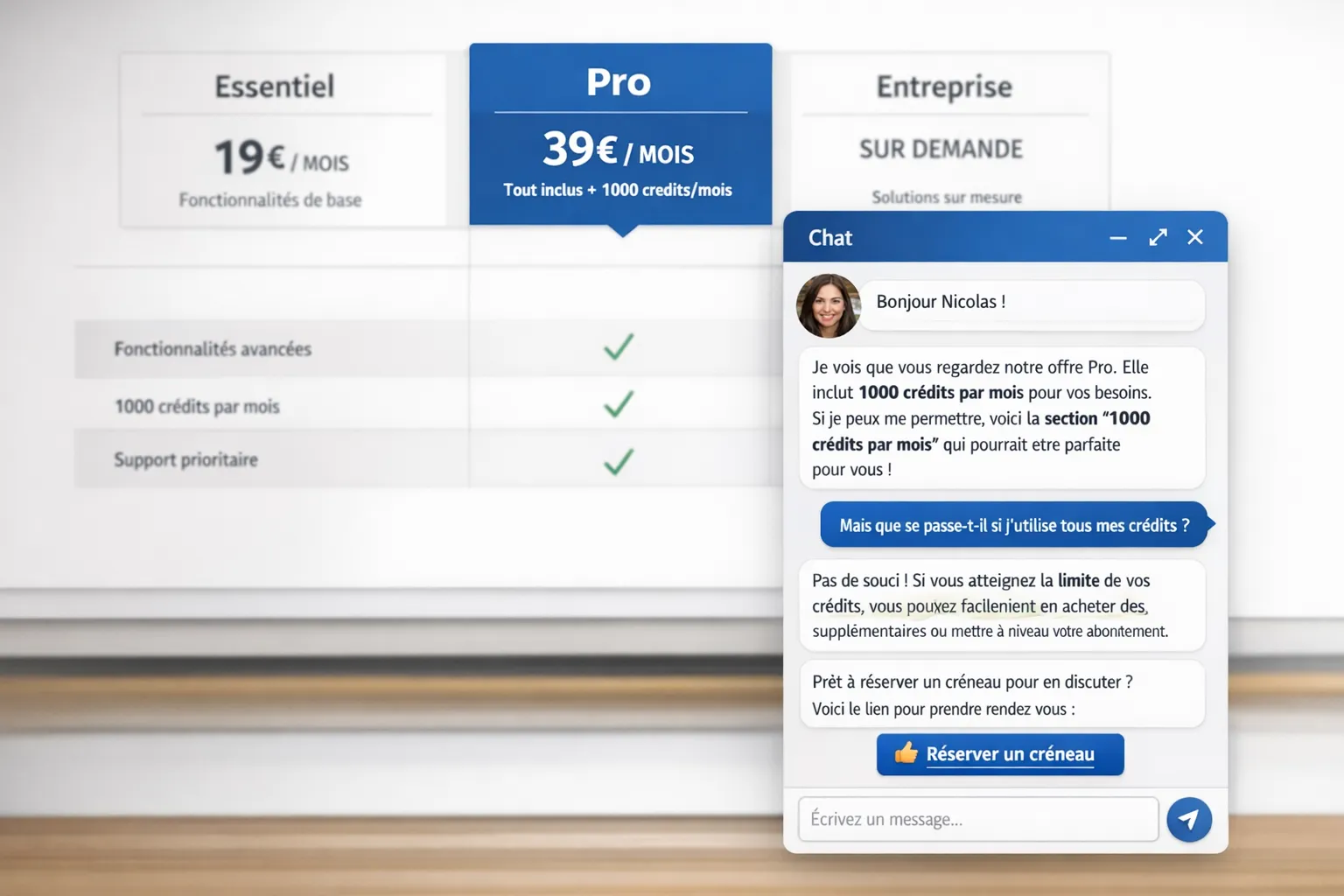
The bot answers strictly with information visible on the pricing grid, explains limits per plan, and opens a comparison if the user hesitates between two levels. If it detects a need for advanced integration, it directs towards an expert contact.
4) "Feature" context
On a feature sheet, the bot answers with usage examples, technical prerequisites, and impact metrics. It proposes a mini quiz in 2 questions to estimate expected value and suggests a targeted demo.
Conversational playbooks oriented towards conversion
Rapid and respectful qualification, 2 to 3 questions maximum, aligned with your ICP and your MQL criteria. See our entry MQL if needed.
Management of frequent objections, price, integrations, security, with proven answers and verifiable sources.
CTA branches adapted to intent level, book a call, try a sandbox, calculate ROI, download a case study, contact technical support.
Fluid escalation, handover to a human if the request goes outside the scope or if the user requests it.
To frame the ROI, select key indicators and avoid vanity metrics. Our guide on Essential AI Chatbot KPIs details measures that make business sense.
Measuring impact, from visit to opportunity
KPI
Useful Definition
Where to instrument
Chat engagement rate
Share of visitors interacting with the bot
Chat tool, event analytics
Lead rate
Visit to identified lead, with consent
GA4 tagging, CRM
MQL Conversion
Lead to MQL according to your rules
CRM and marketing automation
Appointment booking
Conversations ending in a booked slot
Calendar tool, bot logs
Containment rate
Questions resolved without human agent
Chat platform
Time to response
Average delay for first bot response
Chat platform
CAC Impact
Variation of blended CAC after deployment
Finance control, attribution
Tip: tag your key bot messages as GA4 events, for example view_pricing_details, objection_security_resolved, meeting_booked. You will thus be able to correlate journeys and identify prompts that create value.
Implementation architecture, without technical debt
Signal collection, UTM, referer, page type, viewport, returning visitor, all respecting consent via your CMP.
Server-side identity resolution when legitimate, first-party matching with your CRM, hashing of identifiers if necessary.
Structured conversational context, including Persona, Intent, Page Context, Knowledge Snippets, Guardrails, and Refusal Policy.
Retrieval of reliable information, RAG limited to your verified sources, current pages, product documentation, client cases. More information in our guide Robust RAG in Production.
Standardizable orchestration, the MCP, Model Context Protocol facilitates connection to sources and context governance.
Business integrations, CRM, analytics tools, appointment booking, and internal notifications, to close the conversion loop.
Compliance and trust, by design
Explicit consent before any use of personal data in the chat.
Data minimization, storing only what is necessary for the conversion objective.
Transparency, visible mention that the interlocutor is an AI and possibility to speak to a human.
Logging and controlled retention, logs limited in time, restricted access.
To go deeper, consult the CNIL recommendations on data protection and user consent, available on the CNIL website.
Deployment in sprints, from idea to A/B test
Scoping, rapid audit of your funnel, definition of personas, MQL criteria, and priority pages.
Prototype, implementation of the chatbot on a pilot page, contextual prompts, 3 conversation playbooks, event instrumentation.
Integrations, CRM and analytics connection, lead routing, escalation scenarios.
A/B test, comparison against the static form, KPI measurement for 2 to 4 weeks, iterations of prompts and sources.
In parallel, take care of the conversational experience and accessibility. Our UI recommendations are detailed in the article AI UI, Key Principles.
Express checklist for your intelligent landing page
The bot knows the arrival source and uses it for the hook.
The context changes according to the displayed page, Pricing, Feature, Case Study.
Answers rely on verified content, not assumptions.
Qualification takes 2 to 3 questions, no more.
CTAs are adapted to intent, demo, quote, resource, callback.
Traffic costs are rising, every unconverted visit weighs on the CAC.
Buyers want immediate, contextualized answers, not generic PDFs.
Language models are progressing, but the difference lies in your context and execution, not the model size.
Impulse Lab accompanies you from opportunity audit to production, with integration into your tools, automations, and team training. We work in weekly sprints, with a dedicated client portal and a clear commitment to delivered value.
FAQ
What personal data does the chatbot use to personalize the conversation? Only those for which the user has given consent, for example, first name and company already shared via a form. We apply a logic of minimization and transparency.
How to avoid the chatbot saying inaccurate things about our offers? By limiting its answers to verified excerpts via RAG and placing guardrails: refusal when information doesn't exist, redirection to a human.
Can we measure ROI without reorganizing all analytics? Yes, by tagging key chat events and linking them to your CRM. You then follow visit → lead → MQL → appointment → opportunity.
Can the bot recognize a prospect from an outbound campaign like Lemlist? Yes, via tracking parameters and, if the person has already identified themselves with consent, by adapting the hook and qualification to the campaign message.
How to manage internationalization? The context includes the browser language and content variants per page. The bot detects the language and remains consistent with the served page.
What are the main risks? Poor consent management, out-of-scope answers, prompts that are too long or vague, and lack of instrumentation. Rigorous conversational design and technical guardrails reduce these risks.
Ready to transform your landing page into an intelligent experience that truly converts? Tell us about your priority page and your goals, we will propose a rapid and measurable implementation plan. Contact us at impulselab.ai.