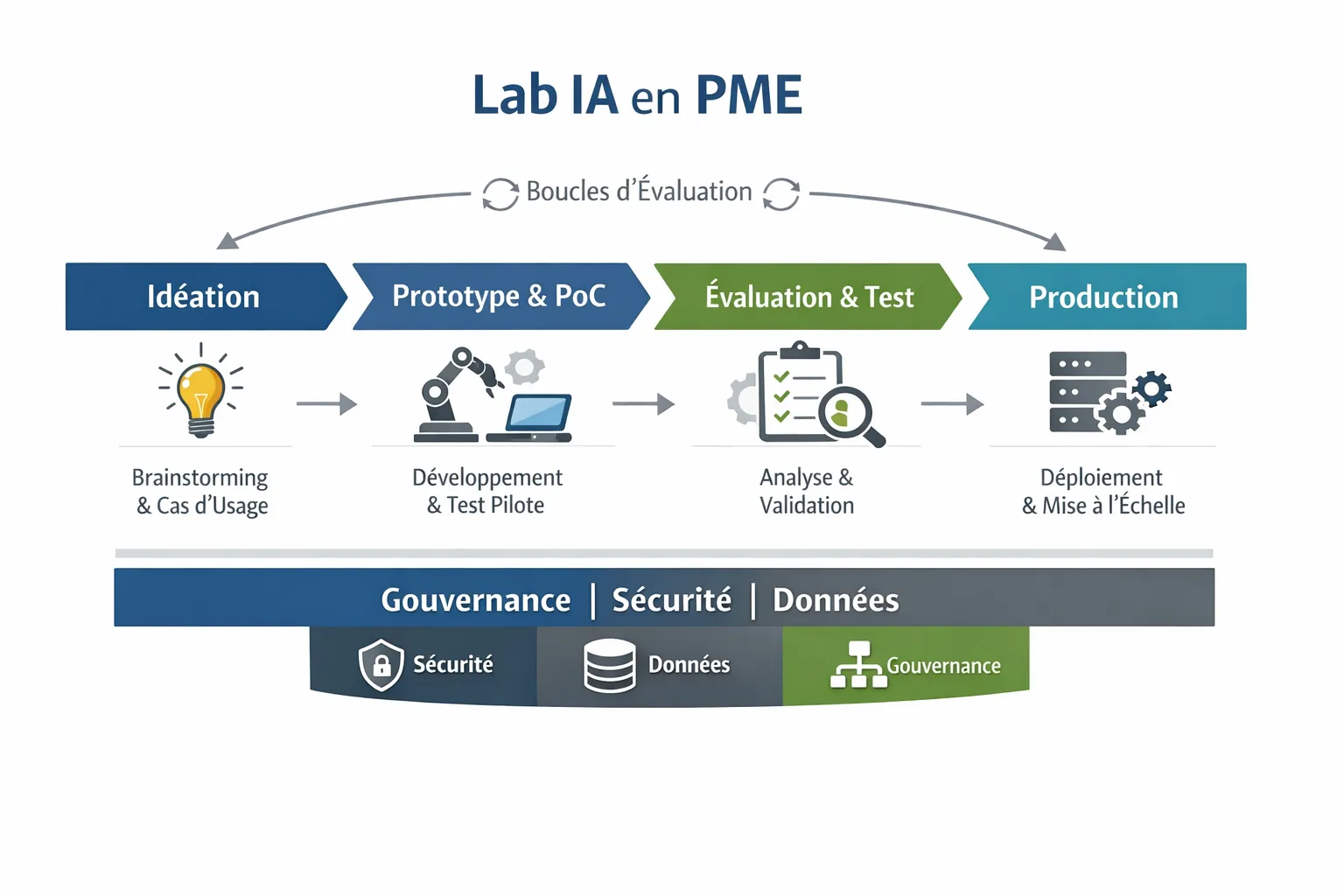
Setting up an AI Lab in an SME is neither heavy R&D nor a risky gamble. It is an operational framework to identify, test, and industrialize high-impact AI use cases while managing risks. Here is a practical guide designed for executives and teams...
December 23, 2025·7 min read
Setting up an AI Lab in an SME is neither heavy R&D nor a risky gamble. It is an operational framework that allows you to identify, test, and industrialize high-impact AI use cases while controlling risks. Here is a practical guide, designed for executives and teams in the structuring phase, to launch your AI Lab in less than 90 days.
What is an SME AI Lab and what is it for?
An SME AI Lab is a lightweight, product-oriented structure that centralizes opportunity detection, rapid experimentation, evaluation, and production deployment of AI solutions useful to the business. The goal is simple: transform AI into measurable value, not dead-end demonstrations.
Expected results within 3 to 6 months
A prioritized portfolio of use cases linked to business objectives
2 to 3 pilots in limited production, with value indicators
A governance, security, and compliance framework adapted to your size
Adoption, training, and continuous improvement routines
Minimum prerequisites to start
You can launch an AI Lab without a heavy overhaul if these basics are in place.
Clear sponsorship from a management committee member
Inventory of available data and simple access rules
Isolated and logged technical test environment
Privacy policy and consent compliant with GDPR
Time budget, even modest, for a core multidisciplinary team
For compliance and risk management, draw inspiration from the NIST AI Risk Management Framework, useful for structuring AI risk assessment and control practices, the European AI Act framework which specifies obligations and risk categories, and CNIL recommendations for AI, which shed light on data protection issues.
NIST AI RMF, AI risk management framework, consult
Executive Sponsor, arbitrates priorities and unlocks resources
Lab Product Owner, translates objectives into a roadmap and value criteria
Tech Lead Data, secures architecture, integrations, data quality, and light MLOps
Business Referents, one person per target function to define needs and test
Compliance Referent, coordinates privacy, security, and risk review
On the governance side, adopt a hub and spoke logic: a small central core drives the method and compliance, while business spokes co-construct use cases. Decide on a weekly ritual: short demo, metrics review, iteration or termination decisions.
The 90-day playbook, from scoping to first production release
Days 0 to 30: align, secure, prioritize
AI opportunity audit, map repetitive tasks, bottlenecks, customer friction. See our guide on AI KPIs to frame objectives, read
Rules of the game, authorized data sources, secrets management, prompt bans, validation cycle, logging
Basic tooling, clean and secure API integrations, read
Prioritization, impact/feasibility/risk matrix, choose 2 to 3 use cases to prototype
Days 31 to 60: prototype and measure
Metrics-driven prototyping, one feature per week, regular demos
Continuous evaluation, response quality, time saved, adoption rate, human escalations
Living documentation and onboarding kit for testers
Days 61 to 90: industrialize and prepare to scale
Move to limited production, restricted access, monitoring, alerts
Compliance and security review, personal data, retention, user notices
Adoption and training plan, short sessions, concrete cases, usage policy
Roadmap: what to amplify, what to stop, what to put under observation
For prototypes involving an internal knowledge base or document search, rely on a robust RAG, guide. For front-office chatbots, see our SME use cases, read.
Typical backlog for SMEs, use cases that pay off
Here is a sample of frequent use cases, evaluated on impact and relative complexity.
Function
Use Case
Data Required
Expected Impact
Complexity
Key Risks
Customer Service
24/7 Chatbot with human escalation
FAQ, ticket history, policies
Response time reduction, satisfaction
Low to medium
Hallucinations, sensitive data
Sales
Lead qualification and CRM enrichment
Inbound emails, CRM, public sources
Processing speed, conversion rate
Medium
GDPR compliance, data quality
HR
HR Assistant, internal policies and onboarding
Handbook, templates, procedures
Time saved, response consistency
Low
Incorrect answers, updates
Finance
Invoice extraction and reconciliation
Invoice PDFs, ERP
Manual entry reduction, errors
Medium
OCR quality, human control
IT
Level 1 Helpdesk, automatic triage
To orchestrate more autonomous workflows, Agentic AI approaches can accelerate multi-step execution. Discover our point of view, read.
Essential AI Lab Toolkit
Chatbots and conversational interfaces, polished conversational design, principles
Retrieval-Augmented Generation (RAG), document indexing, source control, best practices
Process automation, clean connectors via API, queues, idempotency, integration patterns
Observability and evaluation, prompt and response logs, human ratings, dashboards
Security, secrets management, encryption of data in transit and at rest, access control
Model governance, version tracking, prompts, usage policies
Risks, compliance, and ethics: what to frame from the start
Data and privacy, minimization, anonymization or pseudonymization, legal basis and information of individuals
Transparency and human oversight, specify when and how a human can intervene and contest a result
Bias and fairness, regular output review, representative test sets, escalation process
Traceability, log production release decisions, model versions, and prompts
The NIST AI RMF provides a useful grid of functions: govern, map, measure, manage. The AI Act imposes graduated obligations according to the risks of the use cases. This guide does not constitute legal advice; adapt with your DPO or counsel.
Measuring value, your AI Lab KPIs
Link each use case to an objective and an indicator. To go further, see our dedicated guide, read.
Objective
Main KPI
How to measure
Productivity
Hours saved per month
Volume of automated tasks x average duration x adoption rate
Quality
Error rate, rework
Human-in-the-loop sampling, regular audits
Customer Experience
First response time, CSAT
Support metrics, post-interaction surveys
Revenue
Conversion rate, average basket
Simple attribution on cohorts or campaigns
Compliance
Incidents, GDPR requests
Incident register, processing times
Practical tip: set a simple monetary value for the hour saved and the error avoided, then track the cumulative value per use case. Transparency of gains accelerates the decision to industrialize or stop.
Adoption and change management, the key differentiator
Build a small internal hub, portal with documentation, test dataset, metrics
Expand the integration scope, SSO, permission management, common supervision
Implement a quarterly review, pilot success rate, time to production, value generated
Common pitfalls to avoid
Technical prowess without sponsor or metrics
Tools not integrated into the information system, low adoption
Underestimation of security and confidentiality
Missing baseline, ROI impossible to demonstrate
Too many parallel projects, dilution of efforts and delays
How Impulse Lab can help you launch your AI Lab
Impulse Lab is a product and tech agency that transforms AI into value for SMEs and scale-ups. Our team accompanies you from diagnosis to production, with a weekly cadence and a dedicated client portal to track backlog, deliverables, and demos. We intervene on the following aspects: AI opportunity audits, process automation, integration with your tools, development of custom web and AI platforms, training, and adoption. We work in a client-involved mode to accelerate appropriation. Want to accelerate now? Book a chat.
To dig deeper into certain topics, you can also consult: AI Lab, transforming an idea into a profitable prototype, read, AI Agency, essential criteria for choosing well, read, or How to choose an AI Agency in 2025, read.
By launching a value-centered, secure, and measured AI Lab, you build a concrete operational advantage. Start small, ship every week, instrument everything, and scale what works. This is how AI becomes a sustainable asset for your SME.
AI and Cybersecurity: The Minimum Controls for an SME
From summarizing contracts to drafting invoices, each AI use case introduces new access risks. For an SME, AI and cybersecurity must be addressed together before connecting sensitive data or automating actions. Discover eight essential controls and a 30-day rollout plan.