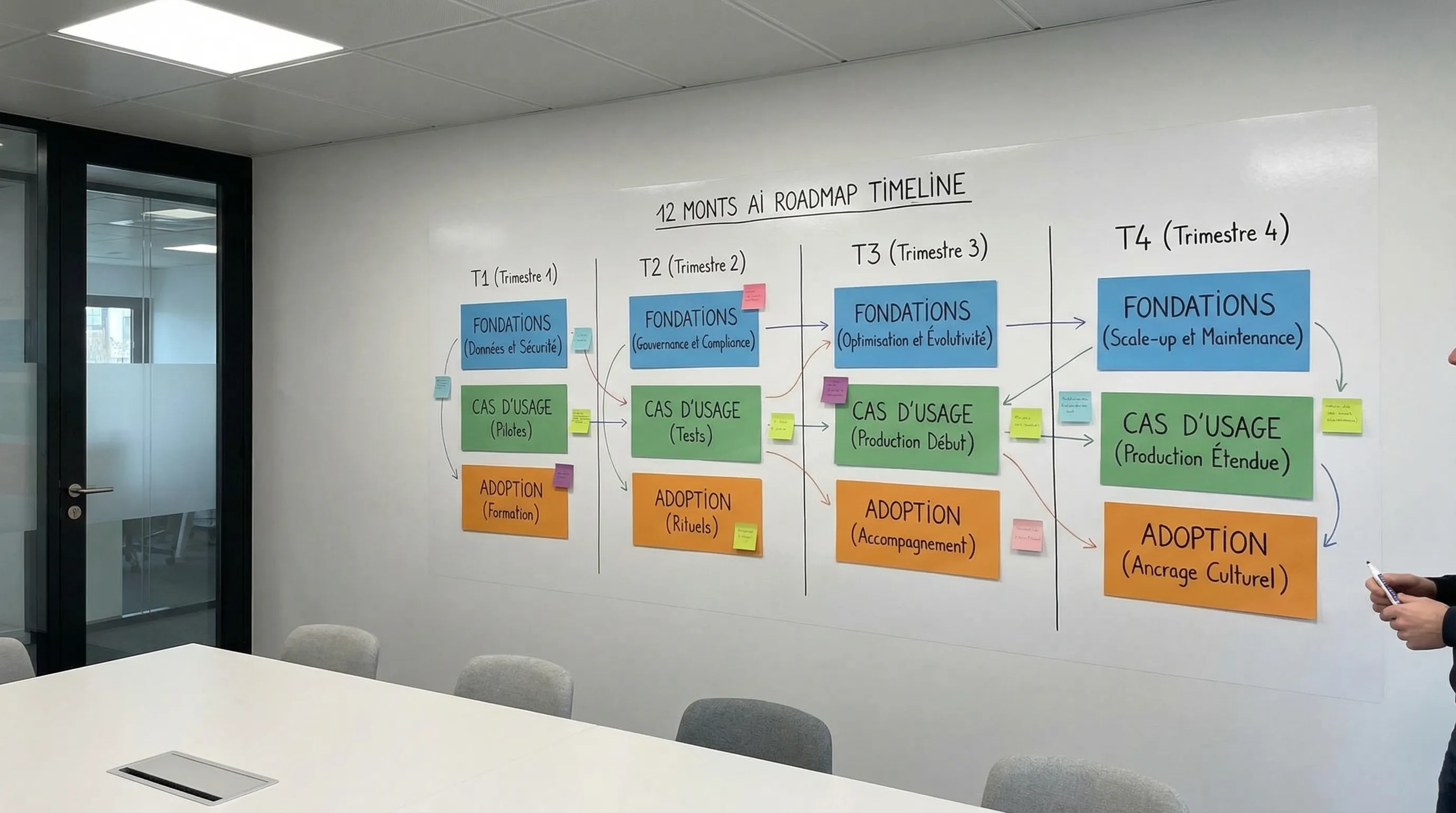
Long-term AI Support: Governance and 12-Month Roadmap
Intelligence artificielle
Stratégie IA
Gouvernance IA
ROI
Gestion de projet IA
Moving from ad-hoc AI testing to stable results requires **long-term AI support**. Not a theoretical plan, but light governance, decision rules, and a 12-month roadmap to turn POCs into operational capabilities.
March 20, 2026·8 min read
Moving from a few AI tools tested "ad hoc" to stable, measurable results requires one thing that many organizations underestimate: long-term AI support. Not a grand theoretical plan, but light governance, decision rules, an execution rhythm, and a 12-month roadmap that transforms POCs into operational capabilities.
The goal of this article is simple: to give you a concrete governance model and a 12-month roadmap adapted for SMEs and scale-ups starting to structure themselves, with deliverables, rituals, metrics, and checkpoints.
Why "long-term" AI support changes everything
AI doesn't often fail due to a lack of a "good model". It fails because:
use cases are not linked to KPIs, so decisions cannot be made,
data is insufficient, or ungoverned,
integrations into business tools don't exist (or arrive too late),
risks (GDPR, security, compliance) are treated at the end of the project,
adoption is not managed, so the impact remains a demo.
Long-term support allows you to maintain three loops in parallel, without slowing down:
the value loop (KPIs, ROI, trade-offs),
the reliability loop (tests, observability, incidents, continuous improvement),
the governance loop (data, compliance, usage rules, decisions, and priorities).
AI Governance: The minimum viable (without over-engineering)
Good governance isn't about "covering everything," it's about reducing risk and accelerating decisions, while remaining proportionate to your size.
The 3 levels of governance to implement
Strategic (monthly or bimonthly): aligns AI with business priorities, validates trade-offs, tracks value.
Tactical (weekly): manages the use case portfolio, removes blockers, maintains delivery cadence.
Risk Governance: GDPR, Security, AI Act, without blocking delivery
In 2026, the question is no longer "should we govern?", but "how to govern without killing speed?". The right reflex is to link the level of control to the level of risk.
12-Month Roadmap: A concrete model, quarter by quarter
This roadmap assumes you want to industrialize, not just test tools. It works well for teams between 20 and 500 people, with real constraints (existing IT systems, security, limited time).
Quarter 1 (M1 to M3): Frame, secure, deliver a first measured case
Objective: Prove measurable impact on a frequent case, while laying minimal foundations.
Recommended deliverables:
AI Register + 10 to 30 qualified ideas (even if you only do 2).
1 to 2 "cash-near" use cases (close to cost or revenue), with baseline KPIs.
Minimal data policy (classification, "OK / forbidden" rules, corporate accounts).
"Clean" integration architecture (at least one stable pattern), to avoid the disposable prototype.
Test protocol and scorecard, even simple.
At the end of Q1, you must be able to answer: "which KPI moved, by how much, and at what total cost?".
Quarter 2 (M4 to M6): Move from pilot to integrated MVP, then stabilize
Objective: Transform the first success into a repeatable capability, and not an isolated project.
Recommended deliverables:
MVP integrated into tools (CRM, support, back-office), with permissions and logs.
Year 2 Roadmap: 3 to 5 initiatives, including at least one "foundation" initiative (data, integrations) and one "showcase" (business visible).
Example of governance cadence (that fits in busy schedules)
The challenge is not to multiply meetings, but to ritualize good decisions.
Ritual
Duration
Participants
Expected Result
Weekly delivery (tactical)
30-45 min
delivery lead + owners
priorities, blockers, next release
Quality and incident review
30 min
tech + security + owner
corrective actions, test updates
Strategic Steering
45-60 min
sponsor + owners + lead
trade-offs, stop/scale, budget
Quarterly portfolio review
60-90 min
extended committee
Q+1 roadmap, major risks
When to get support (and when you can do it alone)
You can manage alone if:
you have 1 isolated use case, low risk, without critical integrations,
you accept limited value (comfort gain, not a business KPI),
the tool is already compliant with your requirements (corporate accounts, security, logs).
Long-term AI support becomes relevant if:
you want multiple use cases, therefore a portfolio,
you need to integrate with the IT system, tools, and security rules,
you have sensitive data, client stakes, or regulatory risk,
you want a delivery cadence (and not a "one shot" project).
FAQ
What is long-term AI support, concretely? It is an approach where AI is managed like a product and a portfolio: governance, integration, tests, adoption, measurement, then iterations, over 6 to 12 months (and beyond).
Why must an AI roadmap cover 12 months, and not just 30 or 90 days? The 30 to 90 days serve to prove a first impact. The 12 months serve to stabilize, integrate, secure, train, and make the value repeatable across multiple use cases.
Which deliverables are non-negotiable to avoid the "POC graveyard"? An AI register, a sheet per use case (KPI, data, risks), a test protocol, and a runbook before production.
How to choose the first 2 use cases of a roadmap? Pick frequent cases, close to cash (cost or revenue), with accessible data, and manageable risks. Avoid "prestige" subjects that are hard to measure.
How to integrate compliance (GDPR, AI Act) without slowing down? By classifying data, proportioning guardrails to risk, and creating recurring checkpoints (rather than a final audit). Document as you go.
What are the signals to "stop" a use case? KPI unreachable despite iterations, uncontrollable variable costs, low adoption, risks too high, or integration too heavy compared to the expected gain.
Implement your 12-month roadmap with Impulse Lab
If you wish to structure an AI program without slowing down your delivery, Impulse Lab can support you on the three blocks that make the difference: opportunity audit, development and integration of custom web and AI solutions, and adoption training.
The most effective starting point is often a short framing (risks, KPIs, data, integrations), then execution in short cycles with weekly deliverables. You can discuss this with the team via Impulse Lab and choose the format best suited to your context (audit, instrumented pilot, or long-term support).