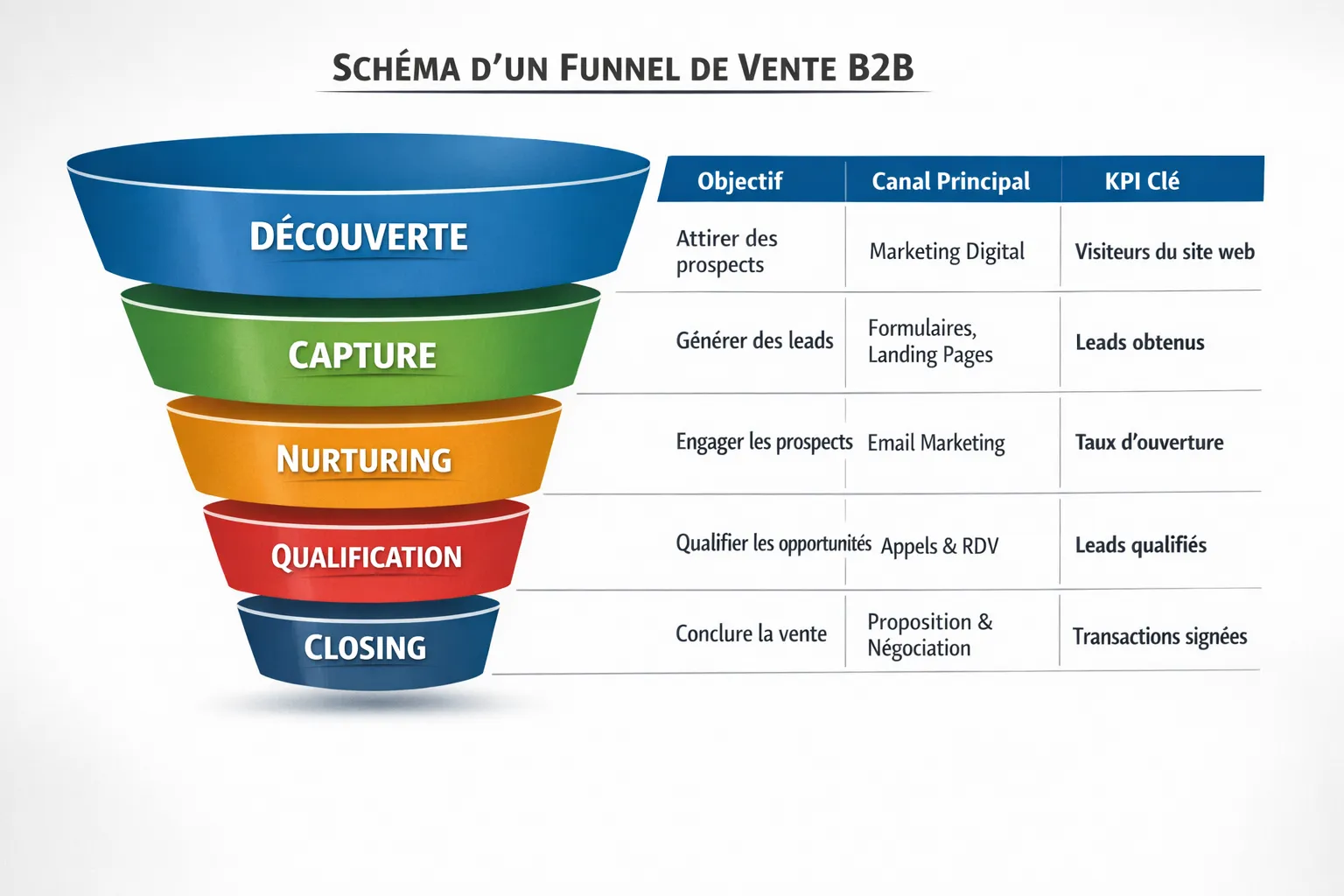
When a company starts scaling, the problem isn't "getting more leads," it's having **a system** that predictably transforms a stream of prospects into qualified appointments, then into clients. A sales funnel serves precisely this purpose.
January 05, 2026·9 min read
When a company starts scaling, the problem isn't "getting more leads," it's having a system that predictably transforms a stream of prospects into qualified appointments, then into clients. A sales funnel serves precisely this purpose.
If you are looking for a sales funnel example with a ready-to-copy model, you are in the right place: below, you will find a complete template (steps, content, messages, KPIs, automations) that you can adapt to your B2B context (services, agency, SaaS, firm).
Before copying the model: 3 decisions to make (otherwise your funnel won't convert)
A good funnel is not a succession of tools. It is a sequence of logical engagements for a specific target client.
1) Your ICP (Ideal Customer Profile)
You cannot "optimize" a funnel if you don't know who should enter it. Define an ICP with simple criteria: sector, size, maturity, stack, intent signals.
Your funnel will be much more effective if you propose an entry offer that is easy to accept (diagnostic, audit, workshop, template, scoped consultation). It serves to build trust and qualify, not to "sell everything" at once.
Typical B2B examples:
Audit (e.g., AI audit, RevOps audit, SEO audit)
Workshop (e.g., 2h scoping, process mapping)
Demo + action plan (if you sell a product)
3) Your trigger event (the real buying moment)
The prospect rarely buys "because you posted on LinkedIn." They buy when a trigger appears: recruitment, new KPI to reach, tool migration, rising CAC, churn, board pressure.
Effective capture doesn't need to be complex. The most important thing: consistency between the consumed content and the offered asset.
Two simple options:
Lead magnet: "AI Audit Checklist in 30 minutes (10 questions)".
Appointment booking: "20-minute scoping session (free): evaluate 1 process to automate".
If your traffic is heterogeneous, a smart landing page with contextual chatbot can help guide towards the right action (without promising miracles, just by qualifying better).
Step 3, Nurturing (transforming interest into intent)
Useful nurturing is mini-education guided towards a decision. Example of a 5-email sequence:
Email 1: "Here is the checklist + how to use it in 15 minutes"
Email 2: "3 signals that AI can improve {process} (and 2 signals where you shouldn't go there)"
Email 3: "Example of a 4-week roadmap: scoping → prototype → measurement → decision"
Email 4: "Frequent risks: data, security, adoption (and how to limit them)"
Email 5: "Proposal: we evaluate a use case together, then you leave with an action plan"
The goal isn't to write a lot. The goal is to address objections before the call.
Without minimal instrumentation (conversion, delays, steps), you don't know where to act. Measure little, but measure well.
Marketing generates leads, sales says "they suck"
This is almost always a problem of MQL/SQL definition, scoring, or internal SLA. The pages MQL and SQL can help standardize.
Too many steps, too soon
If your funnel contains 12 steps, you have likely created an internal process, not a customer journey. Simplify.
Non-compliant tracking
If you use cookies/trackers, ensure you respect consent rules. In France, the practical reference is the CNIL (cookies and other trackers).
Frequently Asked Questions
What is the best sales funnel for a B2B SME? A short and instrumented funnel: Discovery → Capture → Nurturing → Qualification → Closing (then onboarding). The "best" depends mainly on your ICP, your entry offer, and your sales cycle.
What is the difference between a marketing funnel and a sales funnel? The marketing funnel aims primarily to attract, capture, and mature demand. The sales funnel transforms an opportunity into a client (qualification, proposal, closing). In practice, you must align both via MQL/SQL definitions.
How many steps should be in a sales funnel? In B2B, 5 to 6 steps are sufficient in most cases. If you exceed 7 steps, you risk creating friction and losing clarity.
Which KPIs to track to optimize a funnel? Prioritize: visit→lead conversion, Meeting/lead (or reply rate), MQL→SQL, win rate, sales cycle. Then add CAC and average value if you invest in acquisition.
How do I know if my leads are of good quality? Measure the MQL→SQL rate, the no-show rate, and the win rate by source. If a source generates volume but few SQLs, you have a targeting, messaging, or qualification problem.
Can AI improve a sales funnel? Yes, especially to accelerate qualification, enrich data, personalize sequences, and automate repetitive tasks. But AI does not compensate for a vague offer or a poorly defined ICP.
Need a truly actionable (and automated) funnel?
If you want to move from a "funnel on a slide" to a system that runs, Impulse Lab can help you frame priorities, choose the right use cases, and build reliable execution (audit, automation, integration with your tools, and adoption training).
Moving from Excel to a Reliable Workflow Without Rebuilding Everything
To move from Excel to a reliable workflow, you don't need to replace all your tools. The first shift is to stop relying on colored cells, email reminders, and one person's memory. Keep what works, import your existing data, and gradually secure the critical steps.