What Level of RPA Service Should You Plan for After Deployment?
Stratégie d'entreprise
automatisationS
Optimisation
An RPA service doesn't end with deploying a bot. Interfaces shift, access expires, and exceptions occur. For growing businesses, the real question is: who intervenes, how quickly, and with what fallback plan when automation stalls?
November 15, 2026·10 min read
An RPA service does not end with the delivery of a functioning bot. After deployment, interfaces change, credentials expire, and certain cases fall outside the expected workflow. For an SME or a growing company, the core question is straightforward: who intervenes, within what timeframe, and with what fallback solution when automation stalls?
The right level of support depends on the business consequences of downtime, not on the number of bots deployed. Here is how to structure monitoring, maintenance, and vendor commitments without paying for disproportionate coverage.
Choosing Coverage Based on the Impact of Downtime
Start with a business question: how long can this process wait without causing harm? An internal report delayed by a few hours and an interrupted order processing stream do not require the same operational setup.
You should also distinguish between user-triggered bots (attended) and bots running without human oversight (unattended). In the latter case, no one necessarily notices a failure when it happens.
To properly scale your RPA service, balance the tolerable downtime, the feasibility of manual fallback, and the consequences of silent errors.
Process Scenario
Coverage to Consider
Condition to Verify
Deferrable internal task with simple manual fallback
Business hours support and run monitoring
Someone knows how to take over the work
Daily processing with a business deadline
Monitoring and intervention aligned with this deadline
Alerts arrive early enough to take action
Critical flow running overnight or on weekends
Extended coverage or targeted on-call support
After-hours intervention can genuinely restore the flow
These options are planning benchmarks, not rigid contractual tiers. An on-call shift offers little value if the only person capable of unlocking the target application cannot be reached until the next morning.
What Should an RPA Service Cover Post-Production?
The contract must distinguish between what detects an issue, what restores processing, and what evolves the automation. The word "maintenance" alone is not enough.
Monitoring and Corrective Maintenance
Monitoring must track not only the bot's execution status but also the expected business outcome. A technical status of "completed" does not prove that all invoices were submitted or that the amounts are correct.
Plan appropriate controls: reconciliation between received and processed records, duplicate detection, or alerts when no files arrive at the expected time. Every alert must have a designated recipient and an escalation procedure.
Corrective maintenance covers bugs and defects within the delivered scope. Clarify whether it includes diagnosis, fixing, testing, and reprocessing blocked records. Relaunching the bot is not always enough: you may need to determine what was already recorded to avoid duplicate entries.
Preventive Maintenance and Enhancements
The RPA service must also anticipate foreseeable incidents: certificate expirations, secret rotations, dependency updates, or planned changes in the applications being used.
Enhancement maintenance (evolutive maintenance) addresses a different need: a new business rule, an additional file format, or adding an approval step. Ask how these requests are estimated, prioritized, and billed. A minor UI change and a complete process redesign do not represent the same workload.
For access management and data handling, the CNIL personal data security guide serves as a helpful reference. Service accounts, logs, and secrets require specific vigilance, detailed in our article on how to secure data automations.
Making SLAs Measurable and Verifiable
An SLA (Service Level Agreement) must describe a measurable commitment. "Responsive support" states neither when the clock starts nor what the provider must deliver by the deadline.
To compare two RPA service proposals, separate at least the following commitments:
Commitment
What It Measures
Key Point to Clarify
Acknowledgment / Initial Response
Time before actual work begins on the incident
Does an automated email receipt count?
Restoration
Time to return to an acceptable operational state
Is a manual workaround permitted?
Permanent Resolution
Time to permanently fix the root cause
What tests are required to close the incident?
Communication
Frequency of status updates during the incident
Who keeps the business teams informed?
Severity levels must be based on actual impact: blocked operations, threatened deadlines, corrupted data, or absence of a workaround. An error affecting only a few records can still be high-priority if it triggers inaccurate financial transactions.
Also clarify supported hours, time zone, public holidays, and what triggers the response clock. An alert received overnight does not automatically mean an overnight intervention.
An Example of a Clause to Negotiate
For example, a contract might specify an initial response within thirty business minutes for a blocking incident, Monday through Friday from 9:00 AM to 5:00 PM, excluding public holidays. This timeframe is neither an industry standard nor an Impulse Lab commitment.
Under this calculation, an alert received on Friday at 4:50 PM might only be picked up by Monday at 9:20 AM, assuming no intervening holiday. The difference from "thirty minutes after the alert" is substantial.
Your RPA service agreement must specify how external dependencies are handled. If the accounting software is down, who contacts the vendor? If SLA timers are suspended, on what grounds, and how is the client notified?
Defining Responsibilities Before the First Incident
The provider cannot decide alone whether an order should be canceled or an accounting entry replayed. Conversely, business stakeholders should not have to diagnose technical issues.
The business owner validates rules, resolves exceptions, and confirms that results allow normal operations to resume. They also designate a backup contact for absences.
The provider or automation team handles technical tasks outlined in the contract: diagnosis, patching, testing, and recovery support. Their scope should explicitly include or exclude reprocessing backlog items.
The IT team retains agreed responsibilities over environments, access rights, network infrastructure, and third-party software. In a small organization, these functions may be outsourced, but they must still be clearly assigned.
To manage the RPA service effectively, appoint a coordinator capable of bringing these stakeholders together and tracking decisions. Our article on RPA manager responsibilities covers this coordination role in detail. An SME does not necessarily need a dedicated full-time position, but it does need an identified owner.
Factoring in Recurring Costs and Changes
Post-deployment costs go beyond a basic support retainer. Request an annual breakdown that separates infrastructure expenses, support, and enhancements.
Key budget items to review include:
Licenses and infrastructure: automation platform, runner machines, hosting, and monitoring tools according to the chosen architecture.
Operations and maintenance: monitoring, troubleshooting, bug fixes, and preventive tasks included in the scope.
Extended coverage: expanded support windows, on-call standby, or targeted mobilization during high-stakes deadlines.
Enhancements: changes to rules, applications, or formats not covered by corrective maintenance.
Internal time: business validation, access management, testing, and exception handling.
When evaluating an RPA service, make sure the retainer boundaries are fully transparent: included hours, overage rates, exclusions, and prior authorization requirements for extra work. An attractive baseline package becomes difficult to manage if every diagnostic request generates an unexpected invoice.
Avoid applying a one-size-fits-all percentage of the initial build cost. A simple automation running on an unstable interface may require far more upkeep than a complex flow integrated with reliable APIs. The quote should reflect the actual dependencies of the process.
Planning for Recovery, Not Just Repair
A technical fix is insufficient if records remain stuck or if some were processed twice. The recovery plan must describe how to identify the last known good state, isolate exceptions, and rerun only the necessary transactions.
For sensitive operations, such as payment generation, automated retries must be protected by controls that prevent duplicates. When the status of an operation is uncertain, manual verification may be preferable to a blind rerun.
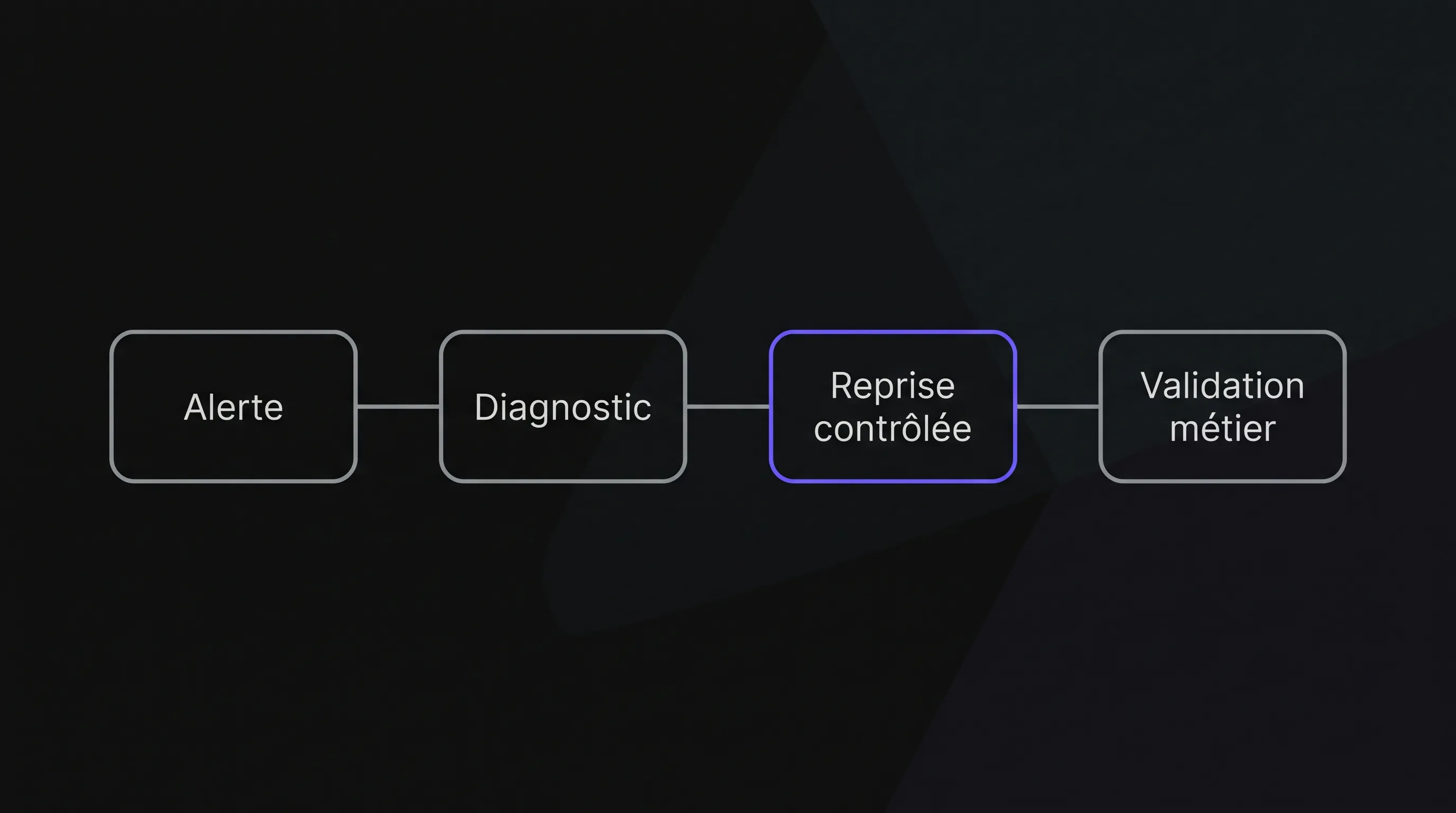
An operationally sound RPA service requires a controlled shutdown procedure, documented manual workarounds, and defined criteria for switching back to automation. This procedure should be tested before an actual incident demands it.
Make sure relevant backups are in place: source code, configuration files, parameters, and data required for recovery. Backup frequency depends on what your business can afford to lose or re-enter. A backup that is available but has never been tested in a restore drill leaves considerable operational risk.
Finally, establish who authorizes the restart. Following a data inconsistency, technical sign-off does not replace formal validation from the business team.
Measuring Quality Without Metric Overload
The count of successful executions alone does not reflect the quality of the system. A bot can complete its runs while dumping an unsustainable volume of exceptions onto your staff.
Focus on a few metrics tied directly to business outcomes: percentage of records processed cleanly, SLA compliance, mean time to recovery, and manual intervention volume. Define how each metric is calculated, especially excluded records and the observation window.
Your RPA service review should also highlight recurring incidents and their root causes. A glitch resolved five times by a simple restart calls for a different fix than an isolated edge case. Distinguish between a quick workaround and a permanent resolution.
For smaller organizations, a monthly review is a solid starting point that can be adjusted based on criticality. It should lead to concrete decisions: fixing a root cause, updating a business rule, strengthening a validation check, or adjusting support hours.
After going live, schedule a stabilization period with heightened monitoring. Define its completion using observable criteria—such as smoothly handling representative deadlines and clearing all critical bugs—rather than an arbitrary calendar date.
Protecting Independence and Reversibility
From the outset, clarify what will be handed over if you switch vendors or bring operations in-house: source code according to agreed licensing terms, documentation, operational runbooks, configuration files, and incident logs.
Licenses and admin accounts must have clearly designated owners. The company must know how to regain control of credentials, revoke access for departing contractors, and transfer necessary information without exposing secrets.
A well-structured RPA service should never rely on the memory of a single individual. Require documentation that another team can readily use, and clarify the terms—and potential costs—of transition assistance.
Training is equally critical: business users must be able to recognize an exception, stop the process if necessary, and submit an actionable incident report. The goal is not to turn every employee into a developer, but to prevent an absence or vendor change from paralyzing operations.
Frequently Asked Questions
Is 24/7 RPA support mandatory? No. Around-the-clock coverage is justified only when an after-hours incident cannot wait and an intervention can genuinely mitigate business harm. For deferrable processes with a reliable manual fallback, standard business hours support is often sufficient.
What is the difference between warranty and maintenance? A warranty generally covers the deliverable's conformity with initial contractual specifications. Maintenance manages its ongoing operation over time. Check durations, exclusions, and how external application updates are handled: labels alone do not define the scope of coverage.
Who should monitor the bots? That depends on your agreement. Monitoring can be handled by your provider or an internal team. In both cases, every alert must have a defined recipient, target response time, and escalation path.
Can support be managed in-house? Yes, provided the company has the required skills, access privileges, and availability. A shared RPA service model can also split duties: routine daily oversight internally, and technical fixes handled by the external provider. This split must be documented and tested.
Structuring Post-Deployment from Day One
Before signing off on an automation project, ask for a written operational framework: support hours, responsibilities, SLA commitments, costs, and recovery procedures. This allows you to evaluate proposals on operational viability, not just initial development rates.
Impulse Lab supports businesses through opportunity audits, custom solution development, and user enablement. These steps ensure operational realities are baked into the project scope from the start, helping you define the right level of support for your critical processes.