AI Agent Development: Architecture, Testing, and Runbook
Intelligence artificielle
Stratégie IA
Validation IA
Gouvernance IA
Automatisation
Moving from an agent demo to reliable production capacity doesn't depend on the "best model." In 2026, the difference lies in a **readable architecture**, a **reproducible testing strategy**, and an **operations runbook** that anticipates incidents, variable costs, and security risks.
Moving from an agent demo to reliable production capacity doesn't depend on the "best model." In 2026, the difference lies in a readable architecture, a reproducible testing strategy, and an operations runbook that anticipates incidents, variable costs, and security risks.
This article proposes a concrete framework for AI agent development in the context of SMEs and scale-ups, with reusable artifacts (reference architecture, test matrix, minimal runbook).
1) Prerequisites: Write an "Agent Contract" Before Architecting
Before talking components, define the contract. An agent isn't just a "smarter chat"; it's a system that observes, decides, and acts. Without a contract, your architecture bloats, tests are incomplete, and the runbook becomes impractical.
An agent contract fits on one page and establishes:
Goal (Business KPI and definition of success)
Scope (what the agent is allowed to handle, and what it must refuse)
Sources of Truth (documents, CRM, ERP, ticket base)
2) AI Agent Architecture: A "Production-First" Reference
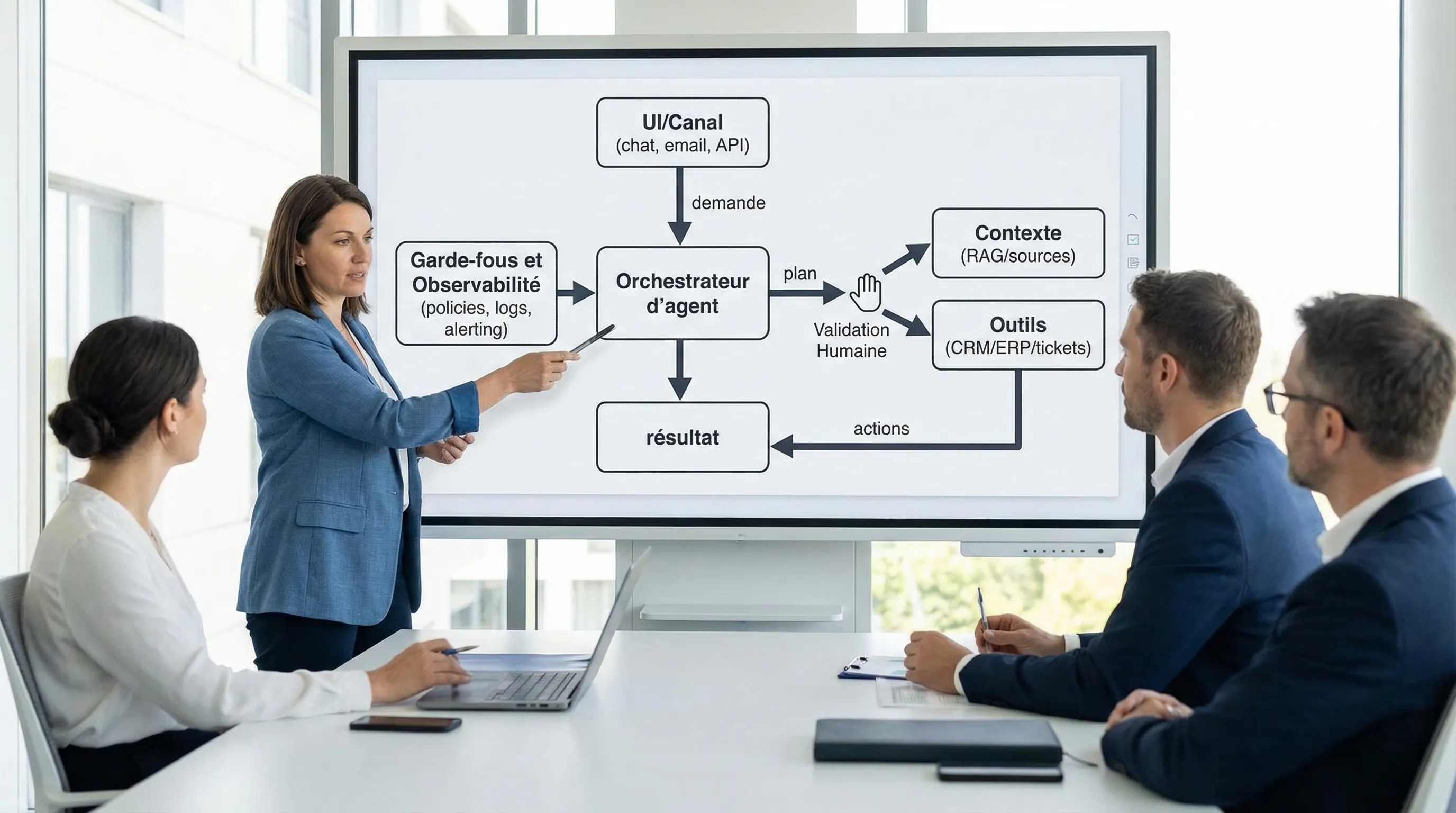
A robust agent architecture is thought of as a mini-platform: the agent orchestrates, but tools, data, and guardrails remain separate. This reduces vendor lock-in, facilitates testing, and avoids coupling your business logic to prompts.
Policies, allowlists, PII filters, human validation
Observability
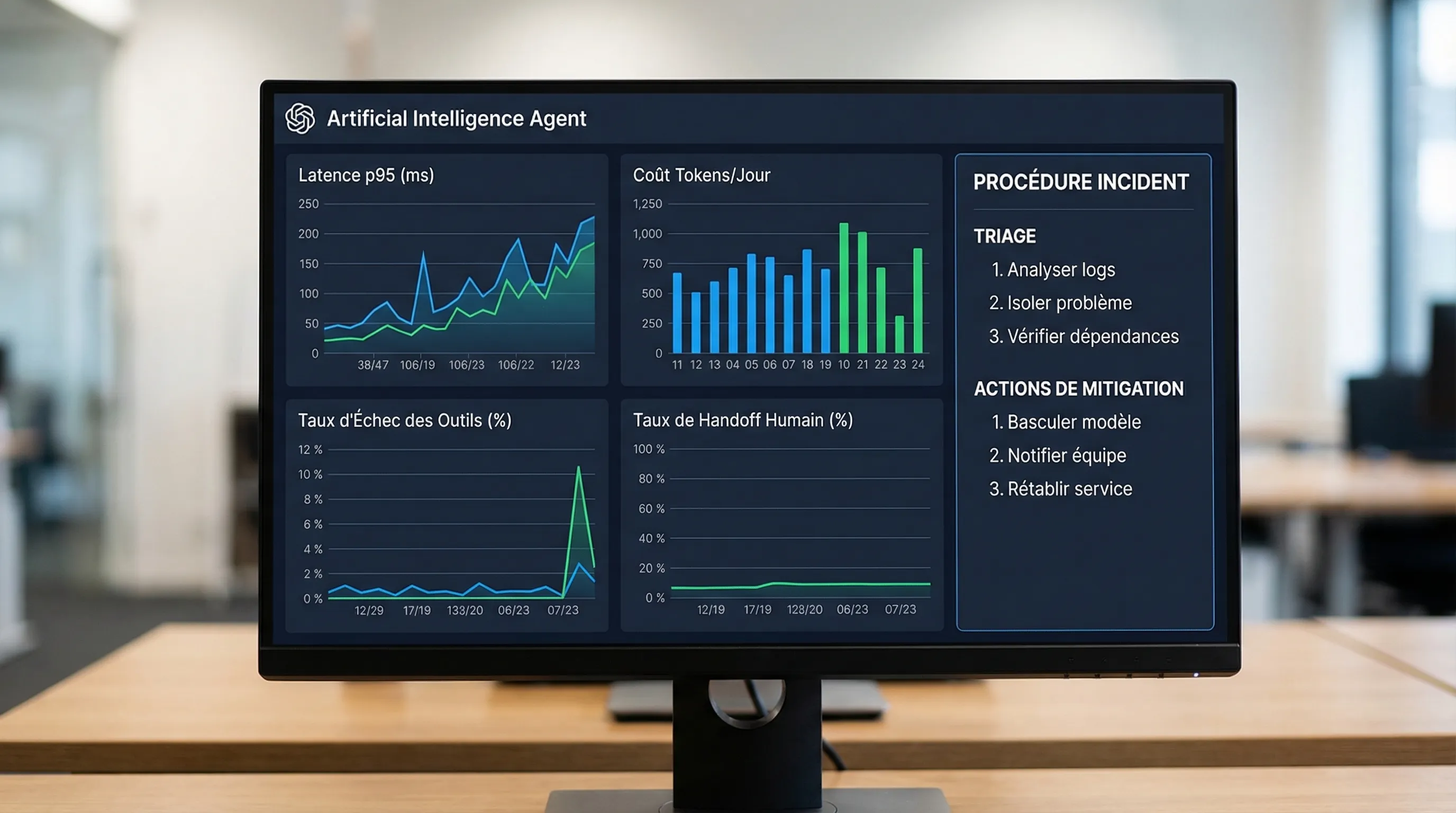
Logs, traces, quality and cost metrics
"Invisible" incidents, drift, spending
Two Rules That Simplify Everything
Rule 1: Separate "reasoning" and "acting". The agent can propose a plan, but execution must go through tooled functions with strict contracts (schemas, validations, rights). This limits free-form outputs and secures actions.
Rule 2: Everything that costs or breaks must be measured. Tokens, latency, tool failure rates, "human handoff" rates, and policy refusal rates are not details. They are your future incidents.
Integrations: The Tipping Point Between Demo and ROI
In many organizations, the agent becomes profitable when it integrates with "hard" systems (CRM, helpdesk, ERP) and reduces recurring friction: qualification, ticket creation, opportunity updates, follow-ups, standard request resolution.
If your context resembles a mid-market company or scale-up with a structuring ERP (e.g., NetSuite), look at integration- and ROI-oriented approaches, like those highlighted by a managed services firm specializing in AI and ERP: AI & NetSuite consulting for the mid-market. The interest here is not the "tool," but the discipline: short cycles, clean integrations, and ROI management.
3) Testing Strategy: What is Specific to Agents (and What Isn't)
An agent is a non-deterministic system, connected to tools, exposed to adversarial inputs, and with variable costs. Your tests must therefore cover:
Useful security reference: the OWASP initiative dedicated to LLMs (injection risks, data leakage, tool abuse) is a good starting point for structuring your test scenarios.
The goal is not "to have an agent," but to have an operable agent.
Frequently Asked Questions
What is the difference between an AI agent and a copilot? A copilot assists the user (suggestions, drafting, research). An agent executes steps and can trigger tooled actions. The more it acts, the more architecture, tests, and runbooks become indispensable.
What are the non-negotiable elements of an AI agent architecture in production? A clear separation between orchestration, context (RAG), tool connectors, guardrails (policies), and observability. Without this separation, you lose testability and risk control.
How do you test an AI agent if its answers aren't deterministic? With a golden set of scenarios, scorecard metrics (utility, accuracy, security), deterministic tool tests (mocks, contract tests), and validation in a controlled pilot before progressive production.
What must an AI agent runbook absolutely contain? SLOs, degraded modes, incident procedures, a rollback mechanism (prompts, rules, index, connectors), and a source maintenance plan (RAG).
Which metrics should be tracked to avoid surprise costs? Cost per session and per task, tokens per step, p95 latency, loop/retry rates, and tool failure rates. Set a budget and limits per user or per workflow.
When should you move from a pilot to full production? When the scorecard reaches an acceptable threshold on quality, security, tool reliability, and costs, with an operational runbook and a clearly identified business owner.
Need a Truly Operable AI Agent (Not a Demo)?
Impulse Lab accompanies SMEs and scale-ups across the entire chain: AI opportunity audit, custom development (web and AI), automation and integrations, and adoption training. If you want to frame an agent-ready use case, define a testing protocol, and deliver an instrumented V1 in short cycles, you can contact us via Impulse Lab.
Behind the search for 'AI today', business leaders ask a concrete question: which tasks can actually be delegated to AI, and with what level of control? The answer goes far beyond writing text. AI can extract data, analyze images, classify requests, and take action in software.