AI bot: definition, use cases, and limits for SMEs
automatisations
Intelligence artificielle
Stratégie IA
Outils IA
Productivité
We hear "AI bot" everywhere, but for SMEs, it covers different realities. From simple FAQ bots to internal assistants and agents triggering CRM actions, the autonomy, risks, and ROI vary greatly. This guide clarifies definitions, use cases, and limits for a pragmatic approach.
We hear "AI bot" everywhere, but the term covers very different realities in SMEs. Between the simple support bot answering a FAQ, the internal assistant connected to your procedures, and the agent capable of triggering actions in your CRM, the level of autonomy, risks, and ROI are completely different. This guide clarifies the definition, concrete use cases, and limits of an AI bot, with a pragmatic, production-oriented reading.
AI bot: definition (simple, but operational)
An AI bot is software that interacts (often in natural language) and uses AI techniques to understand an intent, produce a response, and sometimes execute an action (create a ticket, update a CRM, generate a document, launch a workflow).
In SMEs, the confusion comes from the fact that "bot" can designate three close but distinct families:
Chatbot: conversation-oriented, often limited to informing, guiding, qualifying (see also the Impulse Lab definition: chatbot).
AI Assistant: helps a human go faster (summarize, search, draft), often within a tool (email, internal chat, intranet).
AI Agent: goes further, it can plan and act, with a certain level of autonomy (see: AI agent).
In all three cases, the AI bot is useful when it is connected to context (your data) and connected to actions (your tools). Without these two connections, it remains a "text tool," impressive in demos but quickly disappointing in production.
How an AI bot works (without getting into theory)
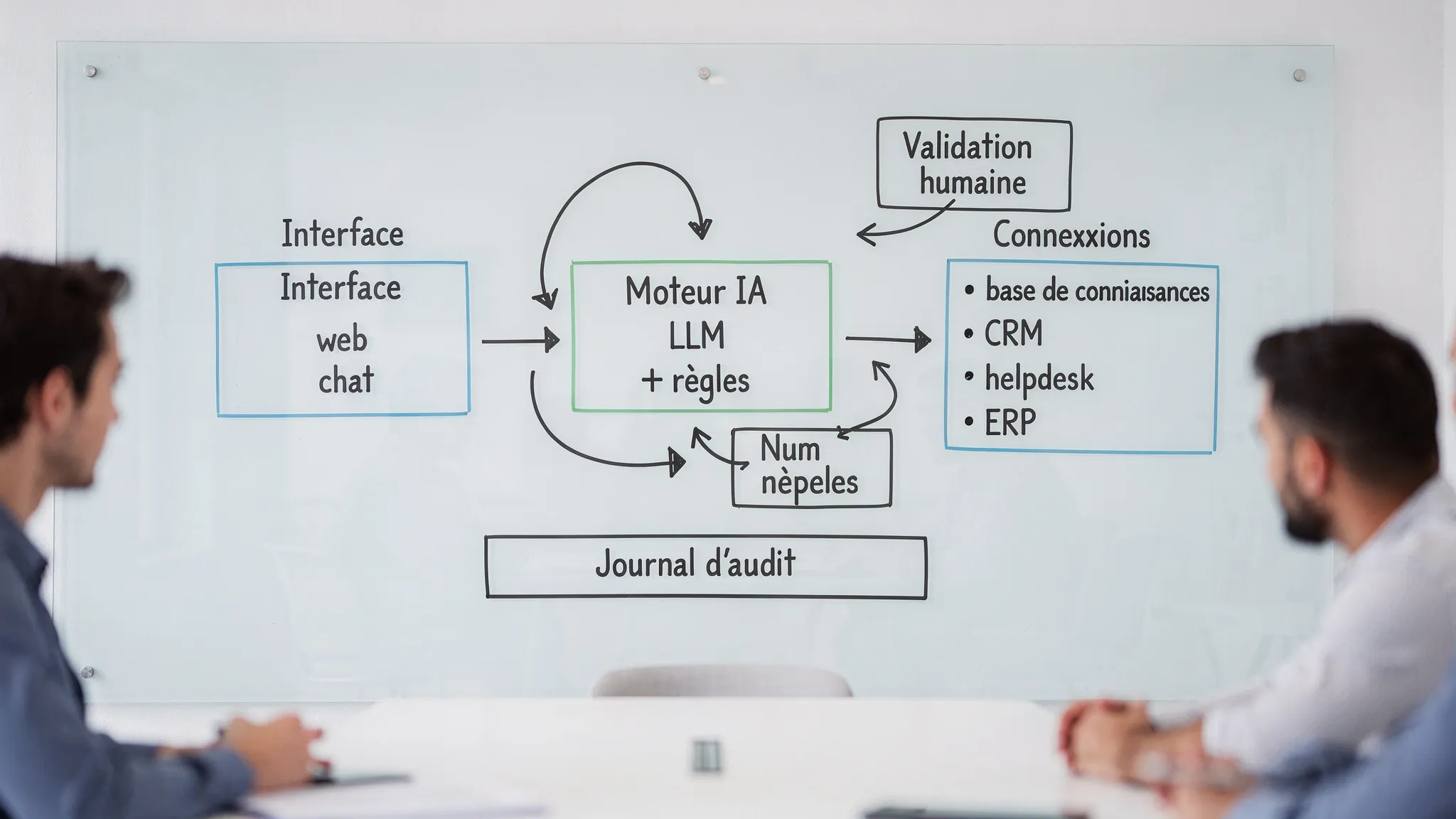
Most modern AI bots rely on an LLM (Large Language Model) that generates text. In a business setting, we avoid letting it "invent" by framing it via:
A knowledge base (FAQ, procedures, documents) and often a RAG (retrieval-augmented generation) mechanism that retrieves relevant passages before answering (see: RAG).
Rules (guardrails) to frame the tone, scope, and forbidden cases.
Integrations (CRM, helpdesk, ERP, Slack/Teams) to read and write in your systems.
Observability (logs, metrics, evaluations) to measure and correct.
In practice, the bot often follows this cycle:
Understand the intent and detect constraints (language, urgency, sensitive data).
Search for context (internal documents, client file, order status, etc.).
Generate a response (with citations or sources when necessary).
Propose an action or execute it (depending on your acceptable level of autonomy).
Record and measure (to improve quality and security).
The different types of AI bots in SMEs (and what that implies)
The right reflex is to classify bots by level of autonomy, not by "wow factor".
Type of AI bot
Main objective
Autonomy level
SME Example
Dominant risks
When it's a good choice
"FAQ" Bot (support)
Answer frequent questions
Low
Hours, delivery, returns
Inaccurate answers, bad UX
Volume of repetitive questions and stable content
"Knowledge" Bot (RAG)
Answer relying on your docs
Medium
Internal procedures, L1 support
Poor retrieval, obsolete documents
You have a usable document base
Transactional Bot
Perform a simple action
Medium
Create a ticket, qualify a lead
Write errors, access rights
Very framed use case, APIs available
Agent (semi-autonomous)
Chain tasks and decisions
High
Follow-ups, file preparation, request sorting
Unwanted actions, drift, compliance
You can accept a human-in-the-loop
Agent (autonomous)
Most successful SMEs start with a RAG + rules + human handoff bot, then increase autonomy in stages.
7 concrete AI bot use cases that "work" in SMEs
The goal is not to have an "intelligent" bot, but a bot that reduces a cost, increases revenue, or reduces a risk, with simple metrics.
1) Customer Support: offload Level 1 without degrading the experience
An AI bot can handle repetitive requests (tracking, returns, invoices, access), and switch to a human as soon as:
On a website, a bot can capture intent (pricing, compatibility, deadlines), filter out-of-target requests, and collect key elements for a salesperson.
The key point: do not invent. If your offer has exceptions or contractual complexity, the bot must answer cautiously or propose a human handover.
3) Internal Assistant: find the right information in under 30 seconds
This is often the best "first AI bot" because:
data is internal
impact is cross-functional (ops, sales, HR, finance)
ROI is fast if documentation is scattered
Typical cases: "What is the reimbursement procedure?", "What is the standard clause for this type of contract?", "What is the status of this client in the CRM?".
4) Ops and back-office: automate repetitive tasks (with control)
A bot can prepare, pre-fill, classify, reconcile, then submit for validation. Examples:
invoice pre-sorting and field extraction
ticket synthesis and tag proposal
drafting standardized responses with variables
We are talking about AI-augmented automation here, not "blind" automation.
Pragmatic deployment in 30 days (without a "big project")
Here is a realistic approach for an SME, based on short cycles.
Week 1: frame a single use case, a single promise
Define:
a clear scope (20 to 50 questions or 1 workflow)
a user target (support, sales, ops)
3 KPIs maximum (time saved, resolution rate, escalation rate, satisfaction)
Week 2: prepare sources and rules
Concretely:
clean and structure 10 to 30 key documents
write "never do" rules
define the handoff (when to switch to a human)
Week 3: integrate and instrument
This is the "value" week. The bot must:
be in the right channel (site, Slack/Teams, back-office)
be connected to the vital minimum (helpdesk/CRM)
trace conversations in a way compatible with your data rules
Week 4: test, red-team, adjust, launch pilot
Objective: a limited, measured, iterative pilot.
test on real cases
correction of knowledge gaps
optimization of the user journey
What SMEs underestimate most often
The quality of the knowledge base: if your docs are obsolete, the bot will be obsolete.
Governance: who validates content, who arbitrates risks, who decides on evolutions.
Run cost: monitoring, improvement, updates, access management.
An AI bot is a living product, not an "install once" plugin.
Frequently Asked Questions (FAQ)
Are an AI bot and a chatbot the same thing? No. "Chatbot" mainly describes the conversational interface. "AI bot" is broader; it can be conversational, but also execute actions, integrate with tools, and sometimes function as a semi-autonomous agent.
What is the best first AI bot for an SME? Often, an internal search assistant (RAG) or Level 1 support bot, because the scope is clear, gains are visible, and risks are well-managed with guardrails.
What are the main limits of an AI bot in business? False answers (hallucinations), confidentiality (GDPR), security (prompt injection), IS integration (last mile), and team adoption.
Is custom-made necessary? Not necessarily. Many SMEs start with a market tool. Custom-made becomes relevant when you need specific integrations, fine control (rights, logs, workflows), or a UX truly adapted to your processes.
How to make an AI bot more reliable? By connecting it to mastered sources (RAG), adding refusal and escalation rules, testing on a set of real questions, and instrumenting quality metrics (resolution rate, errors, escalations).
Moving from a "demo bot" to a useful (and measurable) AI bot
If you are considering an AI bot for your SME, the most profitable approach is often to start with a short framing: single use case, available data, risks, integrations, KPIs, and pilot plan.
Impulse Lab supports SMEs and scale-ups via AI opportunity audits, adoption training, and custom development (web, AI, automation, integrations), with a delivery-oriented logic.