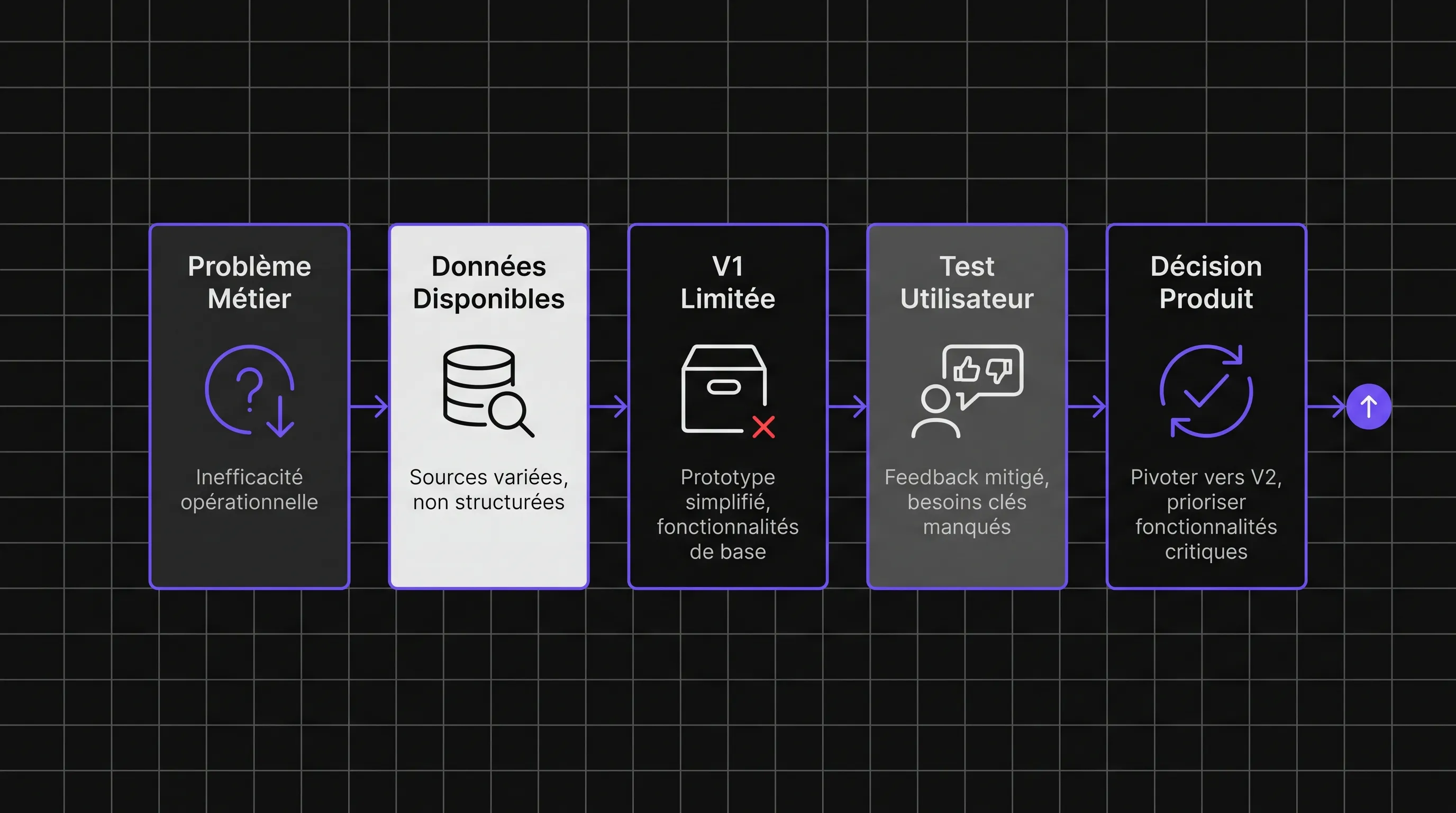
AI Development: Choosing a Useful V1 Before Writing Code
Intelligence artificielle
Stratégie IA
Productivité
Gestion de projet IA
Optimisation
The costliest mistake in an AI project isn't choosing the wrong model—it's coding too early. Many teams search for 'ai dev' with an idea, then jump straight to building. A useful V1 starts before the code by asking: what business behavior must change after delivery?
The most expensive mistake in an AI project isn't choosing the wrong model—it's coding too early. Many teams type "ai dev" into Google with an idea in mind—automating a process, creating an internal assistant, connecting an LLM to their data—and then jump straight to the solution. A useful V1 starts before the code, with a simple question: what business behavior needs to change after delivery?
For an SME, a scale-up, or a growing team, this question protects budget, team energy, and project credibility. A first version doesn't need to be spectacular. It must solve a problem specific enough to be tested in real-world conditions, with identified users, available data, and an observable success criterion.
This is even more true with generative AI, where a demo can look impressive in a meeting without holding up under daily operational pressure. A useful V1 must therefore be judged on its actual usage, not on the perceived magic of a demo.
The AI Dev Method Starts with a Measurable Problem
Before talking about agents, chatbots, RAG, automation, or proprietary models, define the problem in business terms. A solid starting statement looks like this: “Today, the team spends too much time qualifying incoming requests, which slows down response times and causes routing errors.”
This framing has three advantages. It points to an existing process, exposes a concrete pain point, and keeps the solution open. At this stage, you don't yet need to decide whether the answer is an AI agent, classic automation, a web interface, or a combination of several building blocks.
The V1 must then translate this problem into an expected outcome. For example: reducing pre-qualification time, increasing the rate of correctly routed requests, or cutting down manual follow-ups. Without a metric, the project becomes an opinion. With a metric, it becomes a learning experience.
V1, POC, and Prototype: Don't Confuse Objectives
A prototype is used to explore an idea. A POC validates technical feasibility. A useful V1 aims to produce a limited but real business impact. In an AI dev approach, this distinction prevents transforming an experiment into a false production deployment.
A V1 isn't necessarily larger than a POC. It is often stricter. It requires a real user, a real workflow, representative data, and a clear decision to make at the end: continue, iterate, reduce scope, or stop.
Format
Core Question
Real User
Success Criterion
Prototype
Is the idea understandable?
Not always
Qualitative feedback
POC
Is it technically feasible?
Rarely essential
Demonstrated feasibility
Useful V1
Does it improve a real process?
Yes
Observed business metric
The best V1 is intentionally imperfect. It doesn't cover every edge case, doesn't handle every exception, and doesn't pretend to replace a team. It proves adoption within a defined scope.
The 5 Criteria of a Truly Useful AI V1
A useful V1 is selected using a simple framework. It must deliver enough value to justify development, yet remain low enough in complexity to be shipped quickly and tested without disrupting the organization.
A High-Frequency Use Case
A monthly use case is rarely a good starting point. AI becomes valuable when it applies to a recurring action: processing incoming emails, summarizing meeting notes, verifying documents, drafting responses, categorizing tickets, or enriching CRM records.
High frequency enables rapid learning. If the team uses the V1 every day, feedback comes naturally. If they use it once a quarter, you risk spending weeks building a tool whose value no one can properly judge.
Accessible and Representative Data
Data doesn't need to be pristine, but it must be accessible, usable, and close to reality. Proper AI dev scoping identifies useful sources early on: knowledge bases, support tickets, CRM, ERP, shared files, structured emails, or business exports.
Access isn't the only issue. You need to know whether the data is up to date, contains sensitive information, is consistent across tools, and whether the AI can cite or trace what it uses. A V1 that answers without clear sourcing may charm users at first, only to lose their trust at the first major hallucination or error.
A Clearly Identified User
“The teams” is not a user. “The three Tier 1 support agents who qualify incoming requests every morning” is a user. The more precise the internal persona, the simpler the V1 will be to design.
This level of clarity helps select the interface. Sometimes, a new standalone application is appropriate. Often, an integration into an existing tool is enough: Slack, Teams, a CRM, a back office, or a shared inbox. The goal is to bring AI into the existing workflow rather than forcing new habits.
An Actionable Decision or Output
A useful AI V1 shouldn't just produce “text.” It must help make a decision or trigger an action: classify a request, draft a response, flag a risk, generate a reviewable draft, extract fields, or create a task.
This requirement changes everything. A generic summary is hard to evaluate. A summary that enables a sales rep to prepare for a meeting in five minutes is measurable. A vague AI answer is risky. A suggested response complete with sources, confidence score, and human validation becomes operational.
A Simple Feedback Loop
Your V1 must learn from usage, even if the model doesn't automatically retrain. In an AI dev project, the feedback loop can be very simple: thumbs up/thumbs down button, error reason, manual correction, user comment, or a weekly review of edge cases.
Without a feedback loop, you won't know if results are improving. You'll just accumulate subjective, often contradictory impressions. With a clear loop, every week of testing produces concrete decisions regarding prompts, data, interface, business logic, or scope.
A Scoring Matrix to Choose the Right V1
To avoid subjective debates, score each V1 idea across five dimensions. The goal is not mathematical certainty, but making trade-offs explicit.
Criterion
Question to Ask
Low Score
High Score
Business Value
What concrete gain is expected?
Marginal convenience
Impact on time, quality, or revenue
Frequency
How often does the use case occur?
Occasional
Daily or weekly
Data
Is the required information available?
Scattered or unreliable
Accessible and representative
Integration
Where will the user work?
New forced workflow
Existing, familiar tool
Risk
What happens if an error occurs?
Uncontrolled critical impact
Human-in-the-loop validation possible
An idea with high value, high frequency, and manageable risk is often an ideal candidate. Conversely, a high-visibility idea that is rare, vague, or relies on poorly maintained data risks burning significant effort for very little learning.
This matrix complements a broader evaluation of whether to choose off-the-shelf software or custom development. If you're debating whether to buy a tool off the shelf or build your own, this guide on deciding whether custom AI development is justified helps lay out the right criteria before committing your team.
Reducing Scope Without Sacrificing Value
A useful V1 is not a stripped-down, inferior version; it is a focused version. To reduce scope, don't cut arbitrarily. Protect core value and remove whatever slows down rapid testing.
You can narrow down an initial version by user type, data source, language, category of requests, level of automation, or integration channel. For instance, instead of creating an assistant that answers all customer inquiries, start with an internal tool that drafts responses for a single ticket category, with mandatory human sign-off.
In an AI dev mindset, the right question is not “what can we automate?” but “what part of the workflow can we augment without creating disproportionate risk?” This distinction avoids overambitious V1s that promise full autonomy when the organization primarily needs a reliable co-pilot.
Here are scope reductions that are often effective:
Shift from automated actions to human-approved suggestions.
Limit testing to a pilot team rather than company-wide.
Start with a single, highly reliable documentation source.
Handle standard cases and explicitly exclude edge cases.
Measure time saved before targeting total cost reduction.
This approach yields a V1 that is faster to deliver, easier to secure, and simpler to iterate on.
Establishing Guardrails Before the First Line of Code
Guardrails shouldn't be tacked on at the end; they are part of the core product. For a V1, the most critical guardrails cover privacy, human-in-the-loop validation, traceability, and fallback behavior when facing uncertainty.
NIST offers an AI risk management framework with its AI Risk Management Framework, which is helpful for structuring questions of reliability, governance, and control. In France, the CNIL also publishes resources on AI and data protection, particularly to help organizations address compliance and the handling of personal data.
In practice, a V1 should clearly specify what the AI is permitted to do, what it must never do, and when it must hand off to a human. This rule is especially critical in sensitive domains: finance, healthcare, HR, legal, high-stakes customer relations, or decisions impacting individuals.
A well-scoped AI dev project also documents acceptable failure modes. If the AI doesn't know the answer, should it ask for clarification, cite missing sources, alert a human, or decline the request? These behaviors must be established before user testing.
What the Team Must Validate Before Coding
Before opening an IDE or kicking off a technical sprint, bring together the stakeholders who know the process: business, operations, data, IT, and leadership if the stakes are strategic. A single well-structured scoping session can prevent weeks of misdirected development.
The expected deliverable is not a fifty-page specification document. It is a clear V1 one-pager usable by decision-makers and developers alike. It must answer key questions: problem, target user, current workflow, expected output, data sources, integration, risks, metrics, and exit criteria.
For companies looking to move beyond this scoping phase, connecting the V1 to a full production roadmap is essential. The article on the stages of artificial intelligence development details what to plan for next: architecture, costs, testing, security, and operations.
At this stage, the purpose of development is to bring a validated hypothesis to life. Code remains essential, but it is no longer the place to discover the problem—it is the tool used to test it properly.
Signs That a V1 Is Ready for Development
A V1 is ready when the team can explain in two minutes why it exists, who it is built for, and how success will be evaluated. If that explanation requires ten caveats, three major exceptions, and a long technical detour, the scope is likely still too vague.
The positive signals are straightforward: a pilot user agrees to test it, minimal data is accessible, primary risks are identified, a success metric is established, and the team knows what to do if the test fails. In that situation, coding becomes a rational investment.
Conversely, hold off on building if the project depends on non-existent data, if no one wants to take ownership of business testing, or if the value proposition relies mainly on a flashy demo. A useful V1 must survive Monday morning operations, not just the kickoff meeting.
FAQ
How long does it take to define a useful AI V1? For a well-defined use case, a few workshops are often enough to scope the problem, data, pilot user, and success criteria. Cross-functional initiatives take longer, especially if multiple tools or departments are involved.
Should you start with an AI chatbot? Not necessarily. A chatbot makes sense if the workflow is inherently conversational. Many of the most impactful V1s take the form of background automations, drafting assistants, classification tools, data extractors, or integrations into existing software.
What metric should you choose for an initial V1? Choose a metric closely tied to day-to-day work: time saved per task, error rate, processing turnaround time, human acceptance rate, pilot team satisfaction, or ticket throughput. A single primary metric is sufficient to start.
Does an AI V1 need to connect to internal tools from day one? If integration is required to test real-world adoption, yes. Otherwise, start simpler. The priority is to avoid an isolated tool that sits outside everyone's regular workflow.
How can you prevent an AI dev project from getting stuck in experimental purgatory? Define the decision criteria for the next step upfront: production rollout, iteration, scope reduction, or sunsetting. Without a predetermined exit or expansion trigger, experimentation can drag on indefinitely without creating clear value.
Turning an AI V1 into Business Value
Choosing a useful V1 before coding requires product discipline, not just technical expertise. That is where success is determined: starting with a concrete problem, scoping tightly, securing data, testing with real users, and measuring the impact on daily work.
Impulse Lab guides companies through this scoping phase, and then in developing custom web and AI solutions tailored to their workflows, with a strong focus on automation, seamless integration into existing software, and user adoption. If you want to take an AI idea and turn it into a testable first version, you can get in touch with Impulse Lab to map out the right starting point.
Responsible AI is not a luxury reserved for large enterprises. For an SME, it is a practical way to use AI without losing control over data, decisions, or costs. In 2026, leaders must balance risk management, team guidelines, and measurable business value.