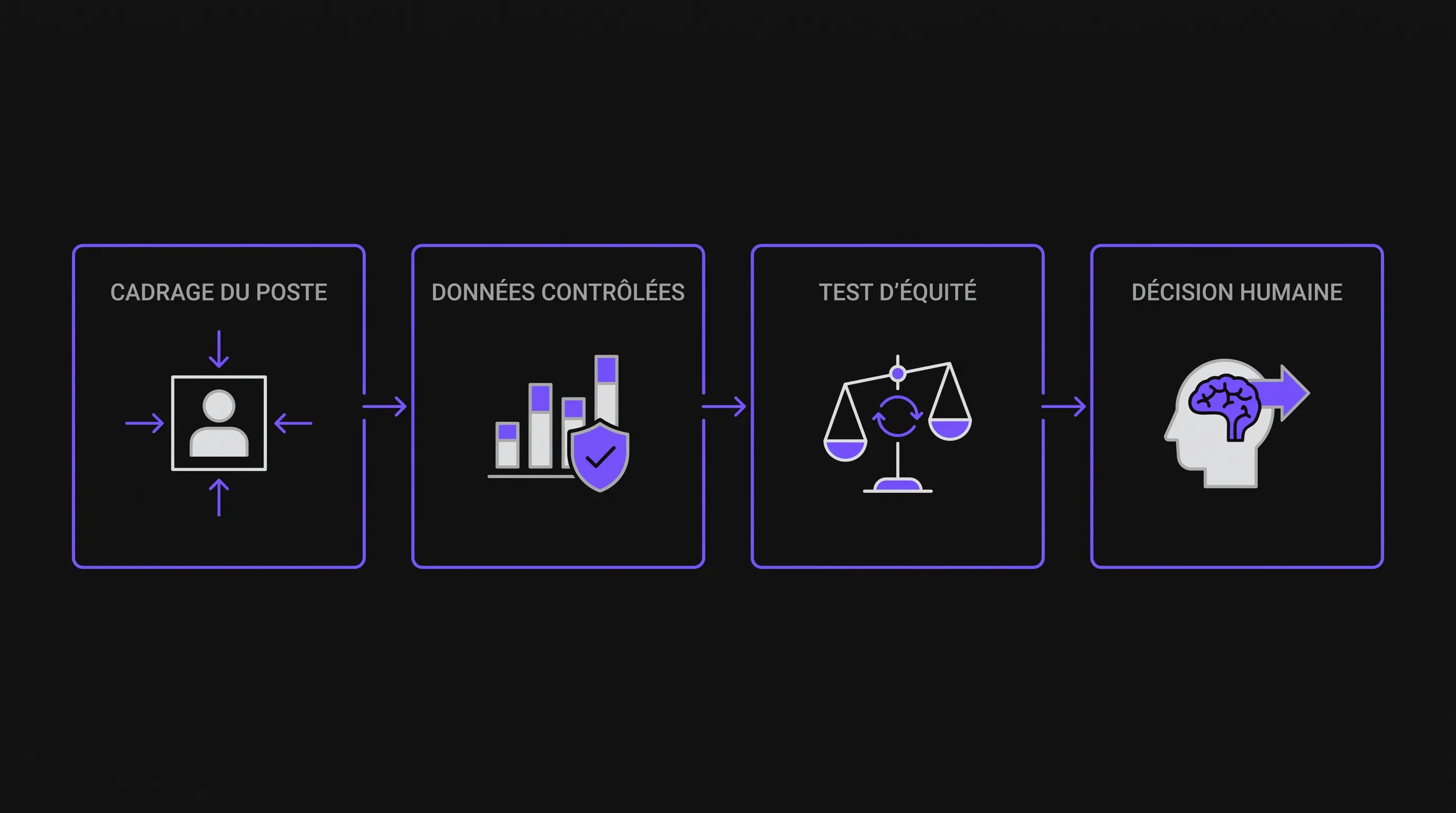
AI in Recruitment: How to Mitigate Bias from the Outset
Intelligence artificielle
Stratégie IA
Gouvernance IA
Gestion des risques IA
AI in recruitment can streamline candidate screening, but risks reinforcing existing biases. Discover actionable strategies to set up objective scorecards, minimize proxy data, and establish human-in-the-loop governance to build a fair, compliant hiring process from day one.
septembre 27, 2026·10 min de lecture
AI-powered recruitment can help an SME or scale-up handle higher application volumes, reduce repetitive tasks, and structure its decision-making. However, if the project kicks off with vague criteria, incomplete historical data, or an over-reliance on the software, AI can easily amplify biases already present within the organization.
Mitigating these biases isn't about magically finding a "neutral" tool. Above all, it requires designing the process before automating it, deciding what the AI is allowed to influence, and documenting human oversight. For a broader overview of operational benefits and limitations, check out Impulse Lab's article on the real gains and risks of artificial intelligence in recruitment.
The goal here is much more targeted: implement anti-bias safeguards right from the start—before vendor selection, before prompt engineering, before ATS integration, and before recruiters form new habits that are difficult to break.
Biases Begin Before the Tool
A recruitment AI doesn't invent criteria on its own. It learns from data, rules, guidelines, or signals provided by both the company and the software vendor. If past hiring decisions unconsciously favored specific degrees, elite schools, certain résumé phrasing, or traditional linear career paths, the tool can turn these habits into seemingly objective recommendations.
AI recruitment becomes risky when teams confuse speed with decision quality. The issue isn't merely technical; it's managerial: who defines what makes a good candidate, using which criteria, and with what level of evidence? Without clear answers, AI often optimizes for what can be easily measured—not necessarily for what is fair or relevant to the role.
The Three Types of Bias to Address
Biases aren't limited to blatant, direct discrimination. They often stem from poorly scoped business criteria, proxy variables, or over-reliance on the automated scoring generated by the tool.
Type of Bias
Common Source
Real-world Risk
Effective Prevention
Criteria Bias
Vague job description, poorly defined "culture fit"
Favoring profiles that simply mirror the existing team
Outline observable skills and clear expected proficiency levels
Data Bias
Skewed or unbalanced hiring history
Repeating questionable past decisions
Audit data before use and eliminate non-relevant variables
Usage Bias
Treating the AI score as a final decision
Discarding non-traditional or atypical candidates too quickly
Maintain a structured, documented human review step
Define the Role Before Choosing the Tool
The first line of defense is defining the hiring requirement without implicit references to an overly narrow "ideal" profile. A skills-focused job description must clearly distinguish between what is essential on day one, what can be learned within three months, and what merely reflects an internal preference.
Before deploying AI-driven recruitment, formalize an evaluation rubric that serves both recruiters and the algorithm. This rubric should focus on criteria directly tied to the actual work—such as proficiency in a specific technical environment, experience handling targeted client scenarios, or familiarity with a comparable sales cycle. It must deliberately exclude weak proxy signals that create noise, such as school prestige when the role doesn't require it.
Build a Simple Scorecard
An effective scorecard doesn't need to be complicated. For each criterion, state the targeted skill, the expected evidence in the résumé or interview, and the necessary standard of proof. For example, "has managed an end-to-end CRM implementation" is far more actionable than "structured profile."
This discipline mitigates bias at the source. It also makes AI configuration much more straightforward, as instructions fed into the system remain anchored in role requirements rather than subjective impressions.
Control the Data Entering the System
In AI-driven recruitment, input data carries immense weight. Inputs might include résumés, cover letters, questionnaire responses, interview notes, ATS data, or historical applicant records. As volume scales, the risk of capturing noise and unintended signals increases.
The safest rule is data minimization. Only feed the AI information strictly necessary to evaluate the candidate for the role. Exact home address, age, family status, photos, or overly personal information have no place in application scoring. Even when not factored in directly, certain variables can act as proxies, indirectly influencing the recommendation.
Anonymization can help, but it is not a silver bullet. A first name, educational trajectory, career gap, or zip code can still produce indirect bias. The most robust approach combines partial anonymization, tightly defined job criteria, and systematic human oversight on critical decisions.
Configure AI Recruitment with Built-in Safeguards
Selecting or configuring the tool should be treated as an architectural decision, not a standard software purchase. The European AI Act classifies many recruitment-related AI applications as high-risk systems, particularly when used to analyze, filter, or evaluate candidates. Applicable obligations depend on the specific roles of the company and vendor as well as the exact use case, but the takeaway is clear: automated hiring requires governance.
To safeguard an AI recruitment initiative, ask the vendor or your technical team the right questions before integration:
What specific data points are used to generate the score or recommendation?
Can sensitive criteria or variables be easily disabled?
Are there comprehensive decision logs available for audit purposes?
Can a recruiter clearly explain the primary factors behind a given recommendation?
How can candidates obtain transparent information regarding the use of AI?
Addressing these questions early prevents a common pitfall: discovering too late that the tool operates as an unexplainable "black box" impossible to defend to candidates, hiring managers, or your DPO.
Test Before Rolling Out to Production
Testing an AI recruitment setup before running live candidate applications exposes the most visible deviations. Testing shouldn't merely verify that the tool "works" technically; it must confirm that recommendations remain consistent when irrelevant variables fluctuate.
A practical method involves creating synthetic candidate profiles. Keep the core competencies identical while altering secondary information like first name, location, résumé formatting, or the chronological order of experiences. If the score shifts drastically without a role-related reason, the configuration needs fine-tuning.
Test to Conduct
Core Question
Red Flag
Corrective Action
Equivalent Synthetic Cases
Do two similar profiles receive comparable scores?
Significant divergence without job-related justification
Refine criteria and prompt parameters
Phrasing Variations
Does the résumé's writing style heavily impact the score?
Unfair bonus awarded to highly polished or templated résumés
Place greater weight on verifiable achievements
Blind Human Review
Does the recruiter concur with the proposed ranking?
Frequent or unexplained disagreement
Tune the model or restrict its scope
Rejection Analysis
Do rejected profiles possess overlooked strengths?
Atypical candidates consistently penalized
Introduce a mandatory manual review step
Exercise caution when measuring bias, however. In France and across the European Union, collecting sensitive personal data is strictly regulated. Avoid compiling tracking spreadsheets covering ethnic origin, health status, or other protected characteristics without a clear legal basis and proper guidance. Stay pragmatic: rely on synthetic test cases, operational metrics, and qualitative decision audits.
Establish Human Accountability
AI recruitment must never eliminate recruiter accountability. Its purpose is to assist in prioritizing, summarizing, comparing, or surfacing insights, but the final decision must remain explainable by an identified human being. The primary risk arises when the automated score turns into the default truth.
In practice, a time-pressed recruiter will often follow the tool's ranking—especially if presented through a clean, persuasive dashboard. To counter this automation bias, enforce a simple rule: every rejection automated or assisted by AI must be justified by at least one verifiable requirement on the scorecard.
Document Without Slowing Down Hiring
Documentation doesn't have to bog down the team. It primarily needs to cover core elements: the tool's intended purpose, criteria used, the exact role of AI, the level of human intervention, accountable stakeholders, and the dispute or reassessment procedure.
On the personal data front, compliance must be integrated by design. Foundations include candidate notices, data minimization, retention schedules, access rights, and rules around automated decision-making. For a deeper dive into this area, refer to the GDPR compliance checklist for AI recruitment as an operational guide.
Implement an Anti-Bias Routine for SMEs and Scale-ups
To keep AI-powered hiring under control, monitoring must continue well after deployment. An effective HR AI initiative is never static; it evolves alongside shifting roles, changing job markets, application volume swings, and recruiter feedback.
For an SME or scale-up, this routine can stay lightweight. The key is establishing a recurring checkpoint between HR, hiring managers, data/tech leads, and the DPO if applicable. Monthly at first, then quarterly, the team should review divergences between AI suggestions and human hires, overall candidate quality, applicant feedback, and instances where the tool's recommendation was overridden.
Key Metrics to Monitor
A few targeted indicators are enough to catch drift without over-engineering your operations:
Acceptance vs. rejection rate of AI recommendations by recruiters
Number of decisions overturned following appeal or second review
Percentage of non-traditional candidates retained through pre-screening
Unexplained score variances across equivalent synthetic profiles
Qualitative manager feedback regarding the relevance of submitted shortlists
While these metrics alone do not guarantee the total absence of discrimination, they create a solid framework for discussion, continuous improvement, and auditability—elements often missing in hastily launched AI projects.
Mistakes to Avoid from the Start
A few common traps frequently derail HR AI initiatives. The first is automating an unstable process. If hiring managers haven't agreed on what standard of competence looks like, AI won't solve the issue; it will simply accelerate ambiguity while obscuring it.
The second mistake is prompting AI to evaluate overly vague concepts, such as "potential," "personality," or "culture fit," without explicit operational definitions. These terms often mask subjective preferences and unfairly penalize profiles that don't match the company's existing demographic.
The third mistake is deploying the software across the entire hiring lifecycle on day one. It is much wiser to start with an assisted, tightly bounded use case—such as drafting résumé summaries or checking profiles against a structured scorecard—before expanding based on field feedback and testing.
FAQ
Can AI truly eliminate recruitment bias? No. It can reduce certain biases when the process is thoughtfully structured, but it can just as easily amplify others. The real goal is making criteria explicit, decisions auditable, and human oversight systematic.
Should all résumés be anonymized before AI processing? Anonymization helps, particularly at initial screening, but it isn't sufficient on its own. Career trajectories, vocabulary, or past locations can still act as indirect proxies. It must be paired with an objective evaluation rubric and human review.
Can an AI score automatically reject a candidate? This is strongly discouraged and legally sensitive in many jurisdictions. Any decision with a significant impact on an individual should remain explainable, verified by a human, and fully compliant with data protection laws.
Where should a small HR team start? Start by scoping a single use case—such as screening assistance for a recurring, high-volume role. Formalize the scorecard, run synthetic test cases, and evaluate deviations between AI recommendations and human evaluations over a trial period of several weeks.
Need to Secure Your HR AI Project?
Mitigating bias isn't just about selecting the right software. It demands functional scoping, technical guardrails, transparent governance, and team buy-in.
Impulse Lab supports growing businesses with AI opportunity audits, team enablement training, and custom web and AI development. If you are planning to automate parts of your hiring process, start by auditing your existing workflow before plugging in a new tool.
Intelligence artificielle responsable : le guide PME
L’intelligence artificielle responsable n’est pas un luxe réservé aux grands groupes. Pour une PME, c’est une façon concrète d’utiliser l’IA sans perdre le contrôle sur les données, les décisions, les coûts ou la relation client. En 2026, les dirigeants n’ont plus seulement à se demander si l’IA peu...