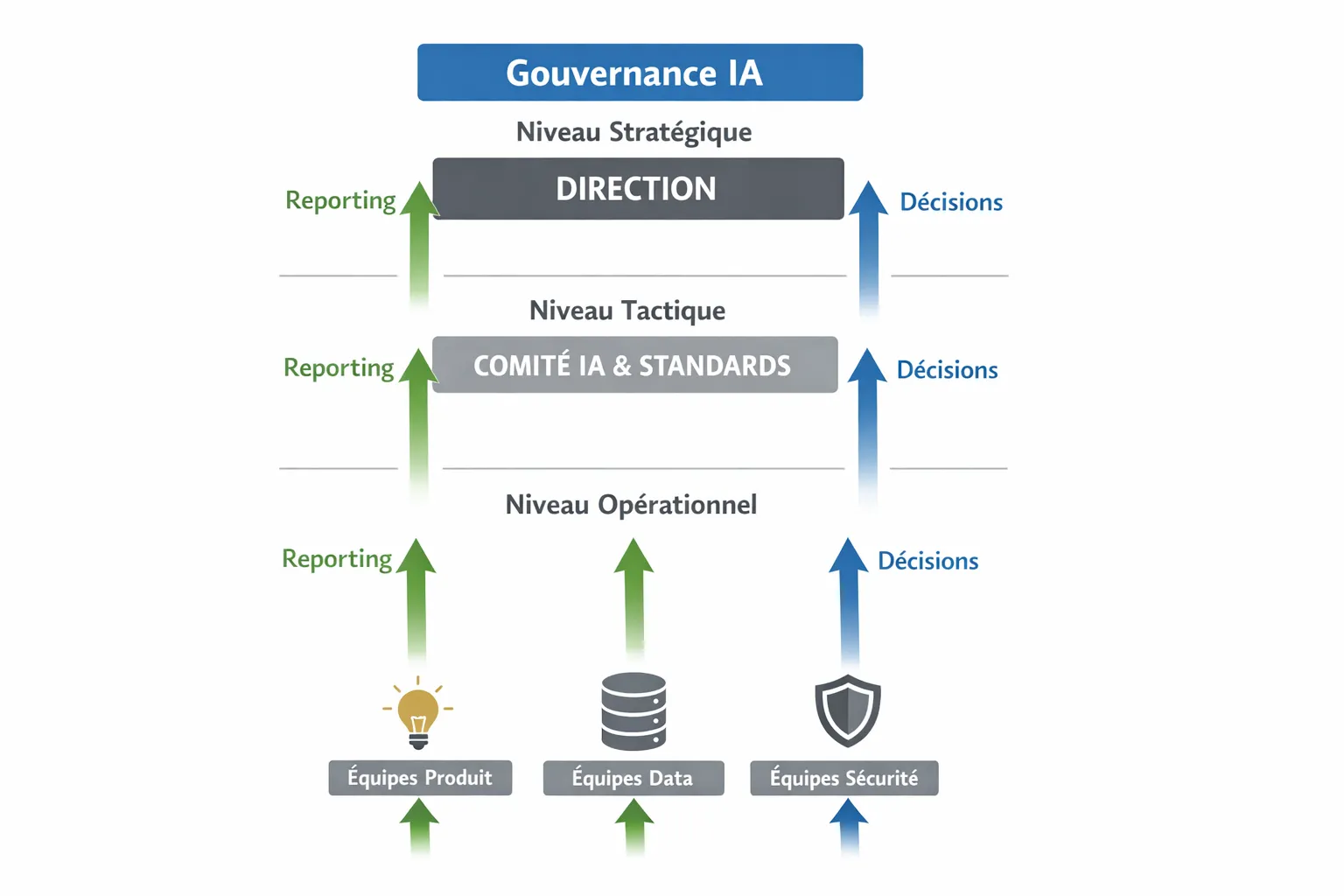
AI Organization: Roles, Governance, and Responsibilities
Intelligence Artificielle
Stratégie IA
Gouvernance IA
Gestion des risques IA
When a company "does AI," it often launches scattered initiatives (support chatbot, marketing writing tool, ops automation pilot) without a common framework. As a result, teams save a little time here and there, but the organization takes risks...
January 06, 2026·9 min read
When a company "does AI," it often launches scattered initiatives (a support chatbot, a marketing writing tool, an ops automation pilot) without a common framework. As a result, teams save a little time here and there, but the organization takes risks (data, compliance, quality) and struggles to industrialize.
A solid AI organization solves this problem by clarifying three things: who decides, who executes, and who is responsible in case of error. In this article, we propose a concrete model, adapted to SMEs and scale-ups, to structure roles, governance, and responsibilities around AI.
AI Organization: What are we (really) talking about?
"AI organization" isn't limited to hiring a Data Scientist or buying an LLM subscription. It is a company's ability to manage AI as a product and as a risk, with:
a usage strategy (where AI creates value, where it doesn't)
Without this layer, you have POCs, but not reliable AI capability.
The 4 AI organization models (and when to choose them)
There is no single "right" organization. The right model depends on your size, your data maturity, and your execution speed.
Model 1: Centralized (AI Center of Excellence)
A central team (often small) defines standards, develops, and serves the business lines.
Advantage: consistency, security, pooling
Limit: bottleneck if demand explodes
Model 2: Decentralized (every team fends for itself)
Each department chooses its tools and use cases.
Advantage: local speed
Limit: chaos, risks, costs, duplications
Model 3: Federated (AI referents per team)
A central core sets the rules, and AI referents exist in each team.
Advantage: balance between speed and consistency
Limit: requires strong animation and training
Model 4: Product-oriented hybrid (AI products)
You treat AI as a range of internal products: "support assistant," "sales copilot," "finance automation," each with an owner.
Advantage: excellent for industrializing and measuring ROI
Limit: requires product discipline and well-defined KPIs
For SMEs and scale-ups, the federated or hybrid model is often the most pragmatic.
Key roles in an AI organization (with responsibilities)
The classic mistake is thinking that "the tech team" is responsible for everything. In reality, AI involves decision-making, data, processes, and compliance.
In a small structure, several roles can be held by the same person. The important thing is that responsibilities exist, even if they are not "full time."
The RACI matrix: the simple tool that avoids conflicts
To make the AI organization actionable, use a RACI matrix:
R (Responsible): does the work
A (Accountable): answers for it, validates
C (Consulted): consulted before decision
I (Informed): informed
Example of a minimalist RACI for common AI topics.
AI Activity
Sponsor
AI Lead
PO
Data Owner
Security
Legal/DPO
Engineering
Prioritize use cases
A
R
C
C
C
C
I
Validate data access
I
C
C
A
C
C
R
Choose a provider / model
A
R
C
C
A
C
R
Define KPIs and measurement plan
I
C
A
C
I
I
This table avoids "gray areas" like: "I thought it was up to you to validate."
Concrete artifacts of good AI governance
Effective governance is not just a committee. It relies on a few simple documents and routines.
AI Usage Charter (internal)
It sets the basic rules:
what data is prohibited in external tools
what uses require validation (e.g., client content, sensitive decisions)
how to report an incident
how to cite, verify, and proofread (especially for public content)
AI Use Case Register
A living table that lists:
business owner and product owner
expected value (KPIs)
risk level
status (idea, POC, pilot, prod)
data dependencies and integrations
"Model card" file or solution sheet (even for GenAI)
Even if you don't train a model, document:
the model and the provider
data used (inputs, sources, retention)
known limits and failure cases
quality tests, guardrails, and monitoring plan
Validation process before production
A light but serious "go/no-go":
functional tests and non-regression prompt sets
security check (secrets, access, logs)
legal check (data, clauses, subcontracting)
success KPIs and stop thresholds
If you work on integrations, you can rely on architecture and security best practices similar to those described in our article on clean and secure AI API integration patterns.
How to structure AI organization in an SME or scale-up (30-60-90 day plan)
The goal is to get a useful AI organization without slowing down.
Days 0 to 30: Clarify the decision and frame
Appoint a sponsor and an AI Lead (even part-time)
List 10 to 20 opportunities, then select 3 to 5 based on value and feasibility
Define the AI usage charter, version 1
Set up the use case register
At this stage, an opportunity and risk audit greatly accelerates prioritization. Impulse Lab offers AI audits precisely to map out the right bets, as detailed in our strategic AI audit approach.
Days 31 to 60: Build an "industrialization-ready" pilot
Choose 1 priority use case with a strong business owner
Set measurable KPIs (before/after)
Integrate into your tools, rather than staying on an isolated tool
Add guardrails, tests, and logging from the pilot stage
Formalize a monthly AI committee (30 minutes, written decisions)
Deploy internal training (by department) and sharing rules
Set up monitoring: quality, costs, adoption
Duplicate the pattern on 2 to 3 new use cases
This is also where culture and training become a scaling factor. On this point, our article on AI culture in 2026 complements the "organization" angle well.
Warning signs: when your AI organization is poorly structured
You can consider governance insufficient if:
no one knows who validated a tool or provider
the same use cases are developed twice in multiple teams
teams use sensitive data in external tools "by default"
you cannot explain why an AI system answers "like that"
API costs explode without correlation to created value
you have no incident plan (even a simple one)
In many scale-ups, the problem is not technical. It is a lack of explicit responsibility.
AI Organization and delivery: how to avoid the "blocking committee" effect
A common fear is that governance slows everything down. In practice, it accelerates things if you adopt two principles:
Standardize what needs to be, so as not to re-discuss the same topics (data rules, security, templates, go/no-go criteria)
Decide quickly on a clear scope, with identified owners
In Impulse Lab projects, we often find this compromise: clear scoping and governance, then iterative delivery. This aligns well with a weekly delivery approach and transparent management via a client portal, without overpromising on "magic AI."
FAQ
What are the essential roles to start an AI organization? A sponsor (to arbitrate), an AI Lead (to structure), a business owner (to validate value), and data, security, and legal representatives (even part-time). Without these responsibilities, AI projects remain isolated initiatives.
Should a "Head of AI" position be created as soon as AI is launched? Not necessarily. In SMEs, the role can be held by a CTO, a product manager, or a hybrid profile, as long as the person has the mandate to define standards and manage a portfolio of use cases.
How to avoid every team using its own AI tools without control? With a usage charter, a use case register, and purchasing and integration rules. The federated model works well: light central governance, and AI referents per team.
What is the difference between AI governance and data governance? Data governance focuses on data quality, access, definitions, and compliance. AI governance includes data, but adds the management of models, usage, risks, guardrails, monitoring, and product responsibility.
When to move from a POC to an AI solution in production? When you have a clear KPI, non-regression tests, security and compliance validation, and a monitoring plan. Without these elements, you risk industrializing an unstable prototype.
Need to structure your AI organization without slowing down your team?
Impulse Lab supports SMEs and scale-ups with AI audits, adoption training, and the development of custom web and AI solutions (automation, integrations, platforms). If you want to clarify your roles, establish pragmatic governance, and then deliver concrete use cases, you can contact us via Impulse Lab.