In 2026, SMEs don't need another "AI tool" or flashy POC. They need a useful **AI report**: a clear view of trends that matter, and an action list to turn AI into productivity, revenue, and risk reduction without exploding costs.
February 08, 2026·9 min read
In 2026, most SMEs no longer need yet another “AI tool” or a spectacular POC. They need a useful AI report: a clear reading of the trends that really matter, and above all, a list of actions that transform AI into productivity, revenue, or risk reduction, without exploding costs or complexity.
This report is written for executives and operational teams (CEO, Ops, Sales, Support, Finance, IT) who want to make quick decisions, deliver in short cycles, and maintain control (data, security, compliance, ROI).
What is an AI report for in 2026 (for an SME)
An effective AI report should not “predict the future”. It must help you make 3 pragmatic decisions:
Which trends will impact my execution in the next 6 to 12 months, not in 5 years.
Which use cases to prioritize (and which to refuse) to avoid the POC graveyard.
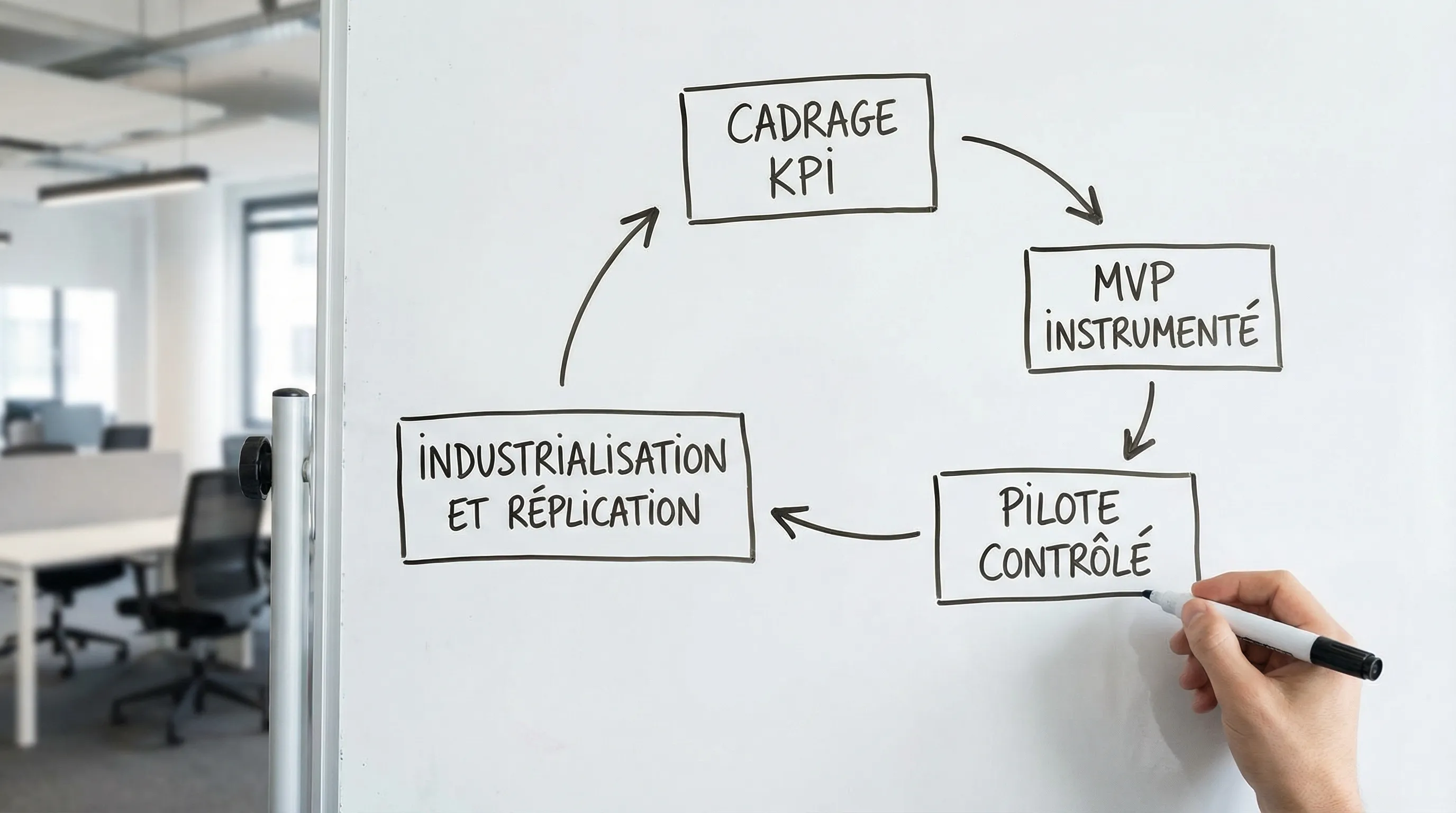
What action plan to adopt to move to production, with measurement, guardrails, and adoption.
If you had read an AI report in 2024, you would have mostly seen “GenAI”. In 2025, the topic was “industrializing” (and mastering costs, evaluation, compliance). In 2026, the shift is happening on a triptych:
Agents and automations integrated into tools, not isolated chats.
Data becomes your advantage (RAG, quality, traceability), more than the choice of model.
Governance becomes an accelerator, if it is proportionate and tooled.
To situate the evolution, you can also consult the previous 2025 AI Report (useful for the “move to production” basics).
AI Report 2026: 7 trends that really count
1) Models are becoming commodities, the advantage shifts to integration
In 2026, many teams can access high-performance LLMs. The difference is made elsewhere:
integration into tools (CRM, helpdesk, ERP, DMS, messaging)
orchestration (rules, tool calling, workflows)
quality and traceability (sources, citations, logs)
costs (routing, cache, batch, quotas)
SME Consequence: do not choose “a model”, choose a system that makes the use case measurable and actionable.
2) Agentic AI becomes useful… if you add guardrails
Agents (systems capable of chaining actions) are gaining ground, especially on semi-structured tasks: sorting, research, drafting, updating tools, preparing responses, pre-qualification.
But the “autonomous” agent without limits remains a risk (silent errors, irreversible actions, cost overruns). The 2026 trend is therefore the “guarded” agent:
3) MCP accelerates integrations, but governance must follow
The Model Context Protocol (MCP) pushes for standardization of connections between models/agents and external systems (tools, databases, tickets, docs). It is an accelerator because it reduces ad hoc integrations.
But this also increases the risk surface (access rights, data exposed to context, audit). The good news is that MCP encourages cleaner patterns regarding security and governance.
4) RAG becomes an enterprise standard, with continuous evaluation
RAG (retrieval-augmented generation) is no longer “a bonus”. It is the pragmatic mechanism to:
answer with your information (procedures, contracts, knowledge base)
reduce hallucinations by anchoring responses
keep traceability (citations, sources)
The 2026 trend is the shift from “RAG that works in demo” to “robust RAG in production”: evaluation sets (golden sets), monitoring, reranking, continuous improvement.
5) Cost mastery becomes a competitive advantage (not an isolated FinOps topic)
Many SMEs have experienced the same scenario: a pilot that “costs almost nothing”, then a bill that climbs with real usage (long context, retries, volume, logs, embeddings, maintenance of the document base).
In 2026, mature organizations implement:
model routing (quality vs cost depending on the task)
cache and batch when possible
budgets per use case and alerting
measurement of cost per useful action (not per token)
6) Compliance: the AI Act enters operations (even for SMEs)
The topic is no longer “one day there will be regulation”. With the EU AI Act, requirements are staggered over time, and in 2026 many companies must already manage:
usage policies (who has the right to use what, with which data)
They don't “do AI”. They build a capacity to deliver fast, safely:
a limited and prioritized use case portfolio
a reusable integration architecture
systematic KPI measurement
light but real governance
change management at the point of use
This is also the logic of Impulse Lab: opportunity audits, integration and automation, custom web and AI platforms, and adoption training, with a delivery-oriented approach.
If you want to transform this report into an executable plan, you can: