AI Services: Which Ones to Outsource Without Losing Control?
Intelligence artificielle
Stratégie IA
Gouvernance IA
Gestion des risques IA
Gestion de projet IA
Outsourcing AI can accelerate a project by months. The real risk for an SME or scale-up is not seeking outside help, but delegating without knowing what must remain internal. Discover which AI services to outsource safely while keeping control of your data and decisions.
Outsourcing AI can accelerate a project by several months. A good partner brings methodology, rare technical skills, and experience gained from other use cases. For an SME or scale-up, the risk is not turning to external help. The real risk is delegating without knowing what must stay inside the company.
Retaining control does not mean doing everything yourself. It means maintaining mastery over your objectives, data, business decisions, risk trade-offs, and the ability to take back the project if you change providers. This is the boundary that must be clarified before signing any consulting, automation, or development engagement.
What “not losing control” really means
In an AI project, control is not limited to owning the code or approving a mockup. It plays out across five very concrete areas:
Defining the business problem to solve
The final decision on rules, exceptions, and acceptance thresholds
Access to sensitive data and critical systems
Validating results prior to production rollout
The ability to maintain, audit, or replace the solution
An organization can outsource a large share of technical execution, but it should never outsource its business judgment. A model that qualifies leads, summarizes contracts, drafts customer replies, or automates reporting always applies a specific operational logic. That logic must remain understandable to the team bearing its consequences.
This distinction becomes even more critical in 2026, with mounting requirements around GDPR, the European AI Act, and internal security policies. The CNIL specifically emphasizes the need to identify the data used, the purposes of processing, and associated safeguards. Even if a third-party builds the solution, the company deploying it remains accountable for many decisions.
A simple matrix to decide what to outsource
Not all AI services carry the same level of risk. Some are naturally suitable for outsourcing, others must be co-managed, and a few should remain strictly internal.
Mission type
Can it be outsourced?
What must stay in-house
AI opportunity audit
Yes
Business priorities and internal constraints
Process mapping
Yes, alongside business teams
On-the-ground reality and operational pain points
Prototype or proof of concept
Yes
Success criteria and business validation
Repetitive task automation
Yes
Exception handling rules and control thresholds
Integration with CRM, ERP, or internal tools
Yes, under strict scoping
Access rights, security, and IT governance
Data cleaning or structuring
Partially
Ownership, sensitivity, and data quality
Team AI training
Yes
Authorized use cases and internal policies
Autonomous agent connected to tools
With substantial guardrails
Permissions, validations, and action logs
Sensitive HR, financial, or legal decisions
Rarely without reinforced oversight
Final decision-making and human accountability
This grid is not theoretical. It turns a vague discussion—"we want to do AI"—into actionable operational decisions. The more a mission touches sensitive data, irreversible decisions, or critical systems, the stronger internal control must be.
AI services you can outsource with confidence
Opportunity audits and prioritization
An AI audit is often the best place to start outsourcing. An outside perspective helps pinpoint repetitive tasks, workflow bottlenecks, double data entry, data quality issues, and areas where an assistant or automation can deliver a fast return on investment.
The service provider can run interviews, map processes, assess technical feasibility, and prioritize use cases. Your role is to validate the actual stakes: time lost, customer impact, operational risk, team adoption, and alignment with your strategic goals.
If you are hesitating between different forms of support, you can compare the approaches of audits, training, and custom development before committing to a larger initiative.
Prototyping and proofs of concept
Prototypes are ideal territory for outsourcing, provided they are properly scoped. A specialized agency or freelancer can move quickly, test multiple approaches, and deliver a working demo within weeks. This is particularly valuable for validating an internal assistant, a document search engine, a report generation tool, or an automation integrated with your software stack.
The pitfall lies in mistaking a prototype for a production-ready system. A prototype serves to learn: is it useful, reliable, adopted, integrable, and economically sound? Moving to production demands an entirely different standard of robustness: access controls, logging, monitoring, error handling, documentation, and support.
Technical integration with your tools
Connecting an AI component to a CRM, ticketing system, knowledge base, or core business database requires skills that not every SME has in-house. This type of service can readily be outsourced, especially if you already have a clear vision of the target workflow.
Control here relies on architecture and permissions. The provider does not need perpetual access to your entire IT infrastructure. You can provide staging environments, anonymized datasets, scoped API keys, and temporary accounts. It requires more discipline up front, but it is vastly healthier over the long run.
Training and adoption
Upskilling teams is one of the easiest AI services to outsource, as external input avoids overly generic or purely academic training. Effective training starts from day-to-day roles: sales, operations, finance, support, HR, or executive leadership.
However, the company must set the ground rules. Which tools are permitted? Which data must never be pasted into a public tool? Which use cases mandate human review? What should someone do when an AI output seems plausible but unverified? Training should not just teach how to "write prompts"—it must build solid control reflexes.
Missions to outsource with caution
Automations triggering real-world actions
Automating a meeting summary does not carry the same risk profile as automatically sending a quote, updating a customer profile, or triggering a payment collection notice. As soon as an AI system acts within a core business tool, you must establish clear boundaries around permissions, approvals, and rollbacks.
A prudent rule of thumb is to start in recommendation mode. The AI prepares the action, a human approves it, and automation expands incrementally as performance is measured. This saves time without creating an uncontrollable black box.
Processing involving sensitive data
Customer records, contracts, HR records, financial statements, trade secrets, or health data should never be handed over to a third party without a rigorous framework. This is not merely a legal issue. A data breach or misconfiguration can permanently damage client trust and strain relationships with partners.
Before any engagement, ask where the data is processed, who accesses it, how long it is retained, whether it is used to train third-party models, and how it can be deleted. These questions belong at the scoping stage, not at deployment.
Autonomous agents
Autonomous agents can plan actions, call tools, read documents, write to databases, and execute multi-step workflows. Their potential is undeniable, but controlling them demands rigorous engineering. OWASP maintains a list of core risks for LLM-based applications, including prompt injection, data leakage, and excessive agency via connected plugins or tools.
If you are planning this kind of project, treat it like a mission-critical software product with role-based access, boundaries, test suites, audit logs, and human-in-the-loop approvals. The Impulse Lab guide on guardrails for autonomous agents in enterprise covers this subject in greater detail.
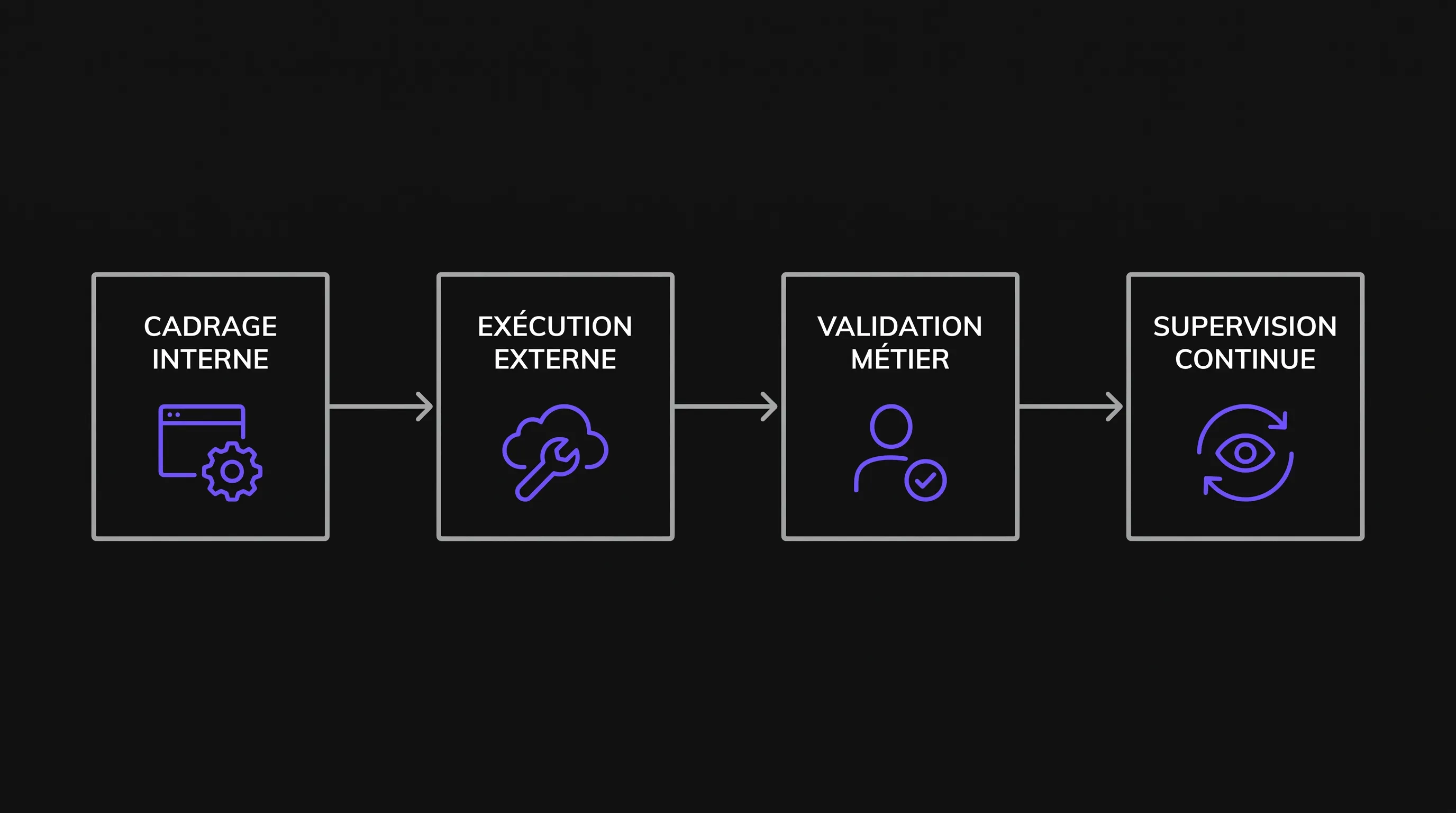
The healthy model: outsource execution, internalize governance
The right balance boils down to one rule: you can delegate the building, but you must retain ownership of the "why," the "how far," and the "how to verify."
In practice, this calls for lightweight yet explicit governance. An SME does not need a sprawling steering committee. Naming a business sponsor, an operational point person, a technical/security lead, and a final decision-maker is often all it takes.
Phase
Provider's role
Company's role
Expected proof of control
Scoping
Formalize use cases and options
Prioritize objectives and constraints
Validated scoping document
Design
Propose architecture and data flows
Validate data, access, and business rules
Clear functional blueprint
Prototyping
Build and test rapidly
Test with real-world scenarios
Results matrix and user feedback
Production
Secure, integrate, and document
Approve the rollout decision
Monitoring and support plan
Improvement
Fix and optimize
Track performance metrics
Change log
This governance model avoids two common pitfalls: letting the vendor unilaterally define what is "good enough," or having a project signed off by executives disconnected from daily operations. The best outcomes come from a close partnership: AI expertise on the vendor's side, deep domain knowledge on the client's side.
Deliverables to demand to retain mastery of the project
A professional AI service should produce far more than a demo that looks impressive in a meeting room. It must deliver assets that allow your team to understand, maintain, and supervise the system.
Demand deliverables covering at least: objectives, assumptions, datasets used, architecture, known limitations, security rules, test scenarios, user documentation, maintenance procedures, and reversibility terms.
Reversibility is frequently overlooked. It answers a simple question: if you part ways with the provider in twelve months, can you continue operating the solution or transition it to another team? This requires access to documentation, accounts, code repositories (where applicable), configuration settings, and architectural decisions.
Intellectual property must also be addressed upfront. Who owns custom code? Which components are open-source, SaaS, or proprietary? Are there dependencies that cannot be swapped out? While these points may seem administrative, they determine your long-term independence.
Red flags before entrusting an AI service
Certain behaviors should prompt you to hit the brakes, regardless of how compelling the sales pitch sounds:
The vendor promises guaranteed results without analyzing your data or processes
They brush off security, GDPR, or access control questions
They refuse to document the architecture or the system's operational boundaries
They recommend an autonomous agent with no human validation or logging
They talk almost exclusively about tools, while ignoring business context, adoption, and maintenance
They do not budget for real-world testing before deployment
Conversely, a reliable partner will often ask uncomfortable questions. They will ask who validates outputs, what margin of error is acceptable, which systems are business-critical, and which use cases must be excluded. That is not a lack of agility—it is the prerequisite for reliability.
If choosing the right partner is your primary concern, you can expand on this framework with our guide on how to choose a reliable AI partner.
SaaS, agency, or internal team: how to decide?
Outsourcing does not always mean "commissioning custom development." Depending on your maturity, an existing SaaS tool may suffice. In other cases, the goal is assembling existing components. Bespoke development becomes necessary when your specific processes, data, or integrations create a competitive advantage that standard software cannot replicate.
The real question to ask is not "should we outsource?" but rather "which piece of the problem warrants external expertise?". An SME might use standard SaaS tools for basic tasks, outsource integration with its internal systems, and maintain tight in-house control over business decisions. A scale-up might contract out the build of an AI platform while keeping product management, performance metrics, and the strategic roadmap internal.
Before kicking off an engagement, set aside an hour to answer five questions. They will prevent the most expensive misunderstandings down the road.
What business outcome are we expecting? Reduced processing times, improved response quality, fewer errors, accelerated sales cycles, or upgraded support quality.
What data will be used? Public, internal, personal, sensitive, confidential, or proprietary strategic data.
What degree of autonomy are we willing to grant? Suggestions, drafts, mandatory human sign-off, constrained automated actions, or fully autonomous execution.
Who validates output quality? A domain expert must run structured test scenarios, rather than relying on gut feeling.
How will we take back full control? Documentation, credentials, access rights, reversibility plans, maintenance routines, and monitoring metrics must be defined from day one.
These decisions do not slow the initiative down. They streamline the right steps and prevent having to rebuild on ambiguous foundations later.
Frequently Asked Questions
Which AI services should be outsourced first? Opportunity audits, team training, prototyping, and straightforward automations are typically the best starting points. They deliver rapid value without giving an unproven system autonomous control over mission-critical operations.
Should we outsource custom AI development? Yes, provided you lack internal expertise and the project scope is clearly defined. Keep business validation, decision-making logic, sensitive access credentials, and architectural understanding firmly in-house.
How can we avoid vendor lock-in with an AI provider? Insist on comprehensive documentation, direct administrative access, contractual reversibility terms, reusable technical deliverables, and foundational training for your staff. Dependency thrives on opacity.
Can an AI service provider access our customer data? Yes, but strictly within an explicit framework: defined purpose, restricted retention, robust security, confidentiality agreements, legal basis, fine-grained access rights, data purge procedures, and an explicit ban on training third-party models.
What is the difference between outsourcing and losing control? Outsourcing means bringing in external expertise or delivery bandwidth. Losing control begins when the company no longer understands how the solution reaches decisions, where data travels, who can trigger actions, or how to shut down and patch the system.
Moving your AI projects forward without a black box
The most valuable AI services do not displace your domain expertise. They enhance it, automate parts of it, and make it scalable. A good partner will help you accelerate execution while making decisions, data flows, and risk factors clearer.
Impulse Lab supports companies with AI opportunity audits, training, automations, workflow integrations, and custom web or AI platforms. If you want to identify what can be outsourced without giving up control, begin with a straightforward assessment at impulselab.ai.
Responsible AI is not a luxury reserved for large enterprises. For an SME, it is a practical way to use AI without losing control over data, decisions, or costs. In 2026, leaders must balance risk management, team guidelines, and measurable business value.