AI crossed a milestone in 2026. Models are powerful, tools are multiplying, yet many companies remain stuck: isolated tests, uneven results, and short-lived adoption. This is exactly where the role of an **AI trainer** becomes decisive...
AI crossed a milestone in 2026. Models are powerful, tools are multiplying, and yet many companies remain stuck in the same place: a few isolated tests, uneven results, and adoption that doesn't last. This is exactly where the role of an AI trainer becomes decisive.
An AI trainer is not there to "give a demo" or to provide generic "ChatGPT training". Their goal is to establish useful, measurable, and controlled use cases (data, quality, security, compliance) within your teams, adapting to your processes and your tech stack.
AI trainer: definition and role (in a company)
An AI trainer is a hybrid profile, both educational and operational, who helps an organization to:
understand what AI can (and cannot) do in their business cases,
use tools reliably (error reduction, verifiable outputs),
integrate AI into concrete workflows (and not just in a chat),
measure adoption and gains (productivity, quality, lead times, risk).
In SMEs and scale-ups, it is often the most cost-effective role when you have already decided to "go for it", but you can't manage to turn the intention into solid habits.
The expected deliverables of an AI trainer (concrete, not theoretical)
A good AI trainer produces simple, reusable, and actionable artifacts, for example:
an AI usage charter (what is allowed, forbidden, and under what conditions),
a data classification (e.g., green, orange, red) and handling rules,
playbooks by business line (support, sales, ops, product),
prompt templates adapted to your documents and vocabulary,
a quality review protocol (how to validate an output, when to escalate),
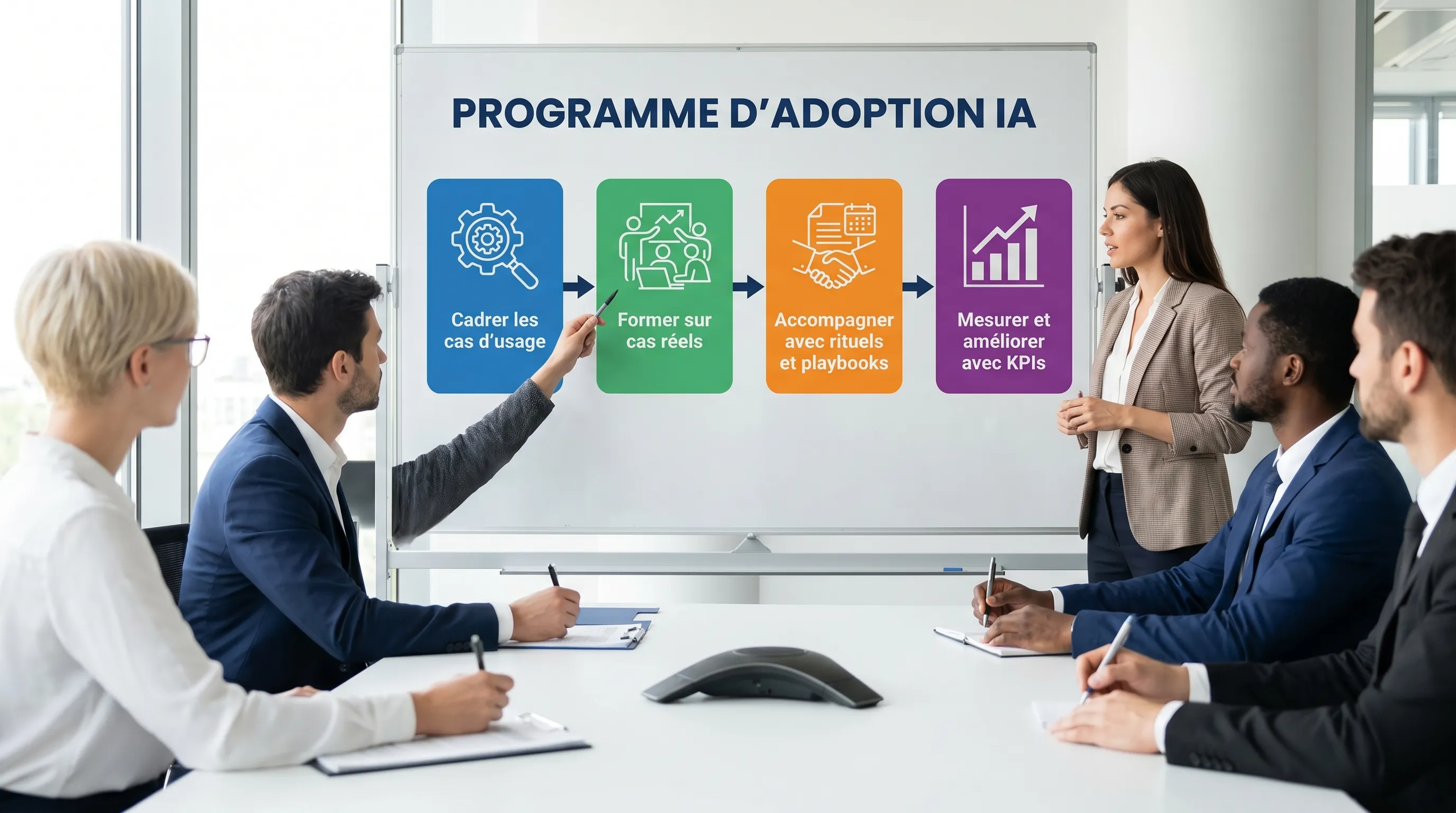
an adoption plan (champions, rituals, continuous training),
a minimal dashboard to track impact KPIs.
If you are aiming for structured adoption, these deliverables matter just as much as the training content.
What an AI trainer is not (and why it matters)
The term "AI trainer" is sometimes confused with other roles. Clarifying this avoids "bad fit" hires, where everyone thinks they are buying something different.
You need to industrialize an integrated AI solution
In many SMEs, the real need is a mix: scoping (what to launch), delivery (integrating), then adoption (keeping it alive). The AI trainer mainly covers this last part, which is often underestimated.
The key skills of a good AI trainer
An effective AI trainer is not necessarily "the most technical". However, they must understand the technology well enough to avoid scoping errors and establish realistic safeguards.
1) Production-oriented pedagogy (not "lectures")
A good AI trainer is recognized by their ability to have people practice on real cases, with real constraints: partial data, exceptions, risks, time pressure.
Look for someone who knows how to:
transform a business case into an exercise (with inputs, expected outputs, criteria),
build a progression (level 1, 2, 3) rather than a "one-shot" session,
provide tools for repetition (templates, checklists, examples, anti-examples).
2) Understanding the limits and risks of LLMs
In 2026, the challenge is no longer to "make a model talk". The challenge is to obtain usable outputs, and to master:
hallucinations and overconfidence,
"plausible" errors, which are dangerous in operations,
specific attacks (prompt injection, exfiltration),
context management (sources of truth, updates).
A good AI trainer doesn't need to code a RAG, but must know how to explain when an answer needs to be verified, when AI must be connected to reliable sources, and how to reduce risk. On these topics, useful references exist on the governance side, such as the NIST AI Risk Management Framework.
3) Data culture, confidentiality, compliance (practical)
The AI trainer must be able to instill simple reflexes: what data can be sent to a tool, in what context, with which accounts, and what traces are left.
In Europe, it is also useful for them to understand the regulatory context (at least at a high level), for example, the AI Act from the European Commission and good data protection practices (in France, the CNIL resources are a relevant baseline).
4) Change management (adoption, habits, rituals)
"One-shot" training is not enough. An AI trainer must know how to organize:
a network of champions (1 per team),
short rituals (e.g., weekly case review, living library),
a feedback system (where bottlenecks occur, which errors recur),
a trajectory: from individual use to standardized use, then to integrated use.
5) Product sense and measurement (value-driven management)
The most common trap: measuring adoption by the "number of users" or the "number of prompts". A solid AI trainer knows how to link adoption to an impact.
To go further on the logic of measurement, a useful resource is your guide on AI KPIs (measurement framework, choice of metrics, instrumentation).
Interview grid: how to test an AI trainer
Skill
Simple interview test
Good signal
Use case scoping
"Choose a business case and propose a 90-minute workshop"
Structured exercise, success criteria, risks
Data management
"What do you do if an employee pastes a client contract into a public tool?"
Clear rules, classification, corrective measures
Reliability
"How do you reduce hallucinations on an internal process?"
Sources of truth, citations, validation protocol
Adoption
"Your training was successful, but 2 weeks later, no one is using AI anymore. What do you do?"
Rituals, champions, frequent cases, metrics
Skill transfer
"How do you make the team autonomous without you?"
Playbooks, templates, ownership, documentation
When to hire an AI trainer: the most reliable signals
The right time is not "when we talk about AI", but when AI starts touching your operations, your data, and your responsibilities.
Signal 1: Your usage is exploding, but remains "shadow AI"
You notice scattered practices: personal accounts, different tools, copy-pasted documents without rules. Result: risk, inconsistency, and an inability to capitalize on efforts.
An AI trainer helps create a lightweight but effective framework, without killing speed.
Signal 2: You have occasional gains, but they are not reproducible
A few people "know how to use it", the others don't. Deliverables vary enormously depending on the user. It's time to standardize: templates, checklists, criteria.
Signal 3: You want to integrate AI into a workflow (CRM, support, ops)
As soon as you move from "chat" to connected usage, risks and complexity increase: quality of sources, access rights, traceability, human escalation.
In this case, the AI trainer is often complementary to an integration partner. Example: if you deploy an assistant connected to your documents via RAG, it is useful to have solid benchmarks (see your definition of RAG).
Signal 4: You are exposed to compliance, security, or brand image issues
If AI touches contracts, customer data, sensitive decisions, or external communications, the lack of standardized practices becomes a business risk.
What type of recruitment: internal, freelance, agency?
The right format depends on your maturity, your execution speed, and the need for continuity.
Internal AI trainer
Relevant if AI is strategic, and if you want a sustainable capability.
Strengths: continuity, knowledge of the context, continuous improvement.
Points of vigilance: difficulty in recruiting, risk of a profile that is too "training" and not enough "ops", need for technical support if you industrialize.
Freelance AI trainer
Relevant for quickly launching a program, structuring the basics, and training champions.
Points of vigilance: limited availability, dependency if artifacts are not well documented.
Training and adoption via an agency (team model)
Relevant if you want to combine adoption + integration + delivery in short cycles.
Strengths: ability to link training and production deployment, cross-functional support (product, tech, security), acceleration.
Points of vigilance: make sure to demand transfer deliverables (playbooks, docs, ownership), not just sessions.
How to frame the mission of an AI trainer (to avoid "gimmick training")
Before recruiting, align on 5 elements. This is what transforms a training session into an adoption program.
Business objective (not just "using AI")
Examples of correctly formulated objectives: reduce support response time, reduce quote production time, increase qualification rate, standardize the quality of a deliverable.
Scope and users
Who is involved, on what cases, with what constraints? If you need a structured framework, your AI project scoping checklist can serve as a baseline.
Data rules and authorized tools
Without simple rules, adoption immediately "overflows".
Quality protocol (when to check, how, by whom)
The golden rule: AI can accelerate production, but the company must retain responsibility. Therefore, validation must be organized.
Measurement (before, during, after)
Even an adoption program must be instrumented. If you don't measure, you will have activity, not value.
Realistic example: what a "good" 4-week start looks like
Without making promises of results (everything depends on your context), an AI trainer can often structure a quick foundation if you give them access to the teams and real cases.
Week 1: scoping of the 3 most frequent cases, data rules, choice of tools, baseline KPIs.
Week 2: practical workshops by team (templates, checklists, validation criteria).
Week 3: implementation of rituals (champions, case review, library), iterations on prompts and formats.
If you are industrializing in parallel (RAG, agents, automations), the AI trainer becomes a pillar of ownership and risk reduction, in conjunction with delivery.
FAQ
Is an AI trainer "training an AI" or "training humans"? A corporate AI trainer primarily trains humans and teams. They establish practices, rules, and workflows to use AI reliably and securely.
What is the difference between an AI trainer and an AI consultant? The AI consultant often intervenes upstream (strategy, prioritization, scoping). The AI trainer intervenes for adoption, training on real cases, standardization, and usage measurement.
Should you hire an AI trainer before or after an AI pilot? Often during or just before, especially if the pilot involves multiple teams or sensitive data. The goal is to prevent the pilot from becoming an unadopted demo.
How do you measure the effectiveness of an AI trainer? By linking adoption and impact: time saved on a task, decrease in errors, reduction in lead times, improved conversion, compliance with data rules. Avoid measuring only the "number of users".
Is an AI trainer enough to put AI into production? Not always. The AI trainer covers adoption and practices. For integrated AI (RAG, agents, automations), you will often need complementary technical and product support.
Need an AI trainer (and an adoption plan) that fits your workflows?
At Impulse Lab, we help SMEs and scale-ups transform AI into measurable value, with a production-oriented approach: opportunity audit, training and adoption, then development and integration of custom AI solutions when necessary.
If you want to avoid "window-dressing training" and establish reliable use cases (data, quality, compliance), you can start with a discussion to scope: perimeter, expected deliverables, and adoption plan. Get in touch via Impulse Lab.
Personalizing Customer Education with Artificial Intelligence
AI in customer education goes beyond school settings to help users master products. Discover how to personalize onboarding, boost user autonomy, and build reliable learning paths.