Adopting an **artificial intelligence solution** is no longer just about "taking the best model" or "adding a chatbot". In 2026, what makes the difference (and drives ROI) is much more grounded: a frequent use case, clean integration with your tools, and measurement that...
Adopting an artificial intelligence solution is no longer just about "taking the best model" or "adding a chatbot". In 2026, what makes the difference (and drives ROI) is much more grounded: a frequent use case, clean integration with your tools, and measurement that proves the impact unambiguously.
This article offers an operational method, designed for SMEs and scale-ups starting to structure their stack, featuring simple frameworks to choose, integrate, and measure without falling into the POC graveyard.
1) Before choosing an AI solution: frame the "use contract"
Most deployments fail for a simple reason: the company buys a technology when it should have bought a result.
Minimal framing (often doable in 2 to 4 hours) fits on one page and avoids 80% of mistakes.
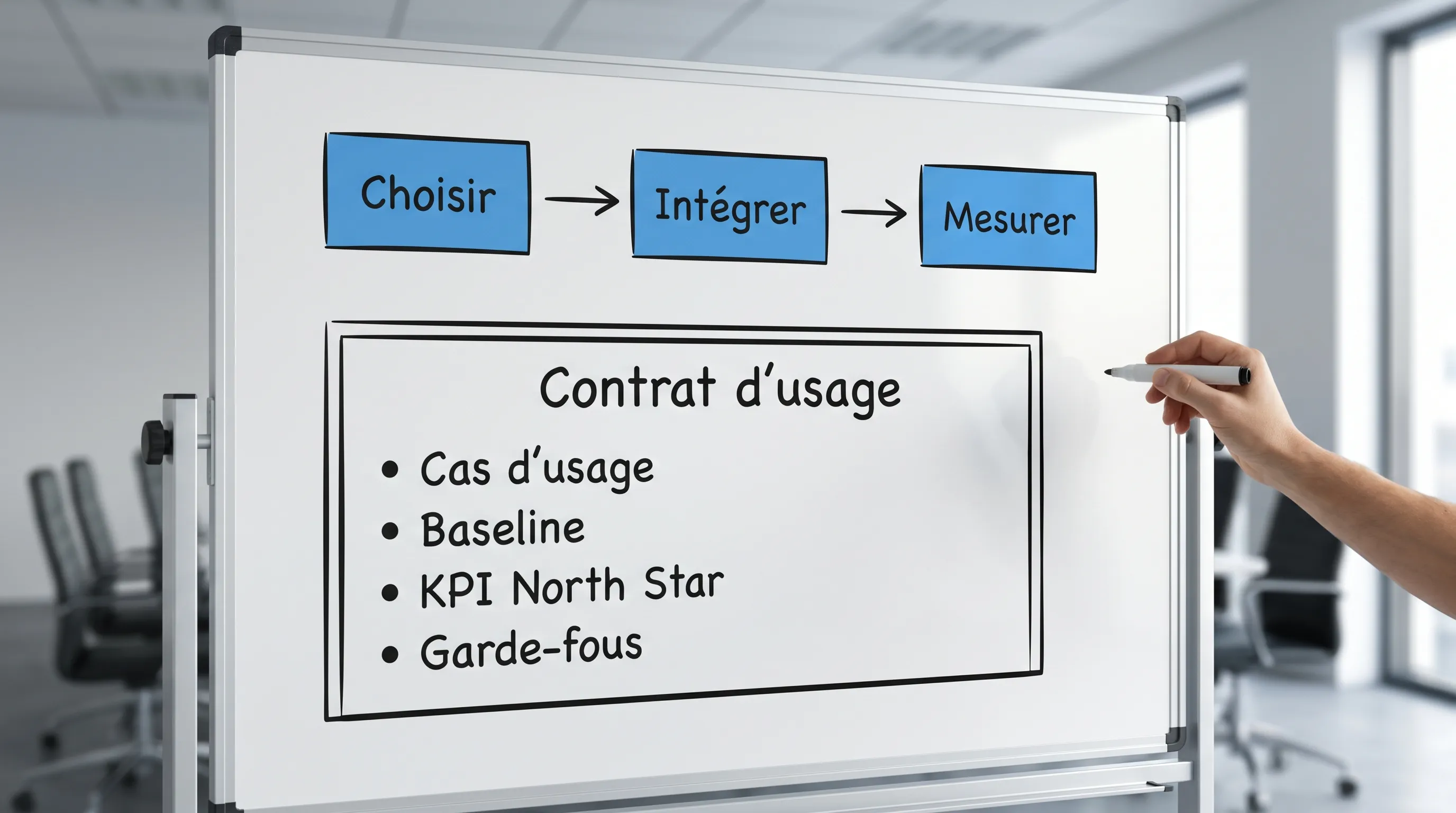
The 6 fields to write down in black and white
Job-to-be-done: what decision, document, or action needs to be accelerated (and for whom)?
Frequency: how many times a week/month does this problem occur? (a rare case almost never pays off)
Baseline: today, how much time, what cost, what error rate, what lead time?
Expected output: what does a "usable" result look like (format, tone, structure, fields, sources)?
Guardrails: what the solution is not allowed to do (e.g., invent an answer, act without validation, access "red" data).
North Star KPI: a single indicator that summarizes the value (e.g., validated time saved, resolution rate, cycle time, margin after returns).
This page becomes your use contract: it serves to evaluate tools, guide integration, and then measure success.
2) Choose: build, buy, or assemble (and how to decide without dogma)
An AI solution can be:
Buy: an off-the-shelf market tool (SaaS) ready to use.
Assemble: an assembly of building blocks (AI APIs, RAG, automation, connectors) to fit your processes.
Build: custom development of an AI platform or module integrated into your product/ops.
The right choice rarely depends on the "quality of the model". It mostly depends on integration, data, and risk.
Quick decision matrix
Criterion
Buy (tool)
Assemble (blocks)
Build (custom)
Simple, standard use case
Highly suitable
Sometimes oversized
Often unnecessary
Need for integration with 2-3 tools (CRM, helpdesk, ERP)
Limited or variable
Highly suitable
Suitable
Sensitive data / strong GDPR requirements
Check case by case
Suitable (if governed)
Suitable (if well designed)
Need for traceability (sources, logs, decisions)
Uneven
Highly suitable
Highly suitable
Business differentiation (unique process, competitive advantage)
Low
Medium to high
High
Product scalability (AI feature at the core of your platform)
Low
Medium
High
The "anti-demo" test to avoid choosing based on gut feeling
Before any decision, test on real cases (not marketing examples), with a repeatable protocol:
10 to 20 realistic requests (tickets, emails, briefs, reports).
A simple scoring grid: usable / partially usable / unusable.
A "sources and rights" check (internal data, sensitive content, intellectual property).
If the solution doesn't pass this test without tinkering, integration and measurement won't change a thing.
For data and compliance topics, useful French references are the CNIL and, for the European framework, the consolidated texts on EUR-Lex.
3) Integrate: AI must live in your workflows, not alongside them
An AI solution "on the side" (another tab, another app) sometimes creates a wow effect, but rarely a lasting transformation. To achieve stable gains, AI must be in the flow: right where the team is already working.
The 3 integrations that really matter
Data integration (the "reliable context")
Which sources are authoritative? (knowledge base, CRM, ERP, Drive, Notion, wiki)
Who has the right to see what? (rights by role, teams, client)
How to avoid obsolete answers? (versioned documents, cited sources)
In many cases, a RAG (Retrieval-Augmented Generation) pattern is the best compromise to connect AI to your sources of truth, without "training a model" on your content.
Identity and access integration (SSO, permissions, audit)
This is often the least "sexy" and most critical part:
pro accounts (not personal),
access logging,
principle of least privilege,
action traceability.
Event and tool integration (APIs, webhooks, automations)
This is what transforms an answer into a result: creating a ticket, enriching a lead, preparing a quote, updating a file, routing a request.
Integration levels (and why to aim progressively)
Level
Description
When it's enough
Main risk
"Standalone" AI
isolated tool used manually
individual tasks, exploration
low adoption, no measurement
"Assisted" AI
models + templates + team rules
content production, summaries
variable quality, shadow AI
"Connected" AI
data access + action via API
support, CRM, ops, back-office
security and access rights
"Actionable" AI (guarded agent)
executes actions with validations
frequent multi-tool tasks
drift, costs, action errors
The goal is not to go straight to maximum autonomy. The goal is to maximize net value (gains minus risks minus costs) and industrialize what works.
4) Measure: moving from "usage" to impact (KPIs + ROI + guardrails)
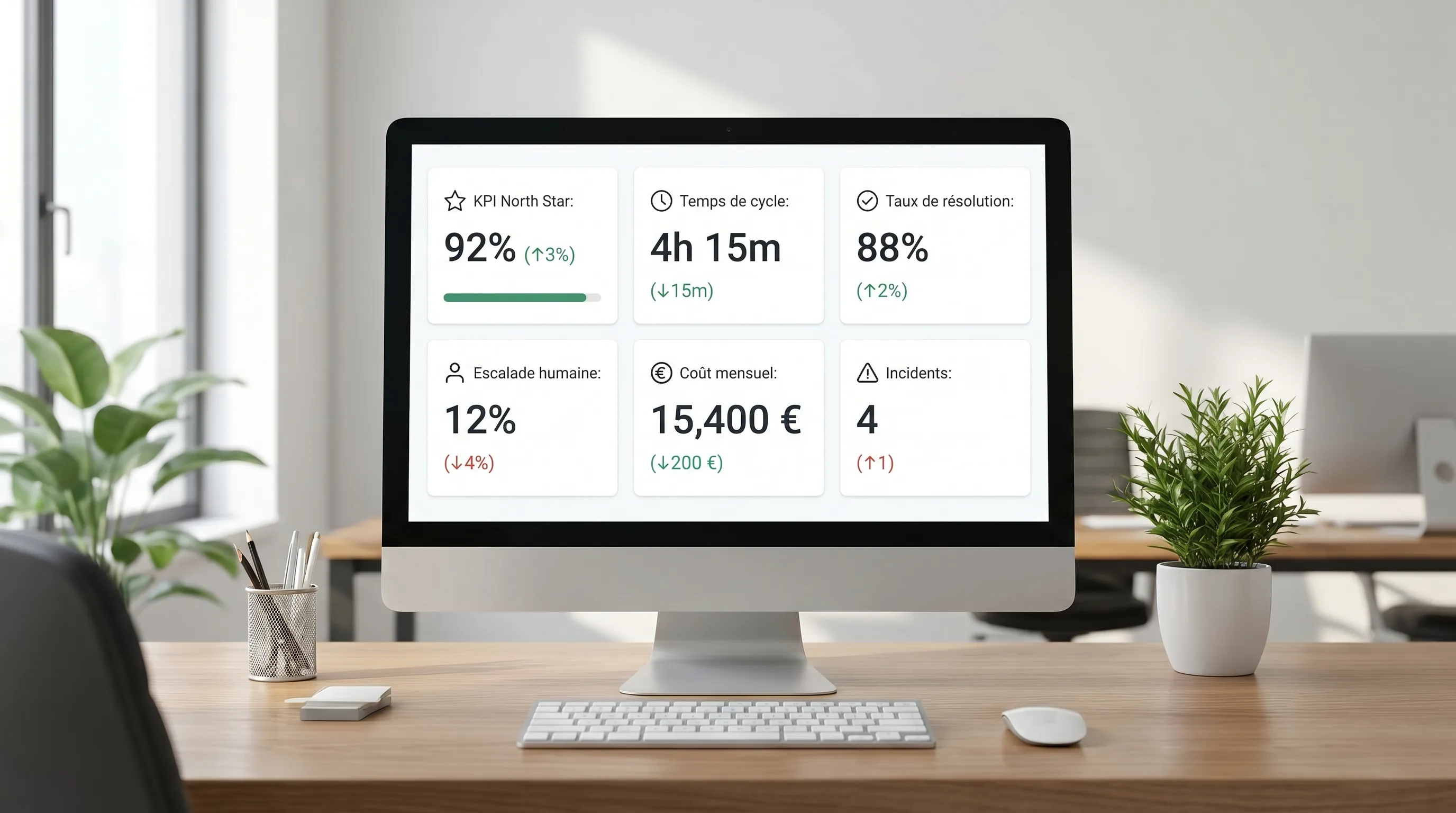
Measuring "the number of users" or "the number of prompts" is almost always insufficient. These are activity metrics, not value metrics.
A robust measurement consists of 4 layers, useful even in SMEs.
An AI solution ROI becomes credible when you have:
a baseline (before),
a comparable test period (after),
an economic unit (fully loaded hourly rate, cost/ticket, cost/return, cost/lead).
Useful formula:
ROI = (estimated and verified monthly gains – total monthly cost) / total monthly cost
The total cost isn't just the subscription. It often includes: integration, source maintenance, supervision, training time, and sometimes variable costs (API usage).
The classic trap: forgetting measurable guardrails
A solution can "perform" while increasing risk. Add 1 to 2 quantified guardrails, for example:
rate of sourceless answers on a RAG case,
rate of canceled actions after validation,
rate of security incidents, or non-compliant data.
For an SME or scale-up in the structuring phase, the most effective roadmap is often: a frequent use case + minimal integration + measurement from day 1.
Week 1: framing and test protocol
Objective: a clear use contract, a set of real cases, a North Star KPI, and an authorized data scope.
Weeks 2 and 3: integrated V1 (small, but real)
Objective: connect to useful sources, instrument events (inputs, outputs, actions), and release a V1 usable by a pilot team.
Week 4: controlled pilot and decision
Objective: measure vs. baseline, identify recurring errors, stabilize guardrails, then decide: stop, iterate, or deploy.
This approach is compatible with short-cycle delivery, which is often the only way to avoid the "AI solution" that remains just a demo.
6) Mistakes that destroy ROI (and how to avoid them)
Choosing a tool before the use case: you are optimizing a demo, not a result.
Underestimating integration: AI without reliable data and without tooled actions produces text, not value.
Measuring activity instead of impact: you get "adoption" without economic proof.
Forgetting ownership: without a business owner for the use case, the solution drifts.
Ignoring compliance and security: risk debt always arrives later, and costs more.
FAQ
What is the best artificial intelligence solution for an SME? The best one is the one that fits a frequent use case, integrates with your tools, respects your data constraints, and proves a North Star KPI in a pilot.
Is custom development absolutely necessary? No. Custom development is justified when integration, traceability, business differentiation, or data sensitivity make a standard tool insufficient.
How to avoid hallucinations in an AI solution? By framing the tasks (expected outputs), connecting the AI to sources of truth (often via RAG), adding guardrails, and measuring quality (citations, escalation rate, errors).
Which KPIs to choose to prove ROI? 3 to 5 KPIs maximum: a North Star KPI (value), 1 to 2 process KPIs (lead time, resolution rate), and 1 guardrail (quality, security, or cost).
How long does it take to get a first measurable result? Often 3 to 6 weeks if the use case is frequent, data is accessible, and the V1 is integrated into the workflow (not an isolated tool).
Moving from an "AI solution" to a measurable V1
If you want to avoid gut-feeling purchases and get a truly integrated solution, Impulse Lab supports SMEs and scale-ups through:
AI opportunity audits (prioritization by ROI and risks),
custom integrations and developments (web and AI),
adoption training to anchor usage and reduce shadow AI.
To start cleanly, the simplest step is often to frame 1 use case, define the baseline, and build an instrumented pilot. Discover Impulse Lab at impulselab.ai.
Can You Trust Artificial Intelligence with Your Math Calculations?
Can you trust AI with math calculations? Yes, provided you distinguish suggested reasoning from actual computation. Discover how to inspect, verify, and ground AI-driven calculations into reliable business decisions.