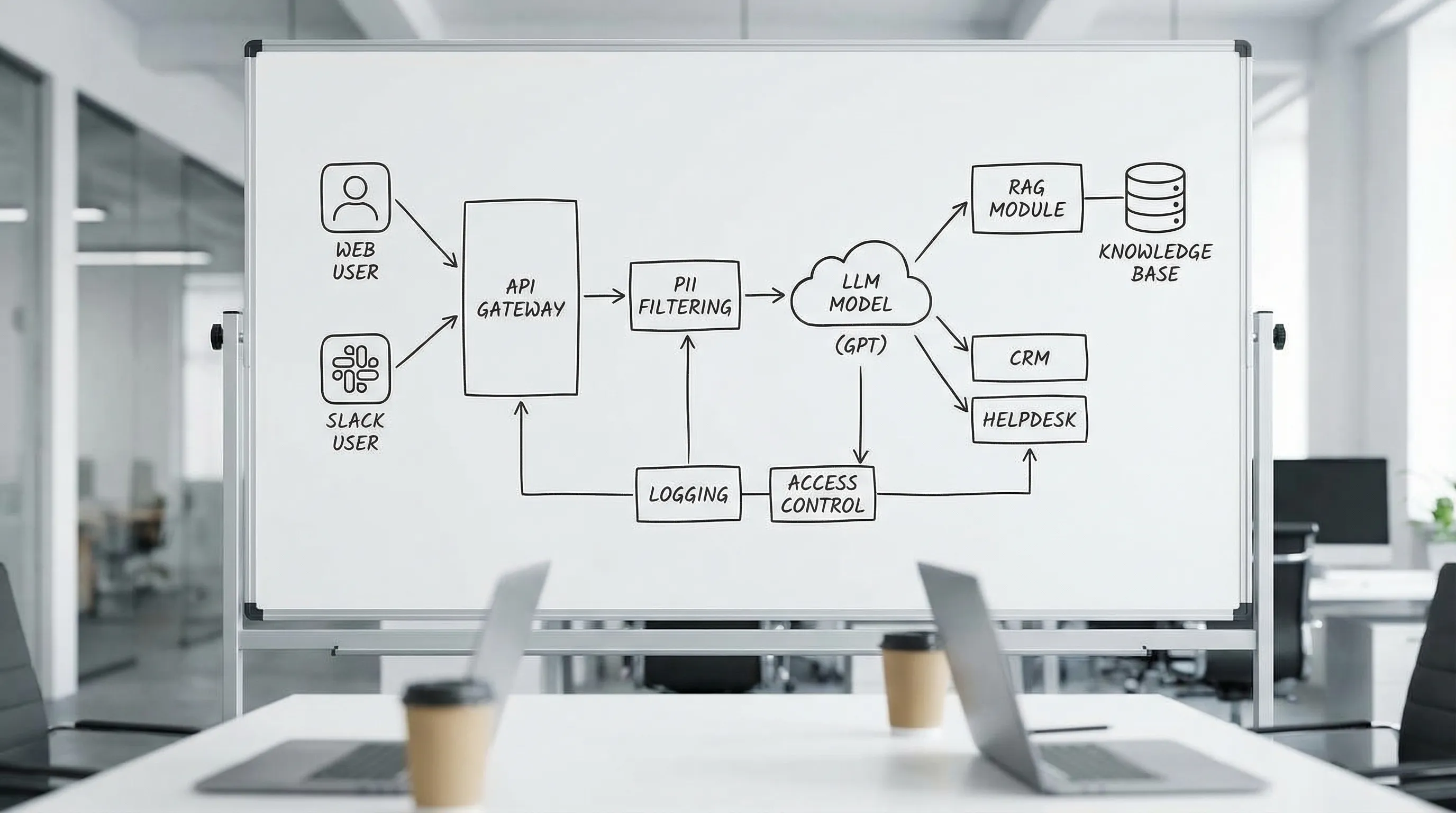
Creating an Enterprise GPT Chatbot: GDPR and Integrations Guide
Intelligence artificielle
Stratégie IA
Confidentialité des données
Gouvernance IA
Automatisation
An enterprise GPT chatbot can reduce support load and streamline knowledge access. However, failure often stems from two main issues: **superficial integration (the bot can't do anything)** and **GDPR ambiguity (sensitive data, subcontracting, transfers)**.
An enterprise GPT chatbot can reduce support load, accelerate sales qualification, or streamline access to internal knowledge. But in practice, the two main reasons for failure are always the same: too superficial integration (the bot can't do anything), and GDPR ambiguity (sensitive data, subcontracting, transfers, retention).
This guide gives you a concrete framework for successfully creating an enterprise GPT chatbot in France: what to scope, which architecture choices to prioritize, which integrations to prepare, and which GDPR points to validate before production.
1) Before “creating a GPT chatbot”: define the right product
The word “chatbot” covers very different realities. However, GDPR and integrations are not handled the same way depending on the level of autonomy.
Chatbot, assistant, agent: what changes
FAQ Chatbot: answers from a base of static content (pages, articles). Quick value, limited risk.
GPT Assistant with RAG: answers from a “source of truth” (knowledge base, internal docs), citing its sources. This is often the best value/risk ratio. See the definition of RAG.
Agent (actions): can trigger actions (create a ticket, modify a file, offer a refund). Here, security and traceability become central.
If you hesitate, start with a V1 “assistant + light integrations” (e.g., ticket creation, human handoff), then increase autonomy.
The “usage contract” to write in black and white
Before design and technical work, write a simple contract shared between business, IT, and legal teams:
Who is the bot for (clients, prospects, internal teams)?
What questions must it cover (top 20 to 50 intents)?
What actions can it trigger, and which are forbidden?
What data is it allowed to see (and under what conditions)?
What constitutes a good answer (format, sources, tone, escalation)?
This document will serve you later for testing, steering, and compliance.
2) GDPR: mapping the processing (and avoiding “GDPR-washing”)
A GPT chatbot almost always “collects” personal data, even if that isn't your intention (a client gives their email, an order number, a name, an address).
Roles: data controller and processors
In general:
Your company is the data controller (you decide why and how data is processed).
The chatbot provider, or your integrator, is a processor.
The model provider (or API) can be a processor or a sub-processor depending on the architecture.
Concretely, you must secure:
A DPA (Data Processing Agreement) with each relevant actor.
The list of sub-processors.
Conditions for non-EU transfers if applicable.
To frame this correctly for France, resources from the CNIL are a good starting point (to be adapted to your case).
Legal basis, information, and minimization
Depending on your usage, typical legal bases are:
Contract execution (customer support, order tracking).
Legitimate interest (service improvement, pre-qualification), provided the balance of interests is documented.
Consent in certain cases, especially if you combine chat with trackers/marketing (to be articulated with your CMP and cookie policy). See also the definition of a cookie.
In all cases:
Clearly inform the user (banner, short notice in the widget, link to privacy policy).
Minimize: do not ask for data “just in case”.
Do not let the bot “suck up” your entire client base without safeguards.
DPIA: when to consider it
If the chatbot processes risky data (sensitive data, health, children), operates on a large scale, or introduces significant surveillance/profiling, a DPIA is often relevant. It is not a formality, it is a decision-making tool: scope, risks, measures.
3) The 3 architectures of a GPT chatbot (and their GDPR implications)
The choice of architecture is not “technical”; it structures your compliance, security, cost, and integration capacity.
4) Integrations: the “useful” list (and what you must secure)
A GPT chatbot becomes profitable when it is connected to the truth (your data) and action (your tools). But each integration adds risks: excessive access, leaks, action errors.
The most frequent integrations
Website: chat widget, page context, handoff to form or human.
Pseudonymization: replace a direct identifier with a technical identifier when possible.
Input rules: the bot must discourage the user from sharing unnecessary data.
5.2 Logging, retention, and data subject rights
Decide from the start:
Which logs are necessary (quality, security, proof).
How long you keep them.
How you respond to an access/deletion request.
A classic trap is leaving logs “for life” in multiple tools (chat, helpdesk, observability) without a coherent policy.
5.3 Access control, partitioning, and application security
SSO for internal use, segmentation by roles.
Least privilege principles on every connector.
Server-side secret storage, rotation.
Encryption in transit (TLS) and at rest.
For specific LLM risks (prompt injection, exfiltration via tool, context contamination), the recommendations from the OWASP Top 10 for LLM Applications provide a good security framework.
5.4 Non-EU transfers and provider choice
If a provider processes data outside the EEA, you must frame the transfers (e.g., via SCCs, depending on context) and verify contractual and operational consistency (localization, sub-processors, retention). This subject is sensitive and depends on your case, your data, and your contracts.
6) A realistic delivery plan (4 sprints) to avoid the “demo”
For an SME or scale-up, the most effective approach is to deliver fast, but with “production-ready” quality on a restricted scope.
Sprint 1: scoping, risks, and KPIs
1 priority use case (support, pre-sales, internal).
3 to 5 simple KPIs (deflection, handling time, conversion, CSAT, escalation rate).
Data classification (green/orange/red) and sharing rules.
If you are starting from scratch, a short audit avoids choosing the wrong integrations or overestimating value. Impulse Lab offers risk-oriented AI audits and quick wins.
Sprint 2: conversational design and “source of truth”
Intents, expected answers, failure scenarios.
RAG construction (if necessary): sources, quality, citations.
Refusal policy: when the bot must say “I don't know”.
An escalation mechanism to a human, and refusal answers in case of uncertainty.
Basic monitoring, and an incident procedure.
Conclusion: a compliant GPT chatbot is primarily a well-integrated chatbot
In 2026, “having GPT” is no longer an advantage. The advantage is an assistant that is integrated, measured, and governed: it knows where the truth is (your sources), it knows what to do (your tools), and it processes data in a controlled manner.
If you want to accelerate without sacrificing compliance, Impulse Lab can support you end-to-end, from opportunity audit to delivery of an integrated V1 (with adoption training). Entry point: impulselab.ai.
Artificial intelligence in business raises a question beyond tooling: who actually owns it? The executive funding it, the team using it, the vendor, or the provider? The answer changes depending on whether we discuss ownership, governance, or liability.