Custom AI Development: Criteria for a Rational Choice
Intelligence artificielle
Stratégie d'entreprise
Stratégie IA
Audit IA
Companies seeking "custom AI development" rarely want AI for fun. They seek an **operational capability**: saving time on critical workflows, increasing conversions, reducing risk, or accelerating cycles (support, sales, operations, product).
March 02, 2026·9 min read
When a company talks about "custom AI development," they rarely want "AI" for fun. They seek an operational capability: saving time on a critical workflow, increasing conversion, reducing risk, or accelerating a cycle (support, sales, operations, product).
The problem is that custom development can be, depending on the context, either the best decision (deep integration, differentiation, data constraints) or the fastest way to burn through budget (unmeasured POC, unusable data, model dependency, underestimated maintenance).
This guide proposes concrete criteria to make a rational choice: when to go for custom, when to prefer a market tool, and how to evaluate a provider without getting trapped by a demo.
1) A Rational Choice Starts Before the Tech
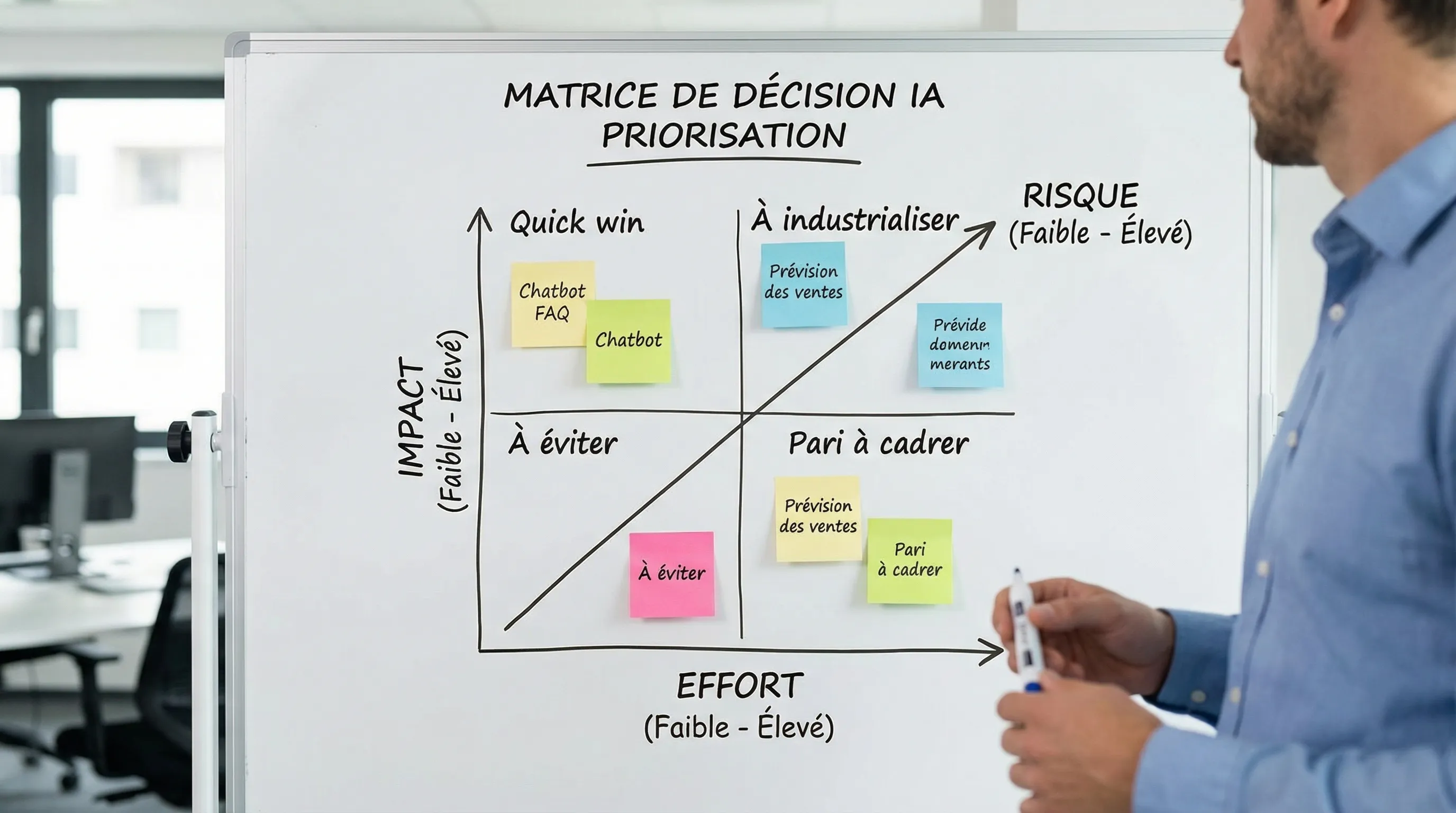
Custom development becomes "obvious" when you have already scoped three things:
The job-to-be-done: what decision or action must the AI trigger (not just "answer," but "resolve" or "route")?
The baseline: how many tickets, minutes, errors, returns, or lost leads today? Without a baseline, you measure usage, not impact.
If this phase seems "theoretical" to you, it is actually the opposite: it is what prevents an AI project from becoming a mere internal showcase. (On this point, an opportunity audit is often more profitable than immediate development; see the approach described in the Strategic AI Audit.)
2) Key Criteria to Decide if Custom is Justified
Custom AI development is justified when you check several boxes at once. The goal is not to be "advanced in AI," but to be specific (integration, data, quality, compliance) and measurable.
Here is a pragmatic reading grid.
Criterion
Why it pushes for custom
Warning signal if absent
Value and frequency of the use case
The more frequent a workflow is and the closer it is to cash (time, margin, conversion), the more industrialization pays off
"Occasional" case or gadget, ROI difficult to defend
Value comes when AI can read and especially act (create a ticket, generate a quote, update a status)
"We'll copy-paste the answer," resulting in low gains and fragile adoption
Proprietary data or internal know-how
Custom serves to exploit your documents, processes, business rules, history, constraints
Dispersed data, unreliable, no owner, no clear rights
Expected quality and need for control
You can instrument, test, iterate, add guardrails, and aim for stable quality
Validating by "feel" (perceived quality), not with test scenarios
Traceability (sources, logs, audit)
Essential for internal assistants, support, compliance, sensitive decisions
"The model said…" without explanation, without proof, without logs
Compliance and risk (GDPR, AI Act, security)
Custom allows designing for compliance (minimization, DPA, filters, roles, policy)
Sensitive data sent "as is" into a public tool
To frame the risk, two serious references can help you ask the right questions from the start: the NIST AI Risk Management Framework and the European framework for AI (EU AI Act).
3) Build vs Buy vs Assemble: The Useful Comparison (Without Dogma)
In reality, most winning SMEs and scale-ups make a hybrid choice: they buy standard bricks, then develop custom layers for what creates value (integration, data, orchestration, UX, guardrails).
Option
Prioritize if…
Advantages
Typical Limits
Buy (market tool)
Standard need, low integration, low criticality, rapid value
Immediate start, predictable costs at the beginning
Limited customization, reversibility sometimes low, data and compliance to verify
Build (custom)
Critical workflow, deep integration, proprietary data, quality/traceability requirements
Business alignment, control, differentiation, adaptable architecture
Requires scoping, rigorous delivery, operations, and maintenance
Assemble (bricks + overlay)
You want to move fast without sacrificing integration and governance
Best speed/control ratio, increased reversibility
Requires real architecture and integration skills
If your topic touches on variable API costs (tokens, quotas, spikes), keep one reflex: estimate the "production" budget, not the "POC" budget. The Impulse Lab post on hidden costs of AI APIs provides a useful method.
4) The "Proofs" to Ask For Before Signing a Custom AI Development
A demo is not proof. To choose rationally, ask for verifiable artifacts.
Proof 1: A test protocol, not an opinion
A good custom project starts with a pack of representative scenarios (anonymized real tickets, typical requests, edge cases). We then validate:
Success rate on scenarios (resolution, correct routing, faithful extraction).
Robustness (variants, phrasing, noise).
Guardrails (refusal when unknown, human escalation, citation of sources).
For specific LLM risks (prompt injection, data exfiltration, tooling errors), the OWASP Top 10 for LLM Applications list serves as a very actionable security checklist.
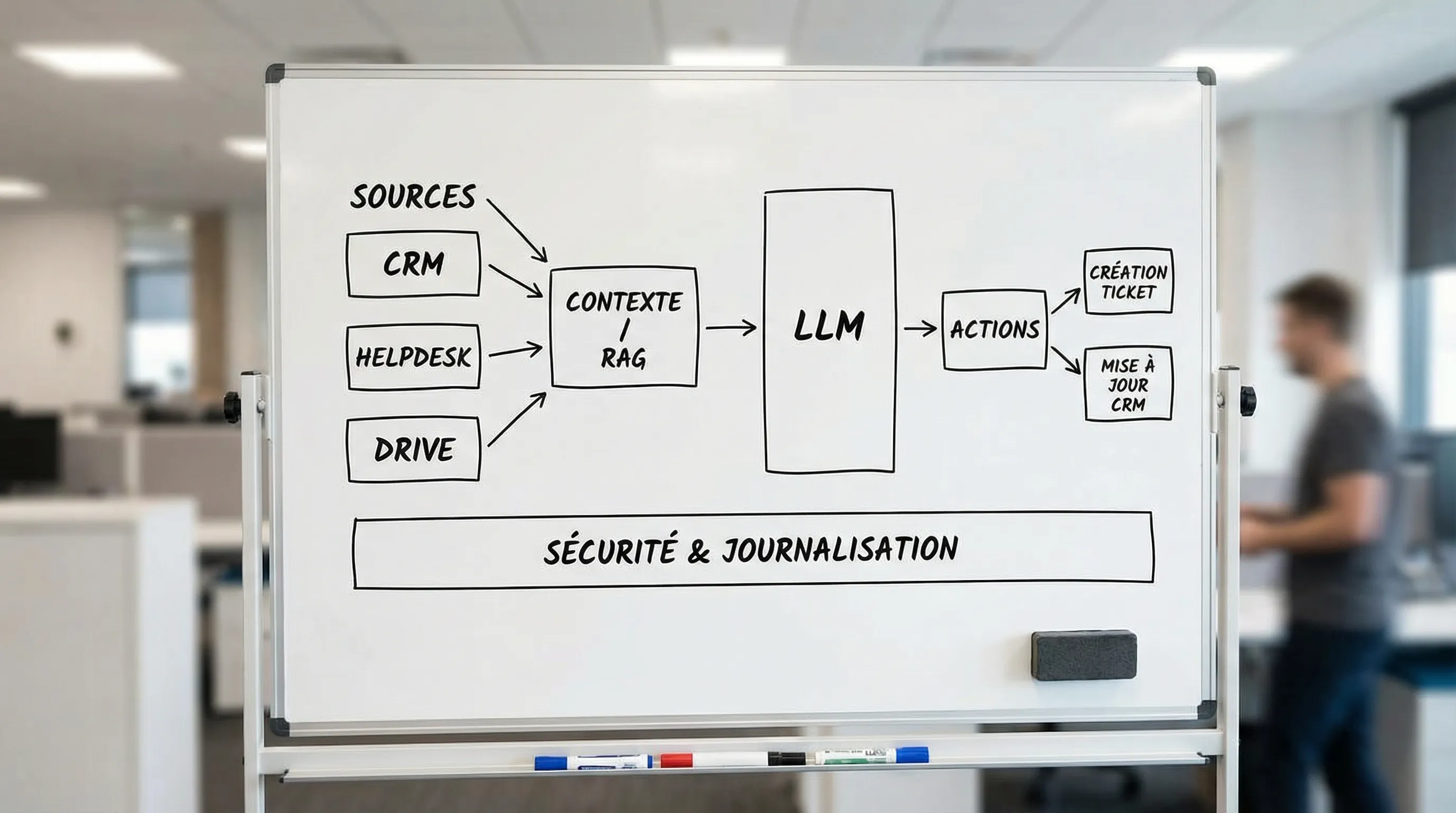
Proof 2: An architecture that separates responsibilities
Even in an SME, you want a readable architecture:
An orchestration layer (logic, versioned prompts, model routing).
A context layer (RAG, sources, rights, index).
An actions layer (CRM/helpdesk/ERP connectors, idempotent execution).
An observability layer (logs, metrics, costs, quality).
This is also what facilitates reversibility and avoids a "magical" system that is impossible to maintain.
Proof 3: An operations plan (run) from V1
In production, AI does not "stay stable" on its own. You need to know:
Who is the owner of the use case?
How is quality tracked (dashboard, incidents, drift)?
How are source updates managed (docs, knowledge base)?
How are costs vs quality arbitrated (model, caching, limits)?
Without a minimal runbook, custom development becomes a project that degrades.
5) Provider Evaluation Checklist (Questions That Filter Quickly)
You don't need a grid of 200 criteria. You need questions that reveal "production" maturity.
Subject
Question to ask
What you want to hear (or see)
Value Scoping
"What North Star KPI do you propose, and how do you measure it?"
Baseline, instrumentation, success metrics, and guardrails
Data
"What exact sources do you use, with what rights and what filters?"
Collection of failures (failures are gold; they frame V2).
Week 4: Decision go / iterate / stop
Estimated ROI with operating costs.
Residual risks.
Concrete backlog.
This logic is consistent with a "product" delivery, typically used in Impulse Lab approaches (audit -> measured pilot -> industrialization), as presented in Transforming AI into ROI.
8) Quick Example: Custom Support Assistant, When It's Rational
Let's take a frequent case in SMEs: reducing ticket processing time and standardizing responses.
The "buy" (AI helpdesk tool) may suffice if:
you have few internal sources,
no integrations (no CRM update, no workflow),
low traceability requirements.
Custom becomes rational if:
you must answer based on internal documents (contracts, warranties, procedures),
you want an answer with cited sources and automatic escalation,
the assistant must act (tag, route, create a ticket, push a draft to the right channel),
you must control GDPR and access (rights per team, per client, per doc type).
In this scenario, custom is not "a chatbot." It is a small product integrated into support, with metrics, tests, and a capacity to evolve.
Conclusion: Custom is Rational When It Makes Your System More Actionable
Custom AI development is not a technological medal. It is an investment that must create a clear advantage: integration, control, quality, reversibility, compliance, and above all measured impact.
If you are still hesitating, the most rational starting point is often a short scoping phase that produces a shortlist of use cases, an ROI estimate, and a roadmap. Impulse Lab accompanies this type of approach via AI audits, adoption training, and the design of custom AI solutions (automation, integration, platforms), keeping a delivery rhythm that allows for rapid validation in the field. To discuss this, you can visit the Impulse Lab website.