Internal communication in large companies: what to modernize
Intelligence artificielle
Stratégie d'entreprise
Optimisation
Communication interne
Outils internes
**Internal communication in large companies** is no longer just about broadcasting management announcements. It must help thousands of employees across various countries, roles, and sites understand priorities, find the right information, and act faster.
Internal communication in large companies is no longer just about broadcasting management announcements. It must help thousands of employees, often spread across multiple countries, professions, sites, and statuses, to understand priorities, find the right information, report weak signals, and act faster.
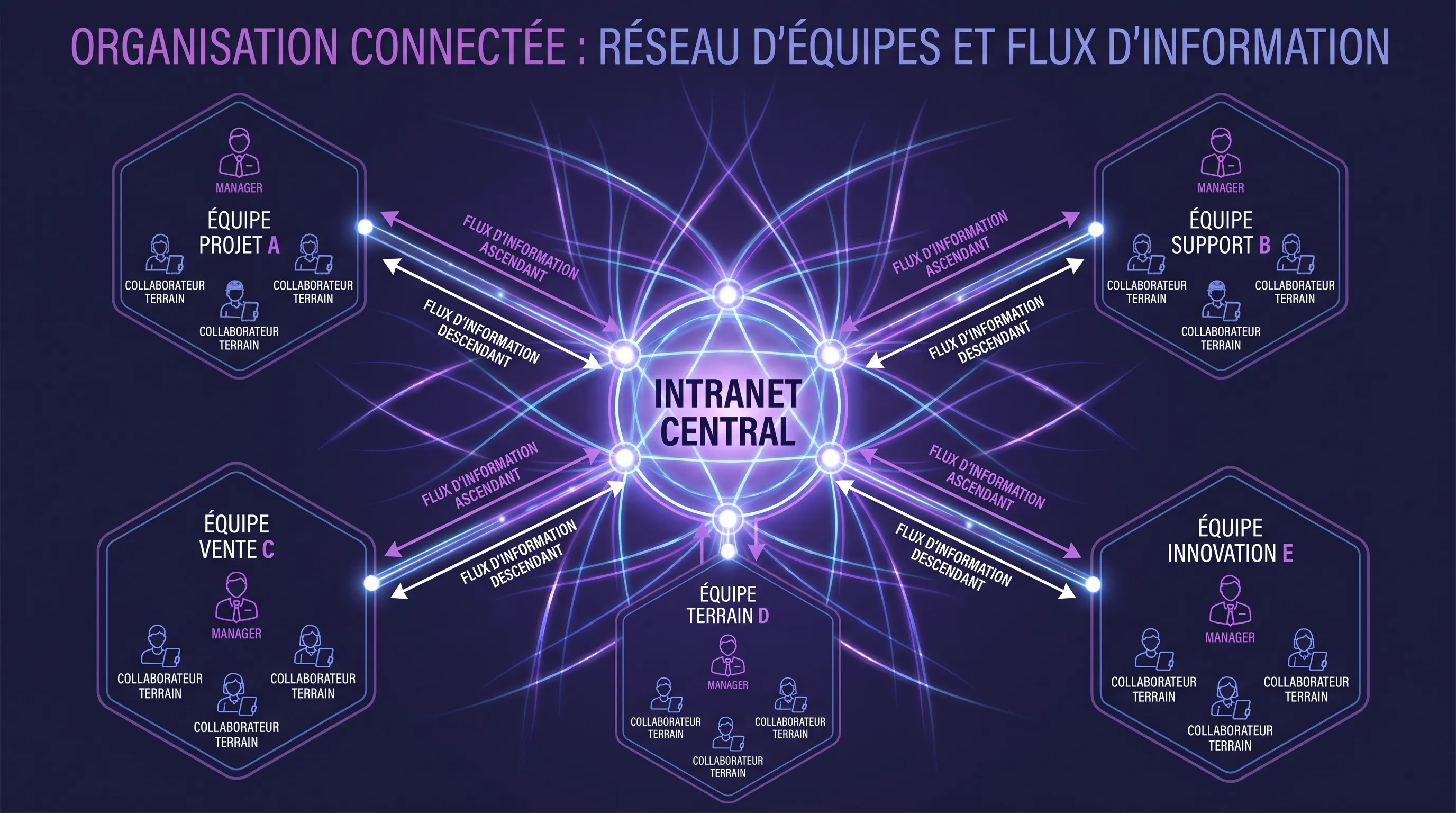
The problem is that many organizations still modernize by adding tools: an internal social network, another newsletter, an extra Teams channel, a new HR platform. As a result, information circulates more, but it also becomes more scattered. Modernizing, therefore, does not mean communicating more. It means making communication more readable, more useful, and more actionable.
For a large company, but also for a scale-up starting to structure itself, the priority projects are not all technological. They relate just as much to governance, usage, knowledge, AI, managerial rituals, and impact measurement.
Start by modernizing the model, not the channels
Before choosing a new platform, the role of internal communication must be clarified. In many large organizations, it is still thought of as a top-down channel: management speaks, teams receive. However, employees expect something else: to understand decisions, access the right resources, ask questions, contribute, and see that their feedback is actually used.
The first modernization therefore consists of moving from a broadcasting logic to an internal information system logic. This means that each flow must have a clear purpose: to inform, align, document, listen, decide, or train.
The symptoms of a model that needs modernizing are often visible:
Employees do not know where to look for reliable information.
Managers relay messages late or unevenly.
Important announcements get lost in chats and emails.
Field teams receive content that is poorly suited to their daily lives.
The same questions constantly come back to HR, IT, or managers.
Internal surveys produce data, but few visible actions.
This diagnosis is essential because it avoids confusing a tool problem with an architecture problem. If editorial responsibilities are blurry, if no one knows what is authoritative, if content is never updated, a new tool will not sustainably fix the situation.
Reduce tool dispersion
In a large company, internal communication often goes through a combination of emails, intranets, instant messaging, meetings, newsletters, HR applications, business platforms, and sometimes on-site screens. This diversity is not necessarily a problem. It becomes problematic when each channel reproduces the same content without a clear logic.
The real issue is not to artificially centralize everything. Some messages must stay in the chat, others in the intranet, others in a project tool or a document base. However, the company must clarify the function of each space.
Communication flow
Most suitable channel
What to avoid
Strategic announcement
Intranet, internal event, managerial relay
Publishing it only in a chat channel
Operational decision
Project tool, structured minutes, document base
Leaving it in an untraceable discussion thread
Quick question
Instant messaging or team channel
Turning every question into a meeting
HR policy or procedure
Intranet or knowledge base
Sending it only by email
Field feedback
Form, listening tool, manager ritual
Collecting it without getting back to the teams
This clarification is particularly useful for growing organizations that are starting to feel tool fatigue. If the challenge is to rationalize without breaking existing usages, a framework like the one presented in this article on choosing an internal communication tool without piling up solutions can help start from real needs rather than available features.
Make the intranet an operational single source of truth
The intranet often has a bad reputation: a rarely visited portal, too institutional, difficult to maintain. Yet, in large companies, it remains one of the best candidates to become the internal source of truth, provided its usage is modernized.
A modern intranet should not be limited to corporate news. It must allow an employee to quickly answer simple questions: what is the procedure? who is responsible? what is the latest version? what should I do now?
The difference is major. News informs, but a useful page saves time. For this reason, the most strategic content is not always the most visible articles. It is often the reference pages: HR policies, onboarding guides, IT processes, security information, document templates, validation rules, key contacts.
In a large organization, modernizing the intranet requires three concrete decisions. First, define the authoritative content. Second, assign update owners. Finally, organize the search around user intentions, not just around the organizational chart.
This is also where AI can become useful, provided there is a reliable foundation. An internal assistant plugged into obsolete documents modernizes nothing. It only accelerates the spread of incorrect information. Before deploying an augmented search engine or a conversational assistant, it is therefore necessary to clean up knowledge, handle duplicates, and clarify access rights.
In large companies, managers are often the most influential and under-equipped channel. They receive messages to relay, but not always the necessary context to answer questions. They must embody decisions, even when they discover them at the same time as their teams.
Modernizing internal communication therefore implies transforming the manager into a mediator of meaning, not just a simple relay. This means providing them with short kits, key messages, Q&As, adaptable materials, and a clear schedule.
A good managerial kit should not be a twenty-page PDF. It must help the manager explain what is changing, why it is changing, what is expected, what is not yet decided, and where to escalate questions. This transparency reduces interpretations and limits rumors.
Managerial communication must also be bidirectional. Managers often see what is really blocking things before central management does: misunderstandings, tensions, overload, poorly adopted tools, overly complex processes. Without a structured escalation mechanism, this information remains local.
Move from occasional internal listening to continuous listening
Many large companies already conduct engagement barometers or annual surveys. These mechanisms remain useful, but they are no longer enough when transformations accelerate. Between two surveys, a project can go off track, a team can disengage, or a misunderstanding can become widespread.
Modern listening combines several signals: short surveys, open questions, manager feedback, support request analysis, content comments, internal event participation, and tool usage data. The goal is not to monitor employees, but to detect irritants earlier and respond to them visibly.
The key is closing the loop. If employees give their opinion without ever seeing what changes, participation drops. Modernized internal communication must therefore integrate a simple ritual: you told us, we understood, here is what we are doing, here is what cannot be changed for now.
This logic builds trust. It also helps management distinguish a communication problem from an execution problem. Sometimes, messages are clear, but the tools do not follow. Sometimes, processes are good, but no one knows where to find them. Sometimes again, employees understand the strategy, but do not see the link with their job.
Use AI to reduce noise, not to produce more content
Generative AI has quickly found its place in communication usages: writing internal articles, summarizing meetings, rephrasing messages, translating, creating FAQs. According to the Microsoft Work Trend Index 2024, AI usage at work is growing strongly, but organizations still need to structure its adoption to extract value from it.
In internal communication, the risk is using it to produce more content, when employees are already suffering from information overload. The right usage is the opposite: helping to prioritize, summarize, personalize, and retrieve information.
Here are the most relevant use cases in a large company:
Automatically summarize long announcements for different audiences.
Generate FAQs from validated documents.
Help managers adapt a message to their local context.
Translate and rephrase content for international teams.
Identify recurring questions in internal channels.
Improve search in a reliable knowledge base.
Caution remains essential. Sensitive, HR, legal, financial, or strategic content must remain under human control. AI must be integrated into clear governance: authorized sources, editorial validation, access management, confidentiality rules, and traceability of answers.
For a company that does not know where to start, an AI opportunity audit often helps identify high-impact use cases without launching an overly broad project. This is precisely the type of approach where an agency like Impulse Lab can support teams, from identifying irritants to designing solutions adapted to existing tools.
Adapt formats to business realities
Internal communication often fails when it assumes everyone works the same way. A headquarters employee, a field technician, a store manager, an industrial operator, and a traveling salesperson do not have the same schedules, the same screens, or the same attention constraints.
Modernizing therefore means segmenting intelligently. Not to create fragmented communication, but to make messages truly accessible. Strategic content can have a long version for managers, a summary for everyone, an FAQ for HR teams, and a mobile format for field employees.
Asynchronous formats play an important role here. Short video, audio, internal carousels, visual summaries, and rich messages can complement written formats. But the format must never mask the essential: a useful internal message answers a concrete question and clearly indicates the expected action.
If your organization wants to explore these formats without falling into the fad effect, the article on new internal communication tools to test can serve as a basis for comparison between AI assistants, asynchronous video, augmented knowledge bases, and listening solutions.
Measure something other than the open rate
Classic indicators, such as a newsletter's open rate or an article's view count, remain useful. But they do not tell whether employees have understood, decided, or acted. A large company must therefore complement broadcasting metrics with effectiveness metrics.
Objective
Useful indicator
Question to ask
Inform
Read rate, reach by population
Did the right people receive the message?
Ensure understanding
Questions received, quiz results, verbatims
Is the message clear or ambiguous?
Drive action
Completion rate, process adoption
Did the expected behavior occur?
Reduce friction
Drop in repetitive requests
Can employees find the answer on their own?
Listen
Participation, quality of feedback, response time
Does feedback produce visible decisions?
This evolution changes the posture of internal communication. It is no longer content with just publishing. It observes the effects, adjusts formats, identifies areas of confusion, and works with business lines to improve the employee experience.
Prioritize modernization projects
Modernizing everything at once would be unrealistic. Large companies benefit from advancing through targeted projects, with visible results in a few weeks or months. A good method is to cross-reference two criteria: employee impact and implementation complexity.
Project
Potential impact
Complexity
Recommended priority
Clarify the role of channels
High
Medium
Very high
Clean up reference content
High
Medium to high
Very high
Create manager kits
High
Low to medium
High
Implement continuous listening
Medium to high
Medium
High
Deploy an internal AI assistant
High if data is reliable
High
Progressive
Personalize content by population
Medium to high
Medium
Progressive
Review all existing tools
Variable
High
To be scoped after diagnosis
Priority should often go to daily irritants. If employees cannot find procedures, if managers do not know what to relay, if channels cannibalize each other, the impact of modernization will be fast and measurable.
A simple 90-day roadmap
To launch modernization without creating an overly heavy program, a large company can structure a first 90-day cycle.
The first month is for diagnosis. This involves mapping channels, identifying critical content, surveying a few representative populations, and spotting duplicates. This phase must include business lines, HR, IT, communication, managers, and, if possible, field teams.
The second month is for simplification. The company clarifies the rules for using channels, selects a few reference contents to revamp, defines editorial responsibilities, and prepares managerial formats that are easier to relay.
The third month is for testing. A pilot scope is chosen, for example, a department, a region, or a business population. Comprehension, access to information, reduction of repetitive questions, and user satisfaction are measured. The lessons learned from the pilot are then used to deploy more widely.
This progressive approach is particularly suited to complex organizations because it avoids the tunnel effect. It also quickly shows that modernization is not an abstract initiative, but a concrete lever for productivity, alignment, and execution quality.
Frequently Asked Questions
What are the first elements to modernize in a large company's internal communication? Priorities are often clarifying channels, making the intranet or knowledge base reliable, equipping managers, and setting up more regular feedback loops.
Should all internal communication tools be replaced? Not necessarily. In many cases, it is first necessary to clarify usages, remove duplicates, and better integrate existing tools before adding or replacing them.
Is AI really useful for internal communication? Yes, if it is used to retrieve, summarize, adapt, and structure information. It becomes less useful, or even counterproductive, if it simply produces more content without governance or reliable sources.
How do you measure the effectiveness of internal communication? Beyond views and open rates, you must track comprehension, adoption of expected actions, the drop in repetitive questions, the quality of field feedback, and the ability to quickly correct irritants.
Can a scale-up draw inspiration from large company practices? Yes, especially to avoid problems before they become costly. Clarifying channels, documenting decisions, and structuring managerial communication are useful as soon as the company grows quickly.
Modernize without complicating
Modernizing internal communication should not become just another project for already busy teams. The right goal is to reduce complexity: less noise, fewer duplicates, less useless searching, more clarity, and more capacity for action.
To achieve this, strategy, usage design, technical integration, and change management must be combined. Impulse Lab supports organizations in this logic, with AI opportunity audits, custom web and AI platforms, automation, integration with existing tools, and adoption training.
If your internal communication relies on too many channels, too much scattered content, or too many manual processes, it might be the right time to identify what can be simplified, automated, or better connected. You can discuss with Impulse Lab to scope the right projects and transform your internal tools into true productivity levers.
In 2026, the AI sector is no longer just about spectacular generative models or viral demos. The most interesting markets are those where artificial intelligence reduces recurring costs, speeds up decisions, secures processes, or allows teams to produce more without immediate hiring.