A sales funnel isn't just for big companies. For an SMB or scale-up, it's a simple way to turn a "stream of requests" into a **predictable process**: knowing where prospects come from, where they drop off, and what to improve first.
January 13, 2026·7 min read
A sales funnel isn’t just for big companies. For an SMB or scale-up, it is primarily a simple way to turn a “stream of requests” into a predictable process: knowing where prospects come from, where they drop off, and what to improve first.
This quick guide is designed to get you started without building an “overly complex system” and to lay solid foundations before adding automation or AI.
The sales funnel, in one sentence
A sales funnel describes the steps a prospect goes through from discovery to purchase, with the following for each step:
Trap #1: wanting to cover everything from the start
When you are “starting out,” the right reflex is not to document 12 steps, 5 channels, and 20 automations. The right reflex is to build a minimal viable funnel that you can measure, keep up to date, and improve every week.
Concretely, your first version must answer 3 questions:
Who is your target client (and who isn’t)?
What is the action that proves interest (a request, a meeting, a trial)?
How do you measure the passage from one step to the next?
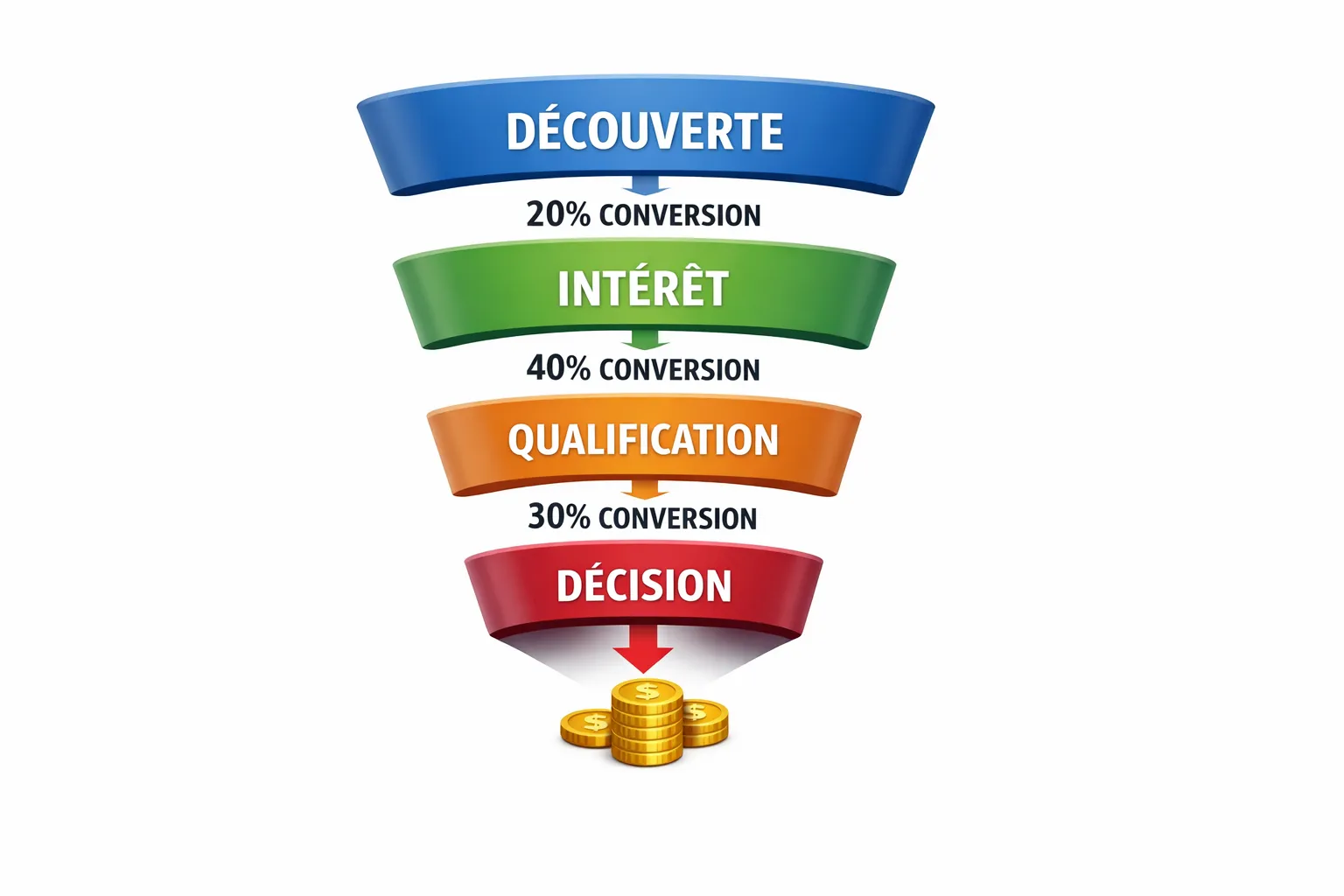
The minimal viable funnel: 4 steps, 4 conversions, 1 dashboard
To start quickly, use a simple 4-step structure. It works for many models (services, SaaS, B2B, high-ticket B2C).
Step
Objective
Expected Conversion
Asset Example
Basic KPI
Discovery
Attract the right profiles
Qualified visit
Content, ads, social, referral
Qualified sessions, CTR
Interest
Obtain a signal
Lead captured
Landing + form
Visit → lead conversion rate
Qualification
Verify fit + need
Qualified lead
Qualification call, scoring
% MQL, % SQL
Decision
Make the sale
Won deal
Demo, proposal, onboarding
Win rate, sales cycle
Step 1: define your ICP (before looking for more leads)
If your funnel attracts “everyone,” it will end up converting “no one,” or wasting the sales team's time.
The most profitable tool at the start is the ICP (Ideal Customer Profile): company size, sector, constraints, maturity level, stack, pain signals.
Add a “negative ICP” version (what you refuse) to filter right from the top of the funnel
Practical goal: write 5 lines that anyone in the company can use to say “yes” or “no” to a lead.
Step 2: choose 1 acquisition channel and 1 entry offer
A funnel that starts well is rarely one that uses the most channels. It is one that masters a channel and knows how to repeat a message.
Select a single main channel for the first 30 days:
inbound (SEO, content, webinar)
outbound (structured prospecting)
partnership (referrers, integrators, networks)
paid (ads)
Next, define an entry offer that reduces perceived risk (and friction): audit, diagnostic, workshop, scoped demo, guided trial.
Important point: the entry offer is not “a discounted product,” it is a step designed to move the prospect toward the decision.
Step 3: create a measurable (and simple) conversion point
Your sales funnel needs a place where “interest becomes data.”
In the majority of cases, start with a single main conversion:
“Request a meeting”
“Request a quote”
“Sign up for a trial”
This point must be:
visible (clear CTA)
trackable (analytics event)
actionable (data arrives in the right place)
regarding tooling, the classic foundation is a CRM, even a lightweight one. If you want to review the basics, the glossary page CRM (Customer Relationship Management) is a good reference.
Step 4: define your lead statuses (otherwise you won't be able to optimize)
To steer a funnel, you need statuses shared between marketing and sales. Otherwise, you will have “leads” in volume, but no reading on quality.
The simple version:
Lead (captured)
MQL (marketing qualified)
SQL (sales qualified)
Opportunity (in the pipeline)
Won / Lost
To avoid vague definitions, base them on standard benchmarks:
Even simple scoring (fit + engagement) often improves sales responsiveness because it avoids treating all leads as equivalent.
Metrics to track at the start (and only those)
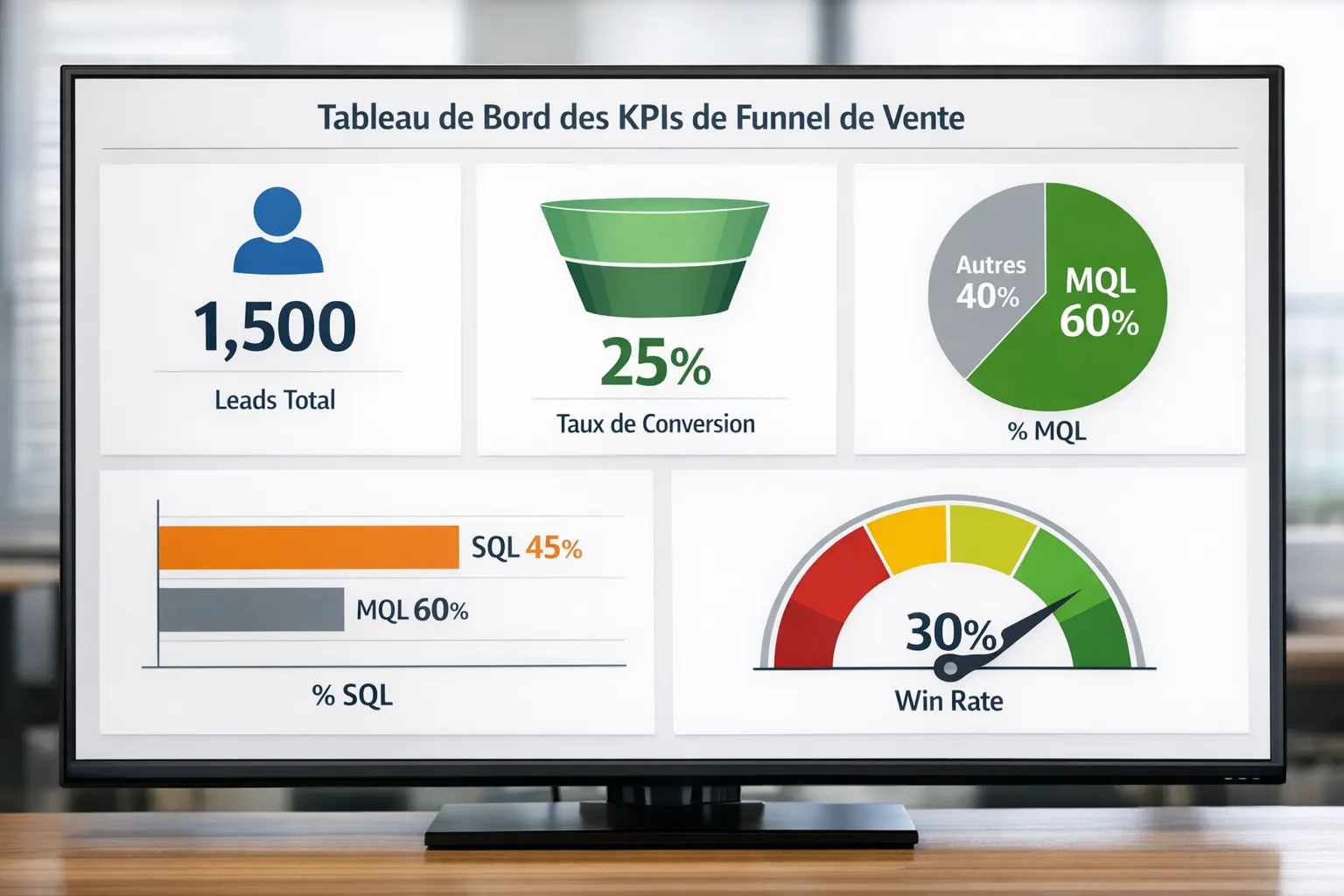
A frequent mistake is multiplying KPIs. For a first version, keep a short, action-oriented dashboard.
Area
KPI
Why it's useful
Frequency
Acquisition
Leads per week
Checks incoming volume
Weekly
Conversion
Visit → lead
Measures landing page efficiency
Weekly
Quality
% MQL, % SQL
Measures fit and sorting
Weekly
Sales
Win rate
Checks closing efficiency
Monthly
Speed
Cycle duration
Helps forecast revenue
Monthly
Tip: define a baseline (current value) before changing anything. Without a baseline, you are “optimizing” based on gut feeling.
Useful automations (without complicating your funnel)
Once your minimal viable funnel is in place, you can add a few high-leverage automations. The idea is to reduce friction and increase processing speed.
Automatic source attribution (UTM) and lead creation in the CRM
Slack or email notification when a “hot” lead arrives
Follow-up sequence if a form is filled out without booking a meeting
Light enrichment (sector, size) to help qualification
Routing (assignment) according to market, zone, or segment
Automatic status updates after a call (with simple rules)
If you want a more “system” framework regarding process alignment, tools, and data, the RevOps discipline is often what stabilizes funnels during the scaling phase: RevOps (Revenue Operations).
Where AI really accelerates a sales funnel in 2026
AI is effective when inserted into an already instrumented funnel. If your process is vague, AI will mostly automate confusion.
A few uses that often bring value quickly:
Assisted qualification (summarizing a request, suggesting questions, identifying fit signals)
Response support (email drafts, rewording, personalization based on known data)
Assistant on landing page to capture and orient (with a compliance framework and controlled content)
Enriched scoring (when you have enough history and decent data governance)
You can build a minimal viable sales funnel internally, but certain situations justify support:
your data is scattered (CRM, forms, emails, billing) and nothing is reliable
you have traffic, but few conversions, and you don't know “where it breaks”
you want to automate and integrate AI, but without risks (security, GDPR, governance)
Impulse Lab supports SMBs and scale-ups via AI opportunity audits, adoption training, and custom development (automation, integrations, web platforms, and AI). If you want to frame your funnel, instrument the right KPIs, and then automate properly, you can start with a conversation at impulselab.ai.
Accelerating Product Sheet Creation with Artificial Intelligence
Exploring AI content creation addresses a key need for e-commerce SMBs: producing more product listings without monopolizing copywriting teams. AI can draft descriptions and adapt tone, but compelling copy does not ensure factual accuracy—making clean data and structured review essential.