Choosing an **artificial intelligence platform** is no longer just a "tool" decision; it's a decision about architecture, compliance, and internal adoption. By 2026, most organizations have already tested generative assistants, but many struggle to move from the "wow" factor to a reliable system...
January 09, 2026·8 min read
Choosing an artificial intelligence platform is no longer just a “tool” decision; it’s a decision about architecture, compliance, and internal adoption. By 2026, most organizations have already tested generative assistants, but many struggle to move from the “wow” factor to a reliable, integrated, measurable, and secure system.
The goal of this article is simple: to give you concrete selection criteria (and questions to ask) to avoid two common traps: buying an oversized platform, or building a custom solution too early without foundations.
Before the criteria: what exactly do we mean by “AI platform”?
The term “AI platform” covers very different realities. Clarifying this category avoids comparing incomparable products.
AI Development Platform: access to models (LLM, vision, speech), SDKs, orchestration, RAG, agents, testing tools.
MLOps / “Classic” AI Platform: training, deployment, ML model monitoring (prediction, scoring), lifecycle management.
AI-Augmented Automation Platform: workflow orchestration, integrations, triggers, sometimes “agents” connected to tools.
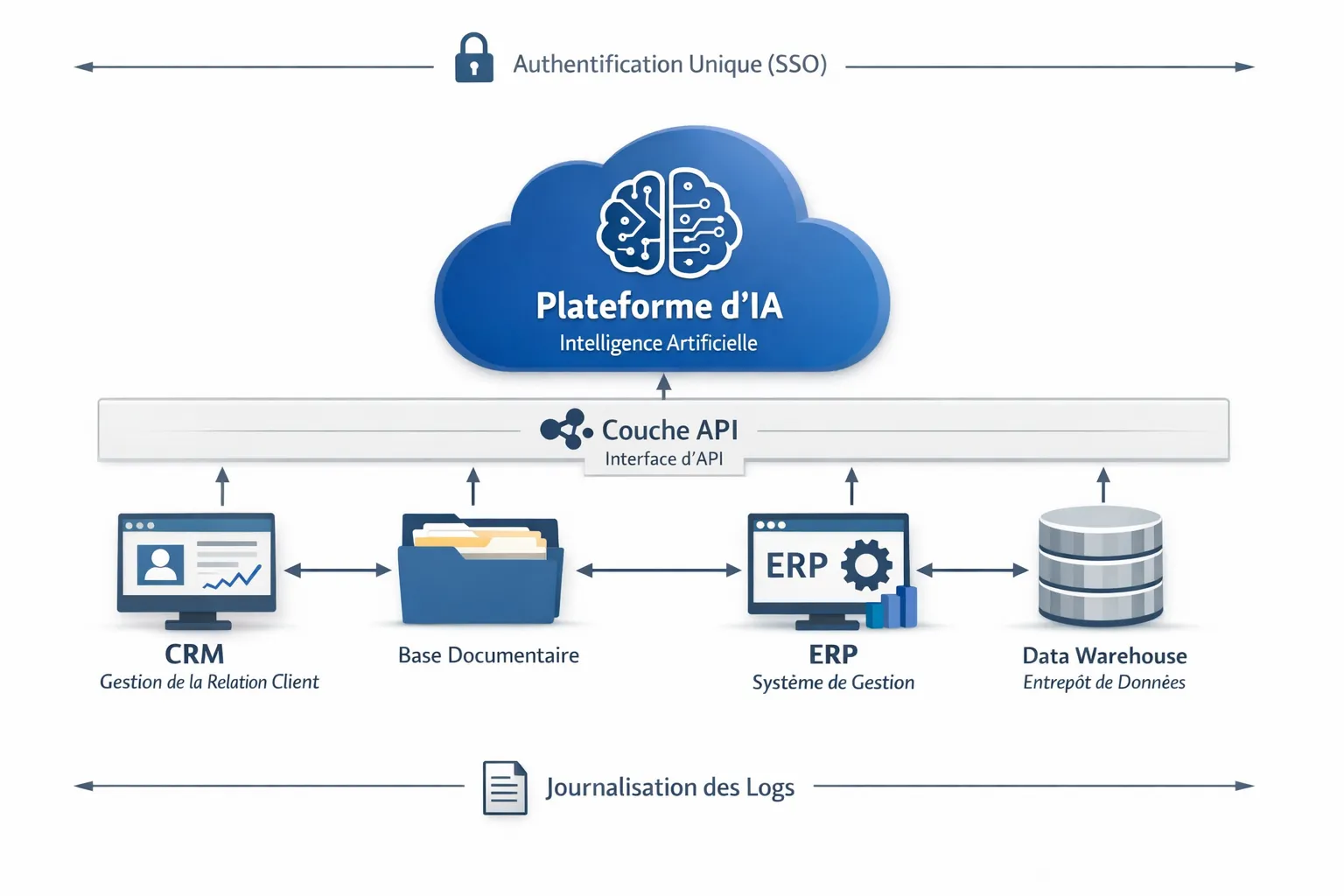
In practice, a company “that scales” often ends up with an assembly: a data foundation, an integration layer (API), a GenAI component (RAG, agents), and guardrails (security, governance).
Step 1: Frame the selection (otherwise, the criteria are useless)
Before evaluating platforms, put it down in black and white: who uses it, for what purpose, and how you measure value.
3 scoping questions to decide on
1) Which use cases to prioritize?
Customer support, internal assistant, CRM automation, document search, content production copilot, or processing chain (extraction, classification, response). Each use case changes your requirements: latency, traceability, integration, risk level.
2) What level of criticality?
A “comfort” usage (drafting, synthesis) is not managed like a decision-impacting usage (scoring, compliance, finance). Control and auditability requirements can skyrocket.
3) What data constraints?
Personal data, trade secrets, client data, legal documents, health data… Your platform strategy depends on sensitivity and obligations (GDPR, contracts, localization).
For the European regulatory framework, keep an eye on the progressive deployment of the European AI Act and its obligations according to risk usage. Reference: European Commission, AI Act.
Step 2: Selection criteria for an artificial intelligence platform
The criteria below are what make the difference between a seductive demo and an operational product in production.
1) Alignment with your use cases (and ability to go to production)
A platform can be excellent at “chat” but weak on: integrations, workflow, supervision, or knowledge management.
What you are looking for:
A clear path to production (authentication, roles, logs, environments, CI/CD, versioning).
Features consistent with your use cases (RAG, agents, extraction, classification, controlled generation, etc.).
Useful indicator: ask for deployment examples comparable to your context, and how the platform manages incidents (user feedback, fixes, rollback).
2) Integrations and architecture (API, connectors, events)
Value is rarely created “inside” the platform; it is created within your information system. An AI platform must therefore integrate cleanly: CRM, ERP, support tools, document base, data warehouse, SSO, etc.
Evaluate:
API Quality (auth, quotas, webhooks, idempotency, documentation, SDK).
Native connectors (useful, but shouldn't be a dependency trap).
Ability to fit into a clean architecture (separation of front, back, AI logic, storage, logs).
Isolation: multi-tenant, dedicated options, space partitioning, connector control.
On the GDPR side, make sure to clarify roles (data controller, processor), legal basis, retention periods, and transfers outside the EU. General reference: CNIL and GDPR.
5) Governance and compliance (AI Act, internal policies, “human in the loop”)
As AI touches important processes, you will need governance: who can deploy a prompt to prod, who validates an agent, who audits results.
Check:
Version management (prompts, configurations, models, workflows).
Usage policies: guardrails, forbidden content, filtering, red teaming.
If you need a framework to quickly scope risks and opportunities even before choosing the tool, a strategic AI audit often helps avoid hasty investments. Example approach: Strategic AI Audit: Mapping Risks and Opportunities.
Frequent mistakes when choosing an artificial intelligence platform
Confusing “AI platform” and “usage tool”
A generic assistant can be excellent for starting, but insufficient for business processes requiring integration, traceability, and control.
Ignoring the existing IS
If your platform doesn't integrate cleanly (CRM, support, docs, data), you create a technological island, and adoption collapses.
Underestimating governance
As soon as AI influences a decision, the question “who validates, who audits, who corrects” becomes central.
Not planning for the “run”
Without monitoring, logs, and metrics, you won't know if quality degrades, nor why.
When to prioritize a market platform, and when to consider custom-built
There is no universal answer. In general:
A market platform is relevant if your needs are standardizable, if adoption must be fast, and if your integration and governance constraints remain moderate.
A custom solution becomes interesting when you have specific workflows, strong requirements (security, data, traceability), and value lies in fine integration with your IS.
At Impulse Lab, the most robust approach is often hybrid: start from a business need, validate quickly, then build an integrated solution if security, automation, and ROI criteria require it (audit, development, training, and production rollout with regular iterations). To discuss this in your context (SME, scale-up, structuring organization), you can start from the home page: Impulse Lab.
Accelerating Product Sheet Creation with Artificial Intelligence
Exploring AI content creation addresses a key need for e-commerce SMBs: producing more product listings without monopolizing copywriting teams. AI can draft descriptions and adapt tone, but compelling copy does not ensure factual accuracy—making clean data and structured review essential.