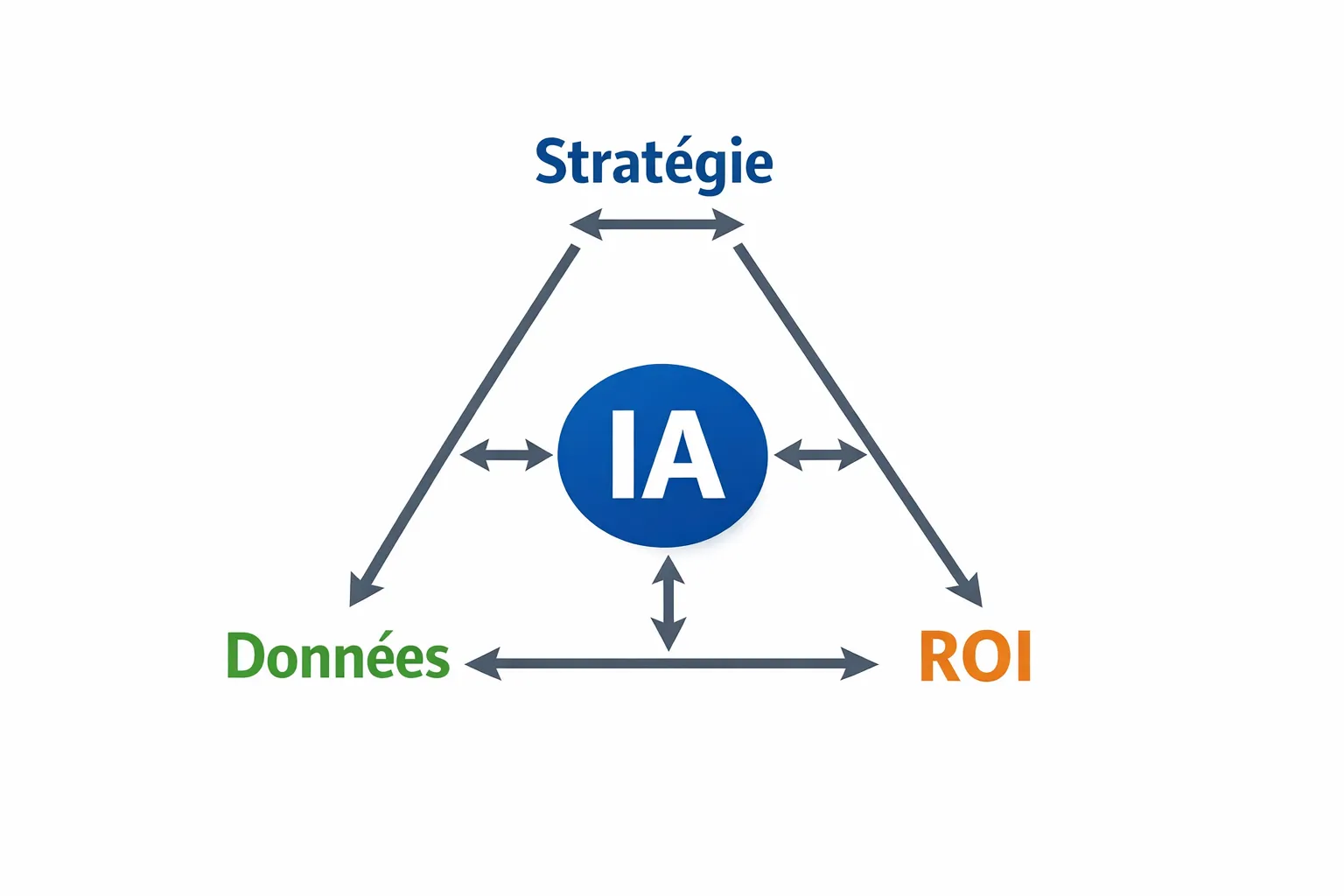
In 2026, the question isn't "should we do AI?" but "**how to make AI a measurable business lever**." Many companies invest in POCs and test assistants, only to face the same reality: gains are diffuse and hard to attri...
January 08, 2026·9 min read
In 2026, the question is no longer "should we do AI?", but "how to make AI a measurable business lever". Many companies invest in POCs, test assistants, automate a few tasks... then hit the same reality: the gain is diffuse, difficult to attribute, and the data isn't up to par.
The Business & AI topic thus becomes a matter of alignment. Alignment between strategy (where the company wants to create value), data (what makes AI truly actionable), and ROI (how to prove, steer, and arbitrate).
Why AI "works" in demos, but not in ROI
When an AI initiative disappoints, it is generally not because "the model is bad". The most frequent causes are structural.
1) The strategy is implicit. We launch AI because "everyone is doing it", or because a tool is impressive. Result: we optimize a task that doesn't really weigh on the P&L, or we automate a process that is already fragile.
2) Data is a bottleneck. AI depends on data that is accessible, clean, up-to-date, and linked to reality (clients, orders, tickets, operations). However, many organizations still have dispersed data, different definitions across teams, or tools that don't talk to each other.
3) ROI isn't "designed" from the start. Without a baseline, without a test protocol, without steering indicators, it becomes impossible to distinguish a real impact from a placebo effect. You can have decent adoption and zero ROI, or the reverse.
The goal is therefore not to "do an AI project", but to put AI at the service of a business trajectory, with data discipline and a measurement mechanism.
Pillar 1: Start with business levers, not AI features
To align strategy and AI, you must translate the strategy into concrete value levers. In most SMEs, scale-ups, and structuring companies, these levers fall into 5 families:
Experience: perceived quality, delays, service consistency.
Next, identify the processes where AI can act with a simple mechanism: decide better (classification, scoring, prediction) or act faster (automation, generation, assistance).
A good test: if you cannot link a use case to a business indicator already being tracked (or that you are ready to track), the use case is probably too much of a "gadget" at this stage.
Typical examples of "Business & AI" alignment (SMEs and scale-ups)
Without falling into an infinite list, here are frequent examples where alignment is often clear:
Customer Support: improving resolution rates, reducing handling time, absorbing growth without multiplying hires.
Sales ops / RevOps: enrichment and qualification, lead prioritization, reducing administrative work in the CRM (to be linked to your sales organization, see the RevOps glossary).
Finance: reconciliations, anomaly detection, reporting generation, accelerating the closing process.
Operations: planning, quality control, root cause analysis from incidents.
The key point: the business sponsor must be explicit (who owns the result), and the gain must be formulated as a testable hypothesis.
Pillar 2: Treat data as a product (and not as a "sub-topic")
AI highlights a sometimes uncomfortable truth: data is not an asset until it is usable.
For a company in a structuring phase, the challenge is not to build a "perfect data platform", but to secure the minimum viable data for your priorities.
The 4 "data readiness" questions to settle early
Availability: does the data exist (or can we capture it)?
Quality: is it consistent, complete, and sufficiently up-to-date?
Accessibility: can it be accessed easily, without manual extraction, and with clear rights?
Legality and risk: GDPR, trade secrets, sensitive client data, traceability.
Here is a simple grid to decide if a use case is ready, or if you need to invest in data first.
Data signal
Team symptom
Risk on ROI
Priority action
Data distributed across 5 unconnected tools
Reporting done "by hand" in spreadsheets
Delays, hidden costs, unusable models
Integrations and automations (light ETL)
Different definitions of the same KPI
Recurring debates in committees
ROI impossible to attribute
Governance (definitions, source of truth)
Incomplete or noisy history
The model "stalls" in production
Loss of confidence, abandonment
Targeted cleaning, quality rules
Sensitive data without a framework
Legal and security brakes
Project stop or high risk
Access policy, anonymization, contractualization
This approach avoids a classic trap: launching a "priority" AI use case without a reliable data pipeline, then concluding too quickly that "AI doesn't work".
For integration topics (API, permissions, data exposure), an architecture framework is often decisive. Impulse Lab has dedicated content on clean and secure integration models, useful if you are connecting AI bricks to your IS: AI API: Clean and Secure Integration Models.
Pillar 3: Make ROI manageable (before even developing)
ROI is not a slide at the end of a project. It is a design constraint.
The formula is simple, but the discipline is rare
ROI = (measured incremental gain) / (total cost of ownership)
Where it gets complicated is in the "measured" and in the "total cost". A serious AI initiative must include:
A baseline (before)
An output metric (what the system produces)
An outcome metric (what changes in the process)
An impact metric (what changes in the business)
Guardrails (quality, risks, satisfaction)
Here is a measurement chain model that works well for teams wanting to prove impact without getting locked into an overly complex system.
Set up an AI portfolio (and stop deciding on gut feeling)
When AI becomes strategic, you don't have "a project", you have a pipeline of initiatives. And therefore an arbitration problem.
A good practice is to steer a portfolio with a common grid, accepting that not all use cases have the same horizon.
Quick wins (2 to 6 weeks): targeted automations, internal assistants, extraction and synthesis, simple classification.
Core process (6 to 16 weeks): IS integration, data quality, process change, adoption.
Differentiation (3 to 9 months): custom platforms, product advantage, data moats.
A simple scorecard to prioritize without internal politics
Criterion
Question
Score (1-5)
Business Value
What impact on revenue, margin, risk, or experience?
Frequency
How many times per week/month does the case occur?
Data Readiness
Does the data exist and is it exploitable?
Feasibility
Integration complexity, dependencies, delays
Adoption
Will teams use it without friction?
Risk
GDPR, errors, reputation, compliance
You can then prioritize by (Value + Frequency + Adoption) versus (Data readiness + Feasibility + Risk), to obtain a realistic roadmap.
Governance: securing value creation (and avoiding "risky ROI")
AI increases speed, but also the surface of risk: sensitive data, automated decisions, hallucinations, bias, vendor dependence.
Two useful benchmarks in 2026:
The European regulatory framework, with the AI Act (European Commission), which structures obligations according to risk levels.
A risk management framework applicable in business, such as the NIST AI Risk Management Framework (useful for structuring policies, controls, and responsibilities).
Without going into a full audit, a pragmatic foundation includes:
Data rules: what can be sent to an external model, what must remain internal, and how to trace it.
Human controls: where the human validates, where AI assists, where AI executes.
A concrete 30-day plan to align strategy, data, and ROI
For an SME or a scale-up, the goal of the first month is not to "deploy AI everywhere". It is to make the decision rational and obtain a first measurable impact.
Week 1: Clarify the value strategy
Choose 1 to 2 levers (margin, revenue, cash, risk, experience) that are truly priority.
List 10 recurring operational pain points (lost time, errors, bottlenecks).
Formulate 3 result-oriented AI hypotheses (with a business owner).
Decide what is missing and what can be fixed quickly.
Week 3: Define measurement and test protocol
Baseline, metrics, guardrails.
Test population, duration, success criteria.
Total cost estimation (tools, integrations, team time, run).
Week 4: Launch a production-oriented pilot
Build a usable flow (even if simple), integrated into daily life.
Train the teams concerned (usage, limits, responsibilities).
Measure, iterate, decide (scale, stop, or invest in data).
This plan may seem "non-technical", but it is exactly what conditions the transition from POC to ROI.
The tipping point: industrializing what works
When you have a validated use case, the question becomes: how to make it reliable, maintainable, and aligned with your IS? This is often where the gap widens between a company that "uses AI tools" and a company that creates an advantage.
Industrialization generally implies: integrations, automation, governance, security, UX, change management, and a delivery cadence that allows for fast learning.
Impulse Lab supports these trajectories with AI opportunity audits, adoption training, and the development of custom web and AI solutions, with a product-oriented and production-focused approach. If you want to frame a roadmap or challenge your priorities, you can discover the agency at Impulse Lab.
Is an AI Use Case Registry Enough to Stay Compliant?
No. **An AI use case registry is a starting point, not sufficient proof of compliance.** It maps where AI is used, who owns it, and what risks to review. But a row in a spreadsheet neither proves data processing lawfulness nor fulfills AI Act requirements.