A **free sales funnel** isn’t a magic promise. It is mostly a pragmatic way to (1) capture leads, (2) qualify them, (3) follow up properly, and (4) measure what works, without waiting for “the perfect stack”.
January 28, 2026·8 min read
A free sales funnel isn’t a magic promise. It is primarily a pragmatic way to (1) capture leads, (2) qualify them, (3) follow up properly, and (4) measure what works, without waiting for “the perfect stack”.
In 2026, no-code and freemium plans allow for speed, but the real risk is piling up poorly connected tools (and unusable data). This guide gives you a selection of no-code tools to test and, above all, a simple way to assemble them into a minimum viable funnel.
Before choosing your tools: define your minimum viable funnel
If you don’t have a simple funnel, tools will only accelerate… confusion.
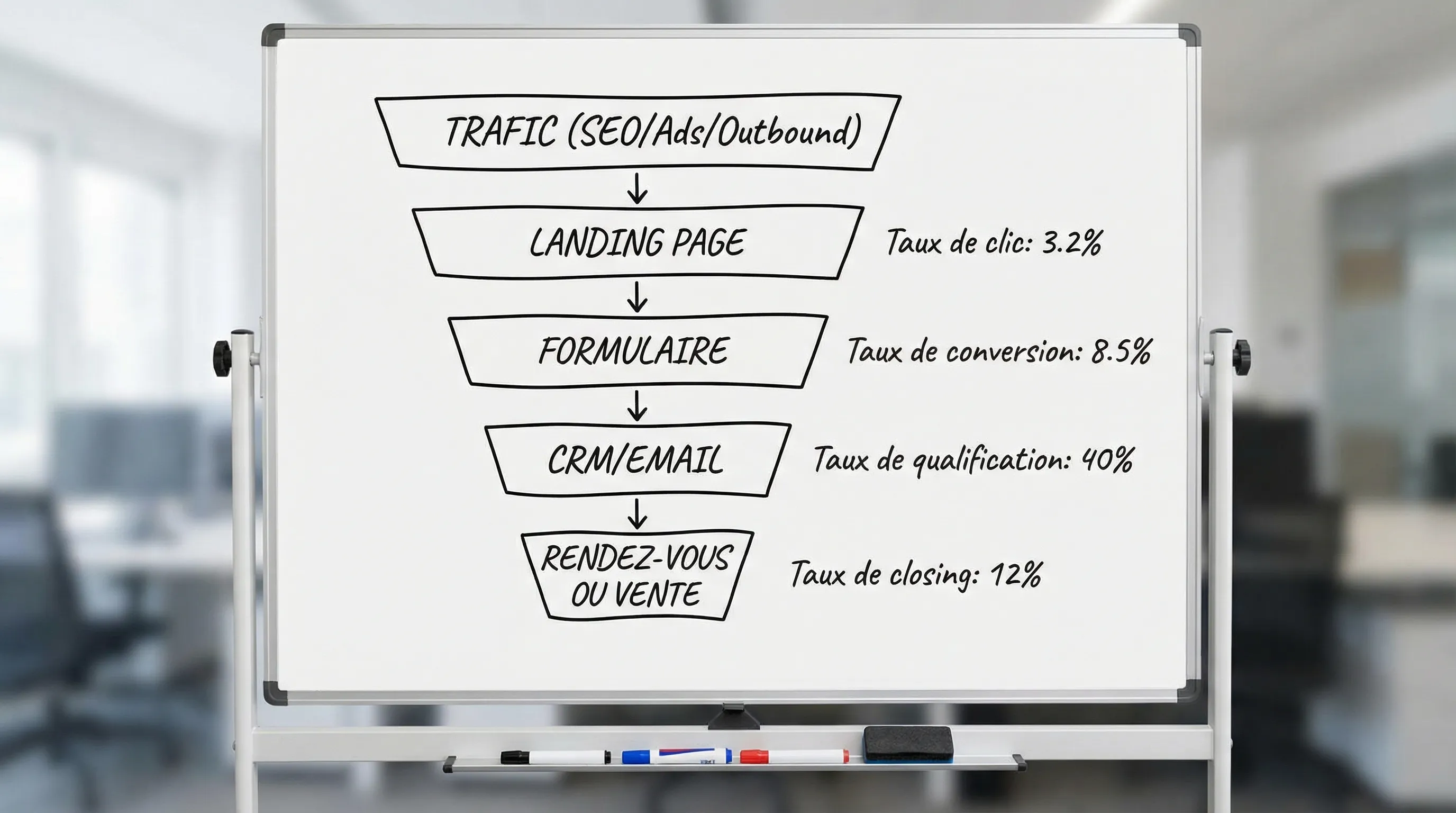
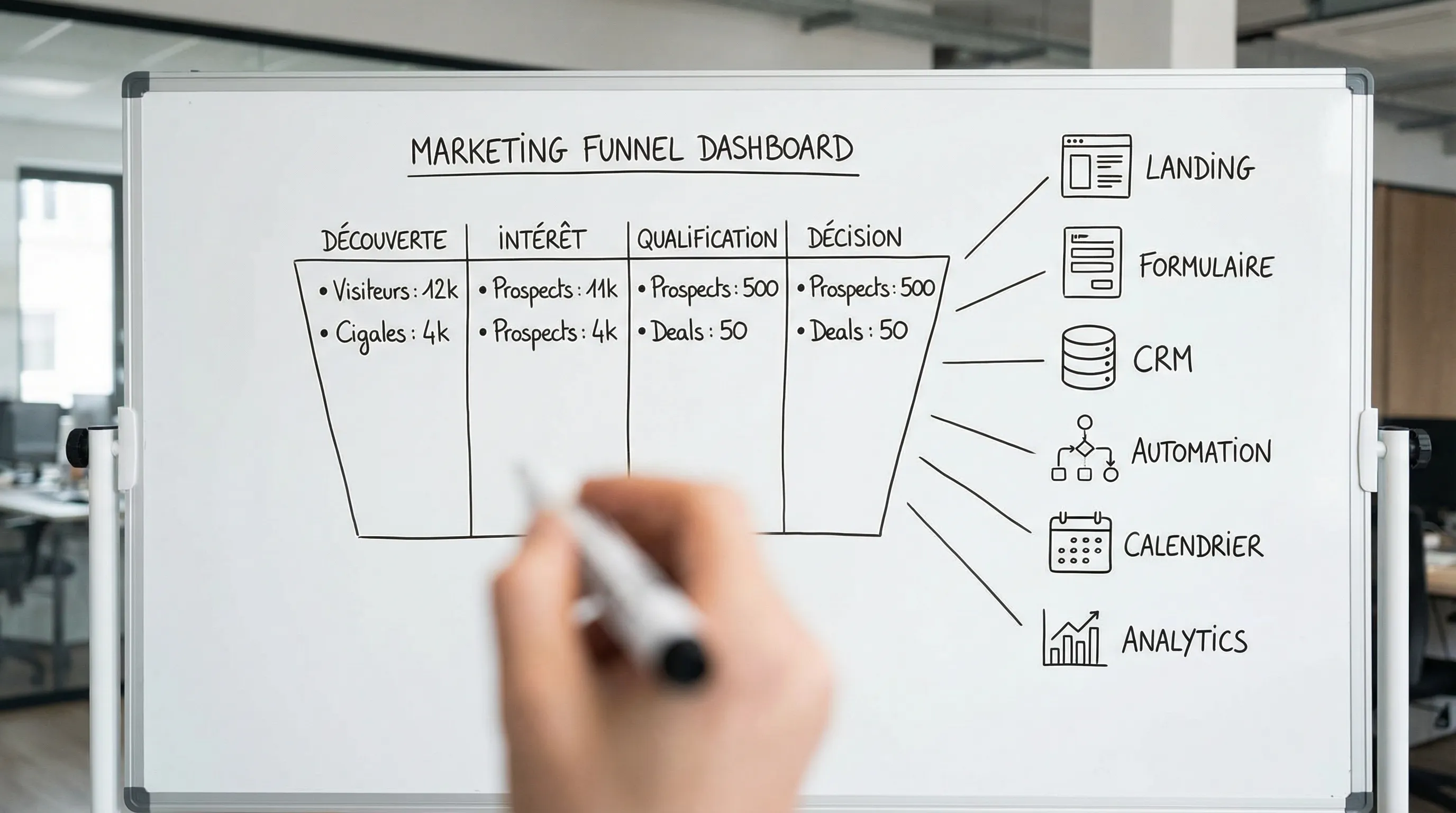
For most B2B SMEs and scale-ups, a minimum viable funnel consists of 4 steps:
Discovery: a priority traffic source (SEO, Ads, outbound, partners)
Interest: a page (or content) that captures attention and proposes a conversion
Qualification: a form + a simple rule (fit + intent)
Decision: an appointment booking or payment, depending on your model
If you want a more complete framework, you can start with the Impulse Lab guide on funnels, then come back here for the tooling: Sales funnel: quick start guide.
The classic trap: looking for “the perfect tool” instead of a measurable chain
The priority isn’t “the best builder” or “the best CRM”. The priority is a simple measurement chain:
1 main conversion (e.g., demo request)
1 priority acquisition source
1 follow-up system
1 place where data lives (a CRM, even a minimal one)
The “no-code stack” of a free sales funnel, step by step
A funnel works when each step has a clear objective and a “good enough” tool. Here is a useful map for choosing.
Funnel Stage
Objective
Absolute Must-Haves
Can Wait
Discovery
Generate qualified traffic
UTM Tracking, clear promise
Advanced personalization
Interest
Convert to action
Fast landing + proof + CTA
Complex A/B testing
Qualification
Sort and route
Form + simple scoring
Predictive scoring
Decision
Advance the deal
Calendar + follow-ups + CRM
Advanced multi-channel workflows
9 no-code tools to test for a free (or almost free) sales funnel
The tools below have free plans or trials. Limits and conditions change often, so consider them as starting points.
1) Framer (fast landing pages)
Framer is particularly effective when you want to release a clean landing page in a few hours, with a very “modern site” experience.
Good choice if:
you iterate your messages often
you need pages per offer, persona, or channel
Point of vigilance: if you are aiming for a very deep SEO architecture (many pages, long content), check that your choice of builder aligns well with your SEO strategy.
2) Webflow (marketing sites and conversion-oriented pages)
Webflow remains a reference for a more structured marketing site, when you want to keep control over design, performance, and conversion pages.
Good choice if:
you want a “real” marketing site that can scale
you need to align branding, content, landing pages, and tracking
Point of vigilance: power comes with a learning curve (or the need for a partner).
3) Carrd (ultra simple, ultra fast page)
Carrd is ideal for an MVP: a single page, a single message, a single CTA. It is often the best option to validate a value proposition before investing.
Typical use case: an entry offer (audit, diagnostic, template) with a form or meeting link.
4) Tally (no-code forms, clean and effective)
Tally allows you to build forms very quickly, with a pleasant UX and enough logic to do simple pre-qualification.
Concrete example of “simple but useful” qualification:
budget (range)
timing (this quarter or later)
context (current tool, main problem)
The goal isn’t to “know everything”, it’s to sort.
5) HubSpot CRM (free CRM to centralize data)
HubSpot CRM is often the simplest choice to centralize contacts, companies, deals, and lay clean foundations.
Good choice if:
you are starting from scratch on sales structuring
you want a CRM that “holds up” even if you grow
Point of vigilance: do not create 50 properties right from the start. Start with a maximum of 10 actually used fields.
6) Brevo (emailing and “accessible” automation)
Brevo (formerly Sendinblue) is a common option in France for transactional and marketing emailing, with simple nurturing scenarios.
Make is one of the best entry points for automating without code: sending leads from the form to the CRM, notifying Slack, enriching a field, triggering a sequence, etc.
Matomo is an alternative to Google Analytics when the question of data control and compliance becomes central.
Important reminder: the analytics tool doesn’t “do” compliance on its own. Also think about your cookie banner, data minimization, and your GDPR documentation.
2 “free sales funnel” stacks ready to test
The goal here isn’t to be exhaustive, but to give you two coherent assemblies that you can activate quickly.
Stack A (B2B services): qualified appointment booking
Landing: Framer or Carrd
Form: Tally
CRM: HubSpot CRM
Automation: Make
Meeting: Calendly
Analytics: Matomo (or your current solution)
What you measure from week 1:
landing → form conversion rate
qualified form rate (fit + intent)
held meeting rate
Stack B (scale-up with content): SEO + nurturing
Site: Webflow
Form: Tally
CRM: HubSpot CRM
Emailing: Brevo
Automation: Make
Analytics: Matomo
What you measure from week 1:
conversions per page (top 10 pages)
email activation rate (open, click, reply)
average lead → opportunity time
How to avoid no-code chaos (and keep a manageable funnel)
No-code facilitates everything, including bad habits. Three simple rules avoid 80% of problems.
1) Choose your “source of truth”
Decide where the commercial truth lives (often the CRM). Then, you feed this system rather than letting each tool have its own version of reality.
2) Standardize 5 events
Even without a data team, you can standardize a few events:
page_view (with UTM)
lead_created
lead_qualified
meeting_booked
deal_won or deal_lost
This is enough to detect where things are blocking.
3) Formalize a mini “data” policy for the funnel
Even a “free” funnel can handle sensitive data (depending on your sector). Set at a minimum:
what data is forbidden in free text fields
who accesses leads and histories
how long you keep unconverted leads
If you work with AI workflows or assistants, also take into account the risks of leakage, retention, and uncontrolled usage (Impulse Lab has published several resources on AI security and governance, useful when you scale).
When a free funnel is no longer enough (signals to switch to custom)
A free sales funnel is perfect for starting, but certain signals indicate that you need to invest in a more robust integration.
You have multiple sources (SEO + Ads + outbound) and attribution becomes blurry
Qualification requires business rules (complex ICP, multi-signal scoring)
Your teams spend time “fixing” data (duplicates, empty fields)
You want to connect the funnel to your internal tools (ERP, product base, support)
In these cases, a short ROI-oriented audit helps prioritize what needs to be industrialized, and what can remain no-code.
Is a free sales funnel enough for an SME? Yes, if your goal is to validate an offer, a channel, and a main conversion. As soon as you have multiple channels, complex qualification, or IT integrations, “free” quickly reaches its limits.
Which no-code tools to choose to start fast? A simple landing page (Framer or Carrd), a form (Tally), a CRM (HubSpot CRM), an appointment booking tool (Calendly), and an automation layer (Make) already cover 80% of needs.
How to know if my funnel works, without advanced analytics? Track 3 ratios: landing → lead conversion, share of qualified leads, qualified lead → meeting or sale conversion. If one of the three is low, you know where to iterate.
Is no-code GDPR compliant? It depends on the tools, their configuration, and your usage (collected data, retention duration, processors, consent). Set minimal rules and avoid collecting useless data.
When should I switch to a custom solution? When data becomes critical (quality, traceability), integrations become numerous, or the funnel is a strategic asset (attribution, personalization, advanced automations, compliance).
Need a funnel that converts and holds up in production?
If you have already tested a free sales funnel but feel its limits (scattered data, fragile integrations, lack of steering), Impulse Lab can help you structure a “production” version without overinvesting.
Audit of opportunities and quick wins (process, data, stack)
Robust integrations and automations (without no-code debt)
Development of custom web and AI platforms when justified
Adoption training so the team actually uses it
Contact the team via Impulse Lab to frame your funnel and transform your tools into a measurable, reliable, and ROI-oriented system.