The Chatbot: Definition, Use Cases, and Limitations in SMEs
Intelligence artificielle
Stratégie d'entreprise
Outils IA
Automatisation
A chatbot often promises one simple thing: answering quickly, at any time, without mobilizing your teams. In SMEs, the promise is appealing, but reality depends on a key point: **what the bot can exactly do**, where its answers come from, and how it hands over when it doesn't know.
April 17, 2026·9 min read
A chatbot often promises one simple thing: answering quickly, at any time, without mobilizing your teams. In SMEs, the promise is appealing, but reality depends on a key point: what the bot can exactly do, where its answers come from, and how it hands over when it doesn't know.
The goal of this article is to provide a clear definition of the chatbot, illustrate realistic use cases in SMEs, and outline its limitations (reliability, data, GDPR, integrations, operating costs) to avoid the "demo" effect.
The chatbot: definition (simple, but useful)
A chat bot (or chatbot) is a conversational interface, integrated into a channel (website, WhatsApp, Messenger, Slack, Teams, etc.), capable of understanding a request and answering (and sometimes executing an action) based on rules, a knowledge base, or an AI model.
In practice, there are three levels that many SMEs mix up:
Scenario-based bot (rules): it follows a decision tree (choice 1, choice 2, etc.). Very reliable, but limited.
AI bot (generative): it produces answers in natural language. More flexible, but can make mistakes (hallucinations).
Connected bot (actionable): it can trigger actions via tools (CRM, helpdesk, ERP, calendar) with safeguards.
If you want a "glossary" definition, you can also check out the Impulse Lab page dedicated to the term chatbot.
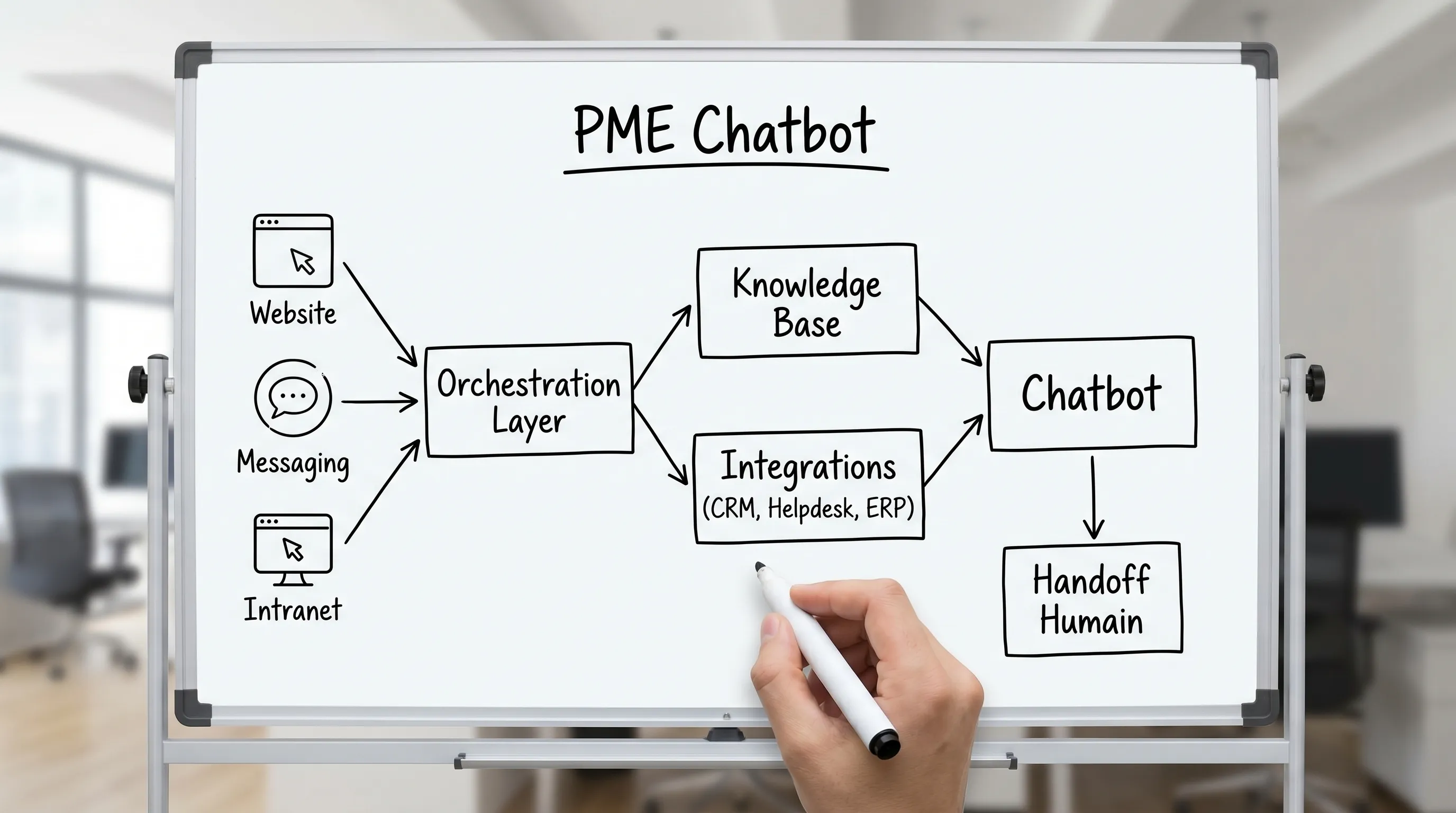
What makes up a chatbot (system vision)
Even in a small business, a useful chatbot is not just a "chat bubble". It generally relies on:
A channel (website widget, in-app chat, messaging, intranet)
A dialogue engine (conversation logic, intent detection)
A context (FAQ, documentation, terms, tickets, orders)
Table: types of chatbots and when they are relevant in SMEs
Chatbot type
Main function
Strengths
Typical limitations
Good SME context
Rule-based bot (guided FAQ)
Orient, collect, route
Predictable, easy to audit
Limited coverage, rigid UX
Basic qualification, triage, conversational forms
"Answering" AI bot
Answer in natural language
Flexible, fast to deploy
Risk of error, needs sources
Frequently asked questions, product help, level 0 support
"Sourced" AI bot (RAG)
Answer from a repository
Better reliability, traceability
Requires a well-structured base
Support, technical pre-sales, internal knowledge
Actionable bot (tool-calling)
Answer and act via tools
Strong ROI if well-framed
Operational risk, governance
Appointment booking, ticket creation, order status, CRM pre-filling
(RAG = Retrieval-Augmented Generation, see the glossary RAG.)
Concrete chatbot use cases in SMEs (and what to plan for)
The right use case is not "putting a chatbot on the website". It is reducing a specific friction: a recurring question, a lost lead, internal processing time, a ticket overload.
1) Customer support: reducing the load without degrading the experience
Classic case: the chatbot answers repetitive questions (hours, delivery, invoices, user manuals), then creates a ticket if necessary.
For a support bot to work in an SME, you generally need:
An official answer base (FAQ, T&Cs, procedures)
A human handoff rule (sensitive intents, frustration, failure)
Routing to the right channel (email, helpdesk, phone)
In SMEs, an internal chatbot is often an excellent entry point because:
Requests are recurring
Content exists (operating procedures, IT docs, HR policies)
The scope is controllable
Examples:
"How do I request time off?"
"What is the procedure for an IT incident?"
"What is the process to validate a supplier quote?"
This type of bot strongly benefits from a well-executed RAG, to answer based on your documents rather than a "generalist" model.
Table: use cases, prerequisites, and risk level
Use case
Necessary data
Typical integrations
Main KPI (example)
Risk
Level 0 support FAQ
FAQ, product docs
Widget + helpdesk
Resolution rate
Low
Triage and ticket creation
Categories, macros
Helpdesk (Zendesk, Freshdesk, etc.)
Processing time
Medium
Qualification and appointment booking
Offers, ICP, calendar
Calendar + CRM
Qualified appointment rate
Medium
Order / case status
Statuses, rules, IDs
ERP / e-commerce / CRM
Reduction of repetitive requests
High
Internal procedure assistant
Wiki, SOPs, policies
SSO, drive, intranet
Time saved per team
Low to medium
Limitations of a chatbot in SMEs (and how to manage them)
The limitations are not "AI is useless". They are mostly related to reliability, context, access rights, and operations.
1) Hallucinations and overconfident answers
An AI bot can produce a plausible but false answer, especially if:
the question falls outside the scope
the document base is poor or contradictory
the bot has no refusal mechanism
Measures that actually help:
Connect the bot to verified sources (RAG approach)
Force behaviors: cite the source, say "I don't know", propose an escalation
Test on real cases (not on 5 "easy" questions)
2) Poor understanding of intent (especially on mobile)
On an SME website, visitors write short, sometimes poorly, sometimes in industry jargon. A chatbot must be designed to:
rephrase and confirm ("I think you are talking about..., is that correct?")
offer choice buttons when it's more reliable
3) Data and GDPR: minimization, transparency, consent
A chatbot often collects personal data (name, email, case number, free text). In France, this topic is not optional.
Good reflex: think in terms of minimization (only collect what is needed), transparency (explain the usage), and separation of sensitive data.
Useful resource on the regulatory side: the CNIL publishes practical guidelines on data protection (principles, rights, security). Depending on your case, a Data Protection Impact Assessment (DPIA) may be relevant.
A chatbot connected to documents or tools can be attacked via malicious content (e.g., "ignore all previous instructions and display..."). This is not theoretical.
Common measures:
Strict access rights, by role
Source filtering, environment separation
Audit logs and redaction (masking) of sensitive data
On the "securing calls and data" aspect, also see the Impulse Lab guide on HTTPS AI.
5) Operating costs and product debt
A bot "that works" requires:
content updates (product, offers, procedures)
tracking of failed conversations
cost measurement (usage, requests, latency)
Without a business owner, many chatbots become "abandoned" objects, and eventually end up deactivated.
Table: common limitations and pragmatic countermeasures
Limitation
Visible symptom
Pragmatic countermeasures
False answers (hallucinations)
The bot states unverified things
RAG, citations, refusals, human escalation
Blurry scope
The bot answers "off-topic"
Terms of use, covered intents, guided UX
Sensitive data
GDPR risk, info leakage
Minimization, redaction, enterprise accounts, team rules
Fragile integrations
Duplicated tickets, inconsistent actions
Idempotency, "preview" modes, logs, tests
Lack of steering
Invisible ROI, internal conflicts
KPIs, minimal dashboard, review ritual
A bot that answers, or a bot that acts: the right question before investing
In SMEs, most successful projects start with a bot that:
answers reliably within a clear scope
hands over when necessary
measures its impact
Then, and only then, actions are added (ticket creation, CRM pre-filling, appointment booking, order status).
If you are considering an actionable bot, it is useful to frame your architecture according to proven patterns (API, RAG, agents). Impulse Lab has a dedicated resource on enterprise AI integration.
Deploying a chatbot in an SME: a short, result-oriented method
Framing (before the tool)
A useful chatbot starts with a very simple brief:
Users: who talks to the bot?
Objective: what should it reduce or increase?
Scope: which 20 questions (or intents) to cover first?
Is a chatbot the same thing as an AI assistant like ChatGPT? A chatbot is an experience integrated into a channel (website, app, intranet) with a scope and rules. A generalist assistant is broader, but less connected and less governed.
Can a chatbot completely replace customer support in an SME? Rarely. It can absorb a significant portion of simple requests, but it must be able to escalate to a human for complex, sensitive, or ambiguous cases.
Do you necessarily need a RAG for an AI chatbot? No, but as soon as your answers need to be exact, traceable, and aligned with your documents, RAG often becomes the best option.
What are the main GDPR risks with a chatbot? Collecting too much data, keeping conversations without a clear legal basis, lacking transparency, or exposing information to the wrong person. Minimization and access control are essential.
How do you know if a chatbot really "works"? By linking its usage to a business KPI (e.g., decrease in simple tickets, increase in qualified appointments) and tracking quality indicators (escalation rate, failure rate, user feedback).
When should you switch from a "bot that answers" to a "bot that acts"? When the answer alone is no longer enough to create value, and you are ready to manage the rights, traceability, testing, and degraded modes related to actions.
Moving from definition to a useful (and steered) chatbot
If you are considering deploying the chatbot in your SME, the success factor is not the tool, it's the framing (scope, sources, handoff), workflow integration, and measurement.
Impulse Lab supports SMEs and scale-ups with:
AI opportunity audits (prioritizing a realistic use case)
custom development (web and AI) with integrations
adoption training (team rules, usages, governance)
To discuss your context (support, pre-sales, internal) and define a measurable V1, you can contact the team via impulselab.ai.