In 2026, an SME "testing AI" without a method risks impactless POCs or rushed deployments. The good news is that an **SME AI lab** can be launched and set in motion in **90 days**, provided the lab is treated as a product (objectives, backlog, iterations), not as an innovation showcase.
January 08, 2026·9 min read
In 2026, an SME that “tests AI” without a method quickly finds itself in one of two scenarios: a succession of POCs with no impact, or a rushed deployment that creates risks (data, compliance, adoption). The good news is that an SME AI lab can be launched and set in motion in 90 days, provided the lab is treated as a product (objectives, backlog, iterations), not as an innovation showcase.
This guide proposes a concrete plan to launch and scale an AI Lab in 3 months, with a cadence, deliverables, and decision criteria designed for structures that are starting to structure themselves and scale.
What we call an “AI lab” in an SME (and what it is not)
In an SME, an AI lab is generally neither an R&D department nor an isolated team of data scientists. It is a transverse capability to:
Identify AI opportunities linked to processes (sales, ops, finance, support, HR)
Prototype quickly, test in real conditions
Industrialize only what proves measurable value
Diffuse usage via training and standards (governance, security, quality)
An SME AI lab is therefore a delivery mechanism. The right indicator is not “how many POCs”, but “how many validated gains” (time, quality, revenue, risk).
To contextualize the stakes, McKinsey estimated that genAI could generate 2.6 to 4.4 trillion dollars of potential annual value (across all sectors), but real value depends mostly on execution and adoption, not technology alone (McKinsey, 2023).
The “minimum viable” prerequisites before Day 1
You don’t need a perfect data platform to start, but you need a clear foundation.
1) An explicit business target
Choose a maximum of 1 to 2 priority objectives for 90 days, for example:
Reduce client request processing time
Increase inbound conversion rate
Decrease administrative load (invoices, follow-ups, data entry)
Reduce data entry errors or non-compliance
Without a target, the AI lab becomes a “tool catalog”.
2) A sponsor and an arbiter
You need:
A sponsor (CEO, COO, CFO, Head of Sales) who protects the teams’ time
An arbiter who decides on priorities (often COO, or a Product/Operations duo)
3) A simple rule on data
Write down in black and white:
Which data is forbidden in external tools
Which data is authorized, and under what conditions
Who validates a new flow (IT, DPO, CISO depending on your context)
In France, rely on CNIL resources to frame GDPR and risks. And keep in mind that the European regulatory framework is evolving, notably with the EU AI Act (risk-based approach, reinforced requirements for certain systems).
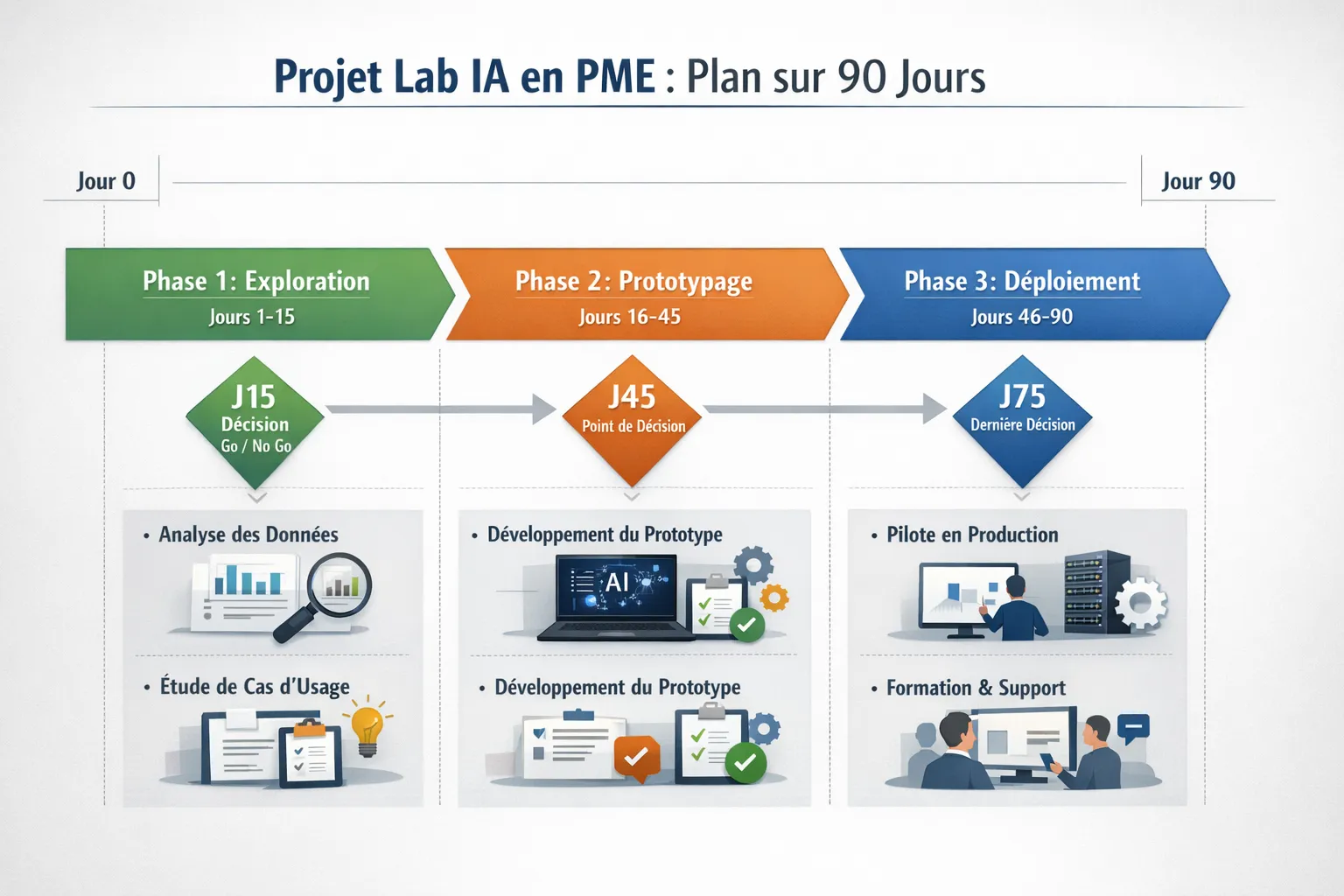
The 90-day roadmap (with deliverables and passage criteria)
The goal is not to “do everything”, but to create a delivery machine: discovery, build, deployment, measurement, iteration.
Overview
Period
Objective
Concrete deliverables
Passage criterion
D1 to D15
Frame, prioritize, secure
Scored use case backlog, data/risk charter, experimentation plan
Top 2 to 4 cases validated, metrics defined
D16 to D45
Prototype and test
Functional prototypes, test scripts, initial measurements
At least 1 confirmed “quick win” or a solid pilot
D46 to D90
Pilot then industrialize
Pilot in limited production, integrations, monitoring, adoption plan
ROI or gain validated, scale plan, standards established
Phase 1 (D1 to D15): framing, backlog, risks, metrics
The number 1 trap in SMEs is starting with “which AI tool to choose”. Phase 1 must answer “where is the value, and how to prove it quickly”.
Build an impact-oriented use case backlog
A good AI backlog is described in business language. Example:
“Answer simple support emails in less than 2 minutes, with human validation”
“Prepare a structured sales meeting report in the CRM”
“Check supplier invoices and flag anomalies”
Each item must specify: users, frequency, pain point, available data, risks, and metric.
Simple, but non-negotiable scoring
To avoid endless debates, use a scoring grid (even out of 5 points) with:
Business value (time, euros, risk)
Feasibility (data, integrations, complexity)
Proof timeframe (in days)
Risk (sensitive data, compliance, possible errors)
Adoption (team ready, stable process)
Define KPIs before coding
If you don’t know how to measure, you won’t know how to scale.
Category
Useful KPIs in SMEs
Measurement example
Productivity
Time saved, tasks avoided
Minutes saved per file, per week
Quality
Error rate, rework
% of human corrections necessary
Customer experience
Response time, CSAT
Average delay, satisfaction score
Revenue
Conversion, pipeline
Qualified leads, meetings booked
Risk
Incidents, compliance
Number of critical errors avoided
Key deliverable: a common “test protocol”
Formalize an internal protocol inspired by experimentation approaches: hypothesis, test population, duration, metrics, decision. Impulse Lab also has a useful article if you want to structure this aspect: Enterprise AI test: simple protocol to validate your ideas.
Phase 2 (D16 to D45): prototypes in real conditions, not demos
Between D16 and D45, the goal is to obtain proofs, not promises.
Choose the right prototype formats
In SMEs, three formats work particularly well:
Internal Copilot: AI assists, human decides (very good for starting)
Automation with validation: AI proposes, a manager approves
Batch processing: AI prepares, the team checks at the end of the day
This avoids the “autopilot” risk too early, especially on client, financial, or legal topics.
Think integration from the start
A prototype “in a corner” doesn’t scale. Even in a quick version, plan for:
Where the AI runs (tool, application, API)
Where the results go (CRM, helpdesk, ERP, drive, internal database)
If you aim for scale, finish the 90 days with a usable pack:
Element
What it’s for
What it looks like
AI Lab Playbook
Repeat the method
Processes, milestones, templates
Backlog V2
Scale up
Prioritized and quantified use cases
Data and risk standards
Accelerate safely
Rules, validations, roles
KPI Dashboard
Prove value
5 to 10 metrics max
6-month plan
Budget and staff
Roadmap and capacity
The typical (lean) team to succeed in an SME
You don’t need 10 specialists. You need clear roles.
Role
Responsibility
Common profile in SME
Sponsor
Arbitration, time protection
CEO, COO, CFO
AI Lab Product Owner
Prioritization, metrics, adoption
Ops, Product, RevOps
Business Referent
Use cases, quality validation
Support, Sales, Finance
Tech Lead / Integration
Connections, security, deployment
Internal dev or partner
DPO/CISO (depending on context)
Compliance, risks
Internal or external
If you have a RevOps or GTM Engineering function, it can play a key role in integrations and automation (see the glossary: GTM Engineer and RevOps).
Mistakes that cause an AI lab to fail (and how to avoid them)
Confusing adoption and deployment
Installing a tool is not “adopted”. Add rituals: weekly review, sharing real cases, usage measurement.
Wanting the “autonomous agent” too early
AI agents can be powerful, but in SMEs, maturity (processes, data, controls) is often the limiting factor. Start with assisted flows, then increase autonomy. To clarify the concept, you can read: AI Agent (definition).
Underestimating integrations
ROI arrives when AI inserts itself into the existing workflow. Without integration (CRM, helpdesk, drive, ERP), the gain is lost in copy-pasting.
Measuring too late
If KPIs arrive at the end, you will have a debate of opinions. Measure from the first week of the pilot.
How to “scale” after 90 days (without creating an over-engineered system)
Once 1 to 2 use cases are proven, scaling consists of increasing delivery throughput and security.
Move from a lab to a portfolio
Set up an AI portfolio with:
A monthly review (value, risks, adoption)
A quarterly budget
“Gates” before industrialization
Implement proportionate governance
No need to import governance from a large corporation. An SME can succeed with:
An AI usage charter (data, confidentiality, responsibilities)
A validation process for new cases (30 minutes, not 3 committees)
A pragmatic way to do it with an agency (if you want to go fast)
If you lack internal bandwidth, an agency can accelerate things provided it is structured around: audit, build, integrations, adoption.
Impulse Lab positions itself precisely as an execution-oriented AI agency (opportunity audit, automation, integration with existing tools, custom platforms, adoption training), with a weekly delivery logic and a dedicated client portal to maintain visibility.
If you want to quickly frame your SME AI lab (use cases, risks, priorities, 90-day plan), the most effective starting point is often a targeted audit, followed by a short delivery phase.
A successful SME AI lab in 90 days is not a question of the “best model” or “best tool”. It is a question of method: a value-oriented backlog, measured tests, daily integration, and managed adoption.
If, at D90, you have at least one use case in a real pilot, tracked KPIs, data standards, and a 6-month plan, you have already done the hardest part: transforming AI into an operational capability, and not a one-off initiative.